Jiff 1.0 Released: A New Choice for Rust Date and Time Libraries

BurntSushi releases the Rust date-time library Jiff 1.0, emphasizing correctness first and sparking heated community discussion.
The Rust ecosystem welcomes Jiff 1.0, a date-time library built by well-known developer BurntSushi, which gained 240 points and 50 comments on Hacker News. The article notes that date-time handling is one of the most error-prone areas in programming, where time zone rules, daylight saving time, and leap seconds can all cause hard-to-reproduce bugs. Jiff continues the author's engineering style from projects like ripgrep and regex, insisting on "correctness over convenience" and focusing on community concerns such as time zone database update strategy, migration costs, and high-concurrency performance. Feedback is divided: some worry about API learning costs and the necessity of reinventing the wheel, while others appreciate its rigor on edge cases. The article argues that competition among libraries is positive for the Rust ecosystem and suggests new projects evaluate Jiff's time zone advantages while existing projects weigh migration benefits.
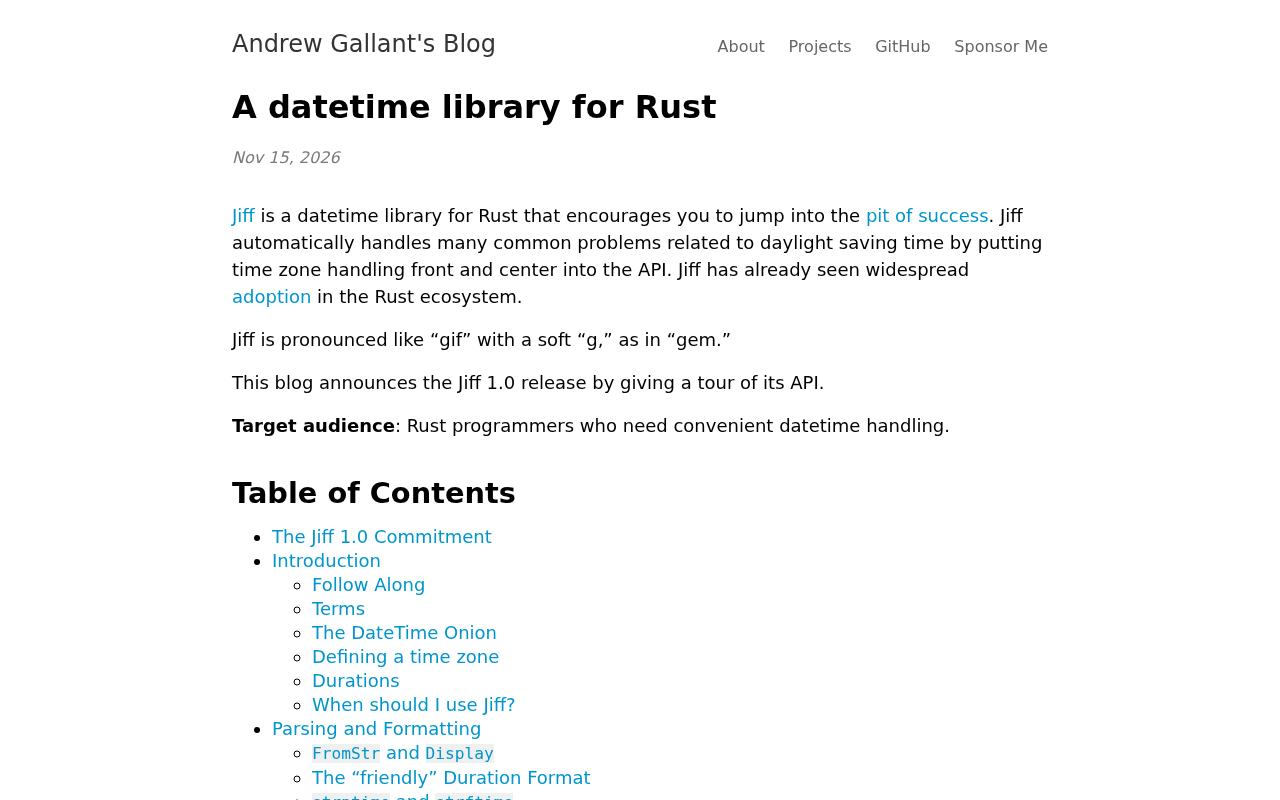
The Rust ecosystem has welcomed another significant date-time library. Jiff, built by well-known developer BurntSushi (Andrew Gallant), has officially released version 1.0, sparking discussion on Hacker News with 240 points and 50 comments. For Rust developers who have long been choosing between chrono and time, this is undoubtedly a signal worth reevaluating their tech stack.
Why Date-Time Libraries Deserve a Fresh Look
Date-time handling seems basic, but it's actually one of the most error-prone areas in a programming language ecosystem. Historical changes to time zone rules, daylight saving time edge cases, and how leap seconds are handled—every detail can cause hard-to-reproduce bugs in production. The Rust community has previously relied mainly on chrono and time, but both make different trade-offs in API design philosophy and time zone data update mechanisms.
Jiff isn't just reinventing the wheel. Judging from the author BurntSushi's past projects (such as ripgrep and regex), he tends to make carefully considered engineering improvements in mature domains. The release of Jiff 1.0 means the library has passed the stage of drastic API changes and has the basic conditions for adoption in production projects.
The time zone database (IANA tz database) is the cornerstone of correct time zone handling in date-time libraries, also known as zoneinfo or tzdata. Maintained by IANA, it records historical changes to time zones worldwide, daylight saving start and end rules, and political adjustments (such as a country temporarily changing its standard time). The database is updated frequently, with multiple versions released each year, and operating systems, language runtimes, and third-party libraries all need to keep up. For Rust libraries, the key decision is: is time zone data embedded in the library and released with versions, or does it rely on the version provided by the system? The former ensures reproducibility but lags in updates; the latter is timely but may cause cross-machine inconsistency due to different deployment environments. Jiff chose to embed tzdb and support overrides via features or at runtime—this is precisely one of the core technical points of community discussion.
Daylight saving time (DST) is the most bug-prone part of time zone rules. At the "spring forward" moment of DST transition, local time has a non-existent interval (e.g., 02:00–03:00 is skipped); at the "fall back" moment, the same local time appears twice. Date-time libraries must explicitly handle these ambiguities: error out, choose the earlier/later offset, or provide an explicit disambiguation API. The default strategies of different libraries vary greatly, directly affecting the correctness of business logic.
Jiff's Design Orientation and Developer Concerns
Although the original discussion link doesn't expand on full technical details, the heat of the Hacker News discussion suggests that community focus centers on several aspects: time zone database update strategy, migration costs from existing libraries, and performance in high-concurrency scenarios.
BurntSushi elaborated on Jiff's design decisions in his personal blog. One notable signal is Jiff's insistence on "correctness over convenience"—which is especially important in date-time libraries, because convenient APIs often come at the cost of implicit behavior, and implicit behavior is the breeding ground for time zone-related bugs.
Two Sides of Community Feedback
The scale of the 50-comment discussion shows this isn't unanimous praise. Some developers expressed concerns about the learning cost of the new API, and others questioned the necessity of introducing another library in an area where chrono is already mature enough. Such disagreements are common in the replacement of infrastructure libraries: maintainers value long-term maintainability and correctness guarantees, while application-layer developers care more about the immediate cost of migration.
"Correctness over convenience" in the context of date-time usually means the library rejects implicit conversions and ambiguous behavior, requiring callers to explicitly declare intent. For example, converting a Zoned time to a Timestamp may require explicitly specifying which interpretation to use when there's DST ambiguity; parsing dates errors out directly on incomplete or invalid input rather than silently filling in defaults. This contrasts with some convenient but lenient APIs in chrono. The cost is more verbose code and a steeper learning curve, but the benefit is that time zone-related errors move from "occasional runtime" to "compile-time or explicit handling," which is especially valuable in production systems.
The positioning difference between chrono and time is also worth clarifying: chrono has the longest history and broadest ecosystem, but lacked active maintenance for a long time, and its time zone support relies on external crates like chrono-tz; time is maintained by the Rust official time library team, emphasizing no panics and portability, but its features are relatively conservative, and time zone support also requires additional crates. Jiff's positioning is to provide a more modern solution outside of these two, with built-in complete time zone capabilities and a more rigorous API, so the essence of the "migration cost" discussion is: how deeply existing code depends on the old libraries' convenient APIs.
Significance for the Rust Ecosystem
Competition among date-time libraries is positive for the ecosystem as a whole. The collision of design philosophies among different libraries will push the entire field to handle edge cases more rigorously. Jiff's decision to go public at the 1.0 milestone also means the author has committed to API stability.
For teams currently making selections, the recommended approach is: new projects can evaluate Jiff's specific advantages in time zone handling, while existing projects need to weigh migration costs and benefits. Following actual usage feedback on Hacker News is more effective at uncovering pitfalls in real scenarios than simply reading documentation.
The release of Jiff 1.0 is not the end, but another starting point for Rust date-time handling moving toward a more mature stage.
One-line Summary
BurntSushi releases the Rust date-time library Jiff 1.0, emphasizing correctness first and sparking heated community discussion.
Paragraph Summary
The Rust ecosystem welcomes Jiff 1.0, a date-time library built by well-known developer BurntSushi, which gained 240 points and 50 comments on Hacker News. The article notes that date-time handling is one of the most error-prone areas in programming, where time zone rules, daylight saving time, and leap seconds can all cause hard-to-reproduce bugs. Jiff continues the author's engineering style from projects like ripgrep and regex, insisting on "correctness over convenience" and focusing on community concerns such as time zone database update strategy, migration costs, and high-concurrency performance. Feedback is divided: some worry about API learning costs and the necessity of reinventing the wheel, while others appreciate its rigor on edge cases. The article argues that competition among libraries is positive for the Rust ecosystem and suggests new projects evaluate Jiff's time zone advantages while existing projects weigh migration benefits.
Related articles

Prompt Engineering for Beginners: From Writing Prompts to Engineering Thinking
Starting from the essence and four functions of prompts, this article systematically explains the six-step process, four success criteria, learning value, and practical limitations of prompt engineering to help you build a complete understanding.

Anthropic Launches Nasdaq IPO: AI Giant's Listing and Risk Disclosures
Anthropic officially launches its Nasdaq IPO under ticker ANT, with market valuation expected to potentially exceed SpaceX's record. The prospectus devotes nearly 100 pages to AI risks, while first-half revenue grew over 14x but net losses widened sharply, reigniting the AI bubble debate.

Rust cURL Clone Uses 4,832 unsafe Blocks—Is the Memory Safety Myth Broken?
A Rust cURL clone uses 4,832 unsafe keywords, challenging Rust's memory safety narrative. We analyze what unsafe really means, compare Fil-C, and examine rewrite motives.