Joby Completes 3,100-Mile Autonomous Flight, Setting Sights Beyond Electric Air Taxis

Joby Aviation flies 3,100 miles autonomously across the US, signaling ambitions far beyond eVTOL air taxis.
Joby Aviation has completed a roughly 3,100-mile autonomous flight across the United States, with no human pilot intervention from takeoff through landing. For a company whose core business is eVTOL air taxis, the flight is more than a technical proof point — it's a strategic signal that Joby aims to turn its autonomous flight system into a broadly extensible technology asset, with potential applications in cargo logistics, defense, and third-party technology licensing. Still, significant hurdles remain: airworthiness certification, airspace integration, and building public trust will determine whether this technical edge can ultimately translate into commercial results.
A Coast-to-Coast Autonomous Flight
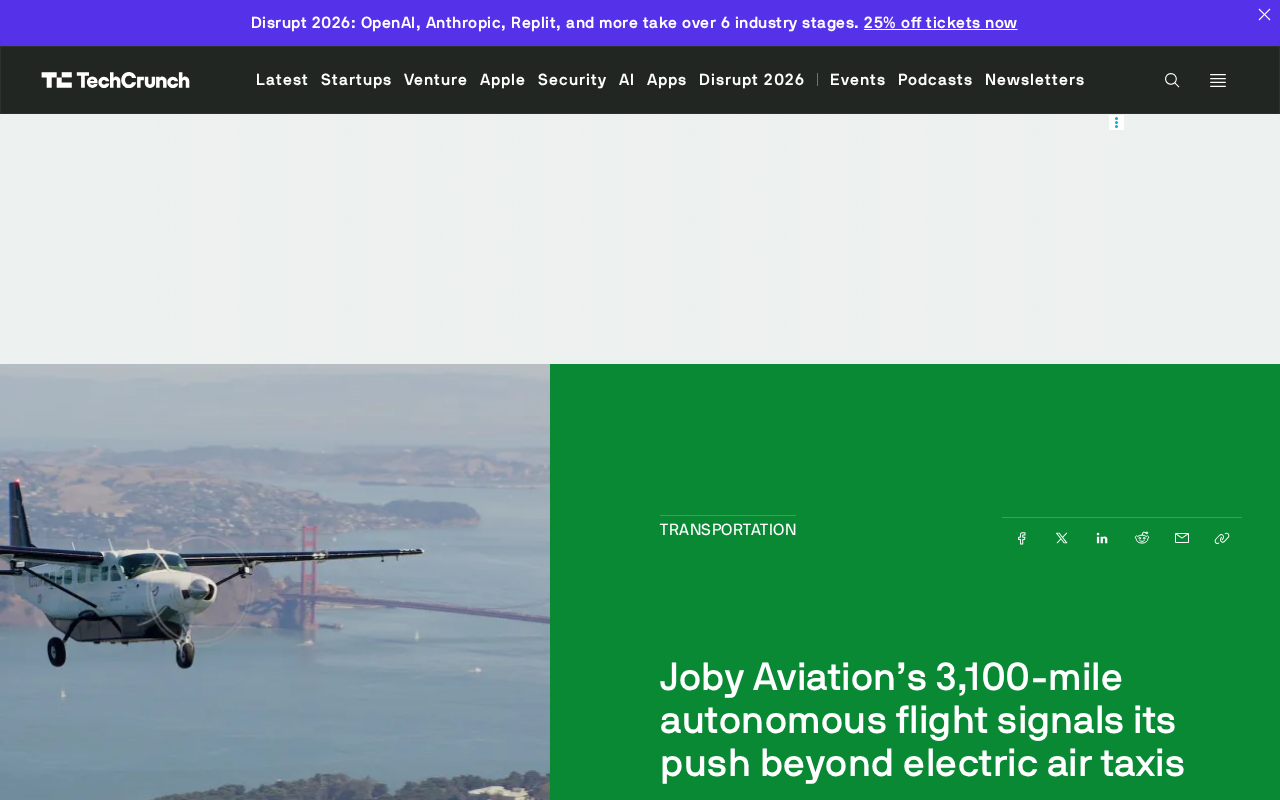
Joby Aviation has achieved a notable technical milestone: an aircraft equipped with its autonomous flight technology completed a roughly 3,100-mile journey across the United States without any human pilot intervention. From takeoff to cruise to landing, the entire sequence was handled independently by the onboard autonomous system.
For a company best known for its electric vertical takeoff and landing (eVTOL) air taxi, this long-distance autonomous flight carries significance well beyond a technical showcase. It sends a clear signal: Joby is setting its sights on applications far broader than electric air taxis.
Why This Flight Matters
Autonomous flight technology is not a new concept in the industry, but actually completing a continuous, cross-country journey spanning thousands of miles with zero human takeover places enormous demands on system reliability, redundancy design, and adaptability to real-world conditions. Along the way, the aircraft encounters variable weather, complex airspace management, and all manner of unexpected situations — any single failure point could abort the entire test.
The 3,100-mile distance is itself a rigorous test of endurance and stability. It evaluates not just how an autonomous system performs under ideal conditions, but how robust it is during sustained, real-world, long-duration operations. That's a fundamentally different proposition from a lab demonstration or a short-haul showcase.
From Air Taxis to a Bigger Picture
Joby's core narrative has historically centered on Urban Air Mobility (UAM) — using electric aircraft to provide point-to-point air taxi service within and around cities. But autonomous flight capability is a foundational technology asset that transfers across use cases.
Once a mature autonomous flight system is in hand, its potential applications extend far beyond passenger taxis. Likely directions include cargo logistics, regional commuting, defense and surveillance missions, and even licensing the autonomous technology platform to other aircraft manufacturers or operators. This long-distance flight can be understood as Joby demonstrating to the market that its technology is not confined to eVTOL.
Background: Urban Air Mobility (UAM) is a concept that has gained significant traction in aviation and transportation circles in recent years. The core idea is to use electric aircraft within cities and near suburbs to provide on-demand, point-to-point aerial travel, easing ground traffic congestion. eVTOL aircraft are the primary vehicle for realizing this vision — capable of vertical takeoff and landing without a runway, they're well-suited for rooftops, helipads, and other constrained urban spaces. Joby Aviation is one of the highest-valued UAM startups in the world, having secured strategic investments from Toyota, Delta Air Lines, and others, while actively pursuing FAA airworthiness certification. Competition in the UAM space is fierce, with Archer, Lilium, Wisk, and others vying for the same market. Joby's demonstrated long-range autonomous flight capability, however, represents a technical dimension that most pure-play UAM companies have yet to reach.
A Technical Moat and Commercial Upside
For aviation companies, the real long-term defensibility rarely lies in the airframe design itself — it lies in building a reliable, certifiable, and scalable autonomous "brain." Whoever holds a battle-tested autonomous system stands to occupy a critical position in the future air traffic ecosystem.
From a commercial standpoint, extending autonomous technology as a standalone capability opens up a potential third revenue stream for Joby, alongside whole-aircraft sales and air taxi services. This "platform" approach is well-established among technology companies that blend hardware and software, and in the aviation space, the upside is especially significant.
Real-World Hurdles Still to Clear
A successful technology demonstration is not the same as commercial deployment. For unmanned autonomous flight to enter routine operations, it must pass exceptionally rigorous aviation regulatory certification. Airworthiness approvals, airspace integration rules, and the definition of safety liability are all concrete obstacles standing in the way.
Furthermore, public trust in fully pilotless aircraft must be built gradually through a long, stable, and transparent safety record. This cross-country flight is a powerful starting point — but the road to scaled commercial operations remains considerable.
Background: Aviation airworthiness certification is the most critical regulatory hurdle for commercializing autonomous flight. In the United States, for example, the FAA has no established certification pathway for autonomous flight systems; the existing framework was designed for crewed aircraft and lacks clear standards for what level of autonomy is acceptable. Moreover, large-scale autonomous aircraft entering the National Airspace System (NAS) involves complex issues around Detect and Avoid (DAA) rules for conflict resolution with existing crewed flights, emergency response protocols when communication links fail, and accident liability attribution (manufacturer, operator, or algorithm developer). These challenges are universal. While the European Union Aviation Safety Agency (EASA) has begun building a regulatory framework for drones and autonomous flight, full autonomous certification for commercial passenger-carrying aircraft remains uncharted territory worldwide.
Conclusion
Joby's 3,100-mile autonomous flight is both a concentrated display of technical capability and a public declaration of strategic intent. It signals that the company is working to move beyond the single label of electric air taxi, positioning autonomous flight as an extensible, reusable core asset. Whether Joby can translate this technical advantage into diversified commercial outcomes will ultimately depend on its continued progress in regulation, safety, and scalability.
Related articles

Workbuddy for Absolute Beginners: How a Desktop AI Agent Fits Into Real Workflows
A beginner's guide to the Workbuddy desktop AI agent: installation, claiming credits, file management, and building automated workflows—compared with CodeX for fit and cost, helping professionals shift from AI question-askers to AI managers.

OpenAI's New Agent Stack: Computer Use, Decisions API, and Ultra-Fast Workflows
OpenAI Dev Day unveiled a new agent stack: Computer Use outperforms humans, Decisions API delivers ultra-low-latency classification via Luna, Agents API opens the same Computer Use capabilities, and GPT-6.1 Sol costs only one-seventh of Astra. Core updates, benchmark data, and developer insights.

Liang Wenfeng Open-Sources DeepInfo Inference Framework, Takes On U.S. Ban
DeepSeek open-sources its DeepInfo inference framework after its models, featuring GPU/CPU cross-pipelining, small-model prediction with large-model verification, and full Huawei Ascend and NVIDIA chip support—facing the U.S. federal ban head-on. This article analyzes its significance for AI deployment and open-source strategy.