Joint Detection of Constructive Speech and Hate Speech in Online Conversations with Multilingual LLMs

A new paper builds a bilingual English-Danish dataset for jointly detecting hate, constructive, and agreement speech, with E5-large performing best.
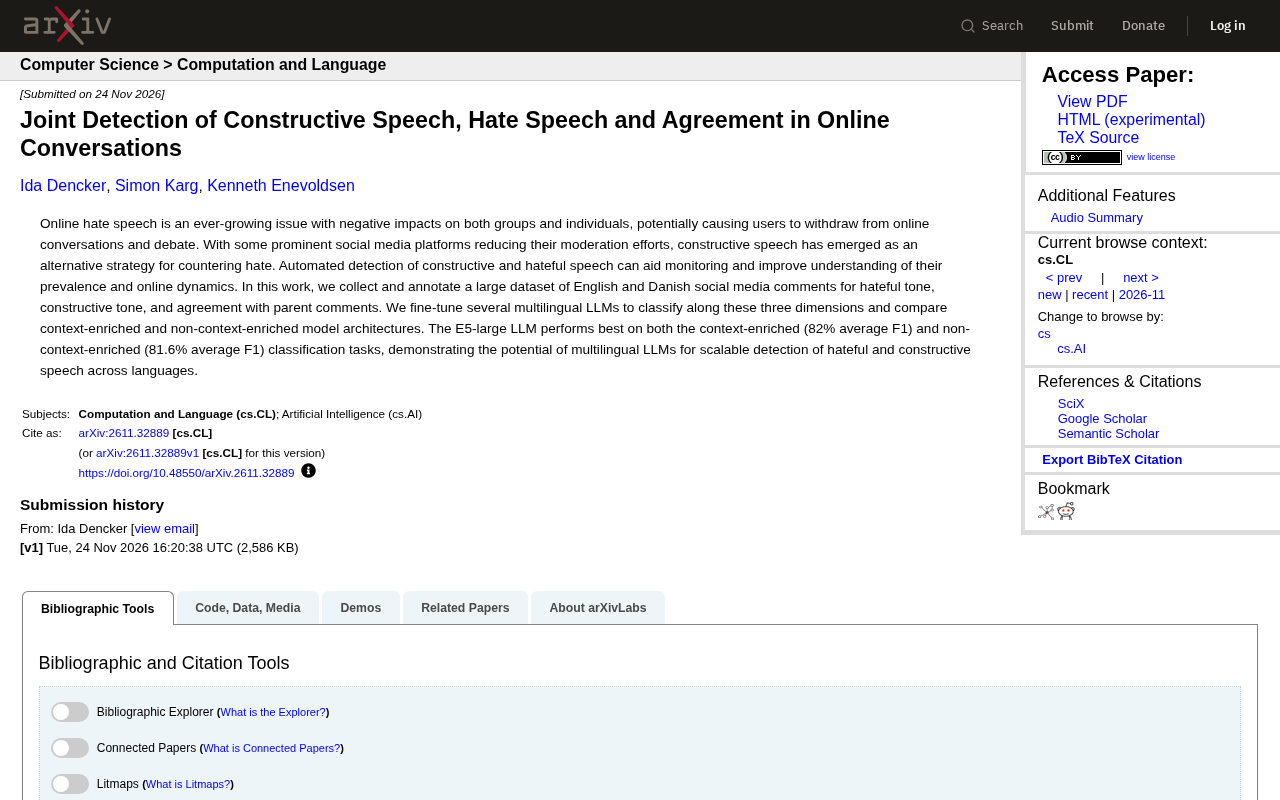
Against the backdrop of social platforms reducing moderation investment, this study proposes a joint classification framework detecting hateful tone, constructive tone, and agreement with parent comments, building an English-Danish social media comment dataset. Multiple multilingual LLMs are fine-tuned comparing context-enriched and non-enriched architectures. E5-large performs best in both settings with average F1 of 82% and 81.6%, though context enrichment adds only ~0.4 points, suggesting single comments already carry strong discriminative information. Joint detection can monitor conversation quality rather than binary deletion, but average F1 may mask per-category differences and detection capability is not equivalent to intervention effectiveness.
Hate speech on social platforms has long been a challenge for content governance, and as some major platforms cut back on moderation investment, "constructive speech" is being viewed as an alternative strategy for countering hate. Automating the identification of constructive versus hateful speech has become key to understanding the dynamics of online conversation. A new paper proposes a joint detection framework and systematically evaluates the performance of multilingual LLMs on this task.
Research Background and Problem Definition
Hate speech has negative effects on both groups and individuals, and can cause users to withdraw from online discussions. The paper notes that as some mainstream social platforms reduce moderation efforts, constructive speech has attracted attention as an alternative strategy for countering hate. Automated detection of these two types of speech can help monitor their prevalence and online dynamics.
The study defines the task as joint classification across three dimensions: hateful tone, constructive tone, and agreement with parent comments. Compared with detecting hate speech alone, this joint modeling better reflects the scenario in real conversations where multiple pragmatic signals coexist.
Constructive speech in the context of content governance generally refers to speech that participates in dialogue through rational discussion, providing information, seeking consensus, or expressing respect—as opposed to hate speech that attacks, demeans, or incites hostility. It does not simply mean "polite language"; rather, it emphasizes whether the conversation can advance understanding or problem-solving. Against the backdrop of platforms cutting moderation resources, encouraging and amplifying constructive speech is seen as a governance approach of "replacing post-hoc deletion with positive guidance," but its effectiveness depends on reliable identification of constructive speech.
Pragmatic signals refer to the intentions, attitudes, and relational information conveyed by language in specific communicative contexts, such as sarcasm, agreement, attack, or mitigation. Unlike lexical-level sentiment polarity, pragmatic signals often depend on context and conversational structure. This paper jointly models hateful tone, constructive tone, and agreement within a single framework precisely because these signals appear simultaneously and influence each other in real conversations, and detecting any single dimension in isolation tends to lose conversation-level information.
Dataset Construction and Annotation
The research team collected and annotated a large-scale dataset of English and Danish social media comments, annotating all three dimensions simultaneously. The bilingual setting enabled model evaluation across different language environments and provided a basis for testing cross-lingual detection capability.
Data annotation covers all three labels—hate, constructive, and agreement—meaning each comment must carry multiple judgments, which places higher demands on annotation quality control. The paper does not disclose the specific sample size or annotation consistency metrics in the abstract, but these details are valuable for reproduction and cross-comparison.
Model Architecture and Experimental Design
The authors fine-tuned multiple multilingual LLMs to perform the three-way classification task and compared two architectures: context-enriched and non-context-enriched. The former incorporates conversational context such as parent comments into the model input, while the latter uses only the individual comment itself.
This comparison directly addresses a practical question: must detecting pragmatic signals in conversation depend on context? The results show that context enrichment brings some improvement, but the margin is limited, indicating that a single comment already carries strong discriminative information.
E5-large is the multilingual version of a text embedding model series, characterized by encoding input text into fixed-dimensional vector representations and being adaptable to downstream tasks such as classification and retrieval through fine-tuning. Unlike generative large language models, E5-type models typically have fewer parameters and lower inference costs, making them suitable for large-scale content moderation scenarios. The paper's choice to fine-tune E5-large rather than call a generative LLM for zero-shot judgment indicates that its goal is to build a deployable high-throughput classifier rather than to explore the upper limits of large model reasoning capability.
Average F1 is the harmonic mean of precision and recall in classification tasks, averaged across categories. It is sensitive to class imbalance: when minority classes such as hate speech account for a very low proportion of samples, a model biased toward predicting the majority class may still achieve high weighted metrics, so per-category F1 and macro-averaged F1 better reflect actual detection performance on minority classes. The "average F1" reported in this paper does not specify the averaging method, so attention should be paid to this difference in convention when making cross-comparisons.
Main Results: E5-large Performs Best
Under both architectures, E5-large achieved the best results: the context-enriched version reached an average F1 of 82%, and the non-context-enriched version reached 81.6%. This result demonstrates the potential of multilingual LLMs for scalable detection of cross-lingual hate and constructive speech.
The gap between the two scores is only 0.4 percentage points, which is noteworthy. It suggests that under the current data and task settings, the marginal benefit of contextual information is not significant, and the model may rely more on the lexical and tonal features of the comment text itself. For deployers, this means the non-context approach is more attractive in terms of engineering complexity and inference cost.
Practical Significance and Limitations
From an application perspective, the joint detection framework can simultaneously output hate, constructive, and agreement signals, making it easier for platforms to monitor conversation quality rather than merely making binary content-deletion judgments. Multilingual capability also reduces dependence on moderation teams for a single language.
Limitations also exist. The abstract does not disclose per-language, per-label performance, and average F1 may mask weaknesses under class imbalance; moreover, agreement judgment inherently depends on parent comments, and the performance of the non-context architecture on this dimension deserves further scrutiny. The paper positions constructive speech as an alternative strategy for countering hate, but detection capability itself is not equivalent to intervention effectiveness—this distinction should be kept in mind during implementation.
One-line Summary
A new paper builds a bilingual English-Danish dataset for jointly detecting hate, constructive, and agreement speech, with E5-large performing best.
Paragraph Summary
Against the backdrop of social platforms reducing moderation investment, this study proposes a joint classification framework for simultaneously detecting hateful tone, constructive tone, and agreement with parent comments, and constructs a dataset of English and Danish social media comments. The authors fine-tune multiple multilingual LLMs and compare context-enriched versus non-context-enriched architectures. Results show that E5-large performs best under both settings, with average F1 of 82% and 81.6% respectively, but context enrichment brings only about a 0.4 percentage point improvement, indicating that a single comment's text already contains strong discriminative information. The study argues that joint detection can be used to monitor conversation quality rather than merely making binary deletion judgments, while noting that average F1 may mask per-category differences and that detection capability is not equivalent to intervention effectiveness.
Related articles

Braised Meat Shop Forced Out by Rent Hike: A Life-and-Death Contest Between Craft and Location
Braised meat shop owner forced out by a 100,000 yuan rent hike moves overnight; landlord's daughter takes over with seasoning packets and overnight meat sickens customers. A tale of location versus craft.

AI One-Click Emotional Short Drama: Bilibili Creator Tests the "Beautiful Landlady" Script
Bilibili creator uses AI to produce the emotional short drama "The Beautiful Landlady Comes to Fix the Guy's Drain," testing everything from script generation to character consistency.

Braised Meat Stall Goes Viral, Landlord Raises Rent—She Leaves Gracefully by Contract While Rival Cuts Corners and Loses Everything
A braised meat stall's rent was hiked from ¥68K to ¥168K after going viral; the owner moved out by contract while her rival cut corners and lost it all.