Jotbus: A Shared Encrypted Scratchpad Built for Coding Agents

Jotbus is a shared encrypted scratchpad giving multiple AI coding agents a secure layer to exchange context.
As coding agents evolve into multi-role collaborative systems, securely sharing intermediate state between agents has become a new AI engineering challenge. Jotbus is an early-stage project positioned as a shared encrypted scratchpad, letting multiple coding agents running on different processes or machines read and write shared context on demand, while encrypting sensitive data like source code and API keys by default. Though still very early-stage with limited community traction, the trend it represents — that multi-agent collaboration needs a dedicated secure intermediate layer — is itself highly worth watching.
When Multiple Coding Agents Need to "Talk" to Each Other
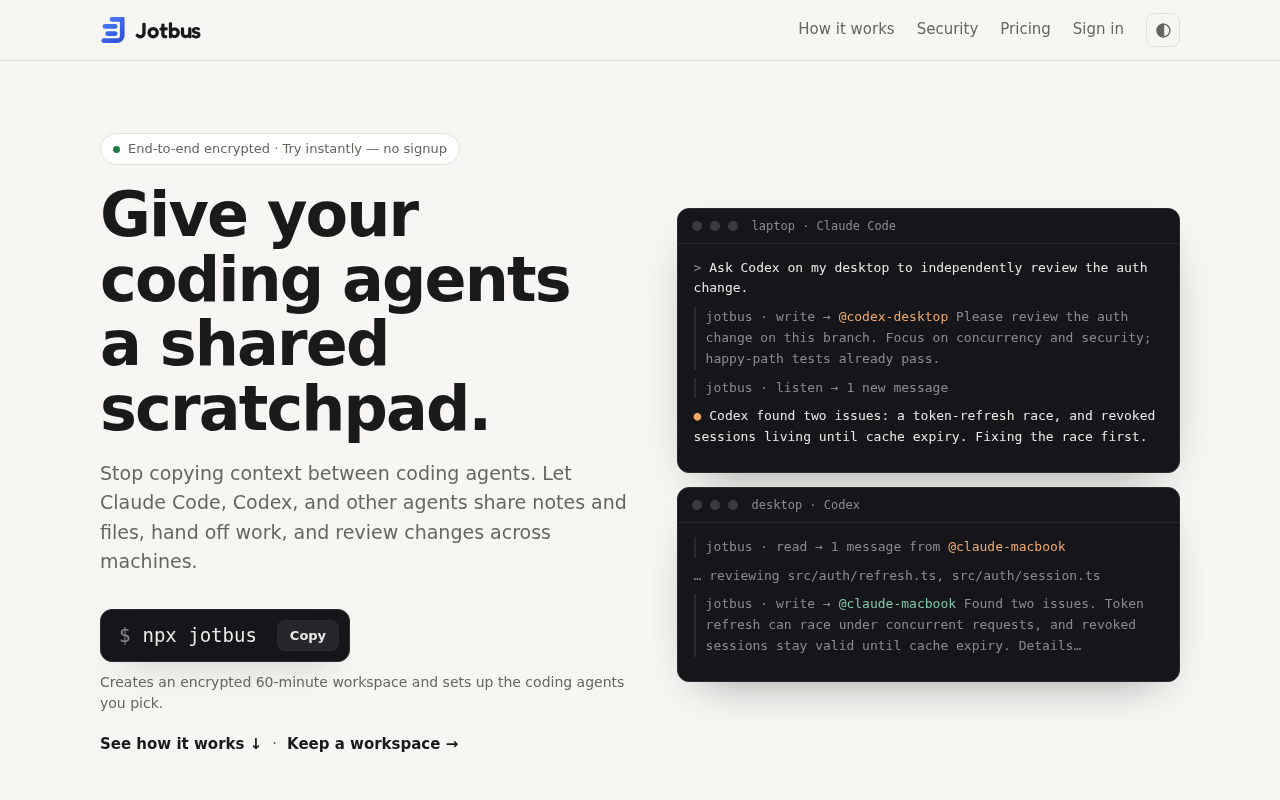
As coding agents evolve from single assistants into multi-role collaborative systems, a long-overlooked problem is coming into focus: how do these automated AI agents share context and exchange intermediate results with one another? A Show HN project called Jotbus offers one answer — a shared encrypted scratchpad designed specifically for coding agents.
At its core, Jotbus targets a key pain point in multi-agent workflows: individual agents often run in separate processes, sessions, or even machines, with no lightweight, secure layer for storing intermediate state. Developers typically resort to temp files, message queues, or custom databases to pass data around — solutions that either lack encryption or are too heavyweight for the task.
"Encrypted" Is the Key Word
The two most notable words in Jotbus's pitch are shared and encrypted. Coding agents routinely handle sensitive material — source code, API keys, business logic. When that intermediate data sits in plaintext temporary storage, it becomes a security liability.
An encrypted scratchpad means multiple agents can exchange data through a common layer while that data remains protected in storage and in transit. This design philosophy aligns with growing attention in AI engineering to "data sovereignty" and "context security" — as AI systems increasingly read and write code and configuration files automatically, securing the intermediate layer is no longer optional.
In AI engineering, "context security" is an emerging sub-discipline. Traditional software security focuses on static data and transport-layer encryption (TLS, AES), but AI agents introduce new attack surfaces: agents dynamically read and write intermediate state containing business logic, credentials, or user data during task execution. If that data leaks, the consequences can be as severe as a database breach. Multi-agent systems also face prompt injection risks — malicious content written into a shared context could hijack the behavior of downstream agents. End-to-end encrypted scratchpads can limit the propagation of such attacks to some degree, but real protection requires pairing encryption with access control and content validation — a deep architectural challenge for tools in this space.
Why Coding Agents Need a Dedicated Collaboration Layer
Most mainstream coding agent tools today focus on improving individual agent capabilities — code completion, debugging, refactoring. But genuinely complex tasks often require a division of labor: one agent plans, one writes, one tests, one reviews.
This multi-role model creates a clear demand for shared state. The conventional approach — stuffing all context into a single massive prompt — is both expensive and inefficient. The value of tools like Jotbus lies in externalizing inter-agent collaboration state into a standalone, addressable scratchpad that each agent can read from and write to on demand, rather than repeatedly shuffling data through conversational context.
Multi-agent collaboration architectures have several mainstream engineering paradigms to draw from. Frameworks like AutoGen (Microsoft), CrewAI, and LangGraph have begun exploring inter-agent message passing and state sharing — but their default designs largely assume all agents run in the same process, communicating via in-memory shared objects. Once agents are distributed across different services or machines — practically inevitable in production workflows — external state storage becomes necessary. Traditional solutions like Redis (key-value cache), Kafka (message queue), or S3/databases (persistent storage) are general-purpose tools not designed for AI agent usage patterns: short lifecycles, dynamic contexts, and unstructured intermediate data. Configuration overhead is high, and they lack native permission models for AI scenarios. Jotbus aims to fill exactly this gap — a lightweight, purpose-built, secure intermediate layer.
The Reality of an Early-Stage Project
It's worth being candid: Jotbus is still a very early-stage project. Its Show HN post received only 4 upvotes and 1 comment, with limited community traction and no large-scale discussion yet. That means its actual maturity, performance characteristics, and the specifics of its encryption implementation all await more public information and third-party validation.
For developers tracking AI engineering infrastructure, Jotbus reads more as a directional exploration worth watching than a production-ready solution. The trend it reflects — that multi-agent collaboration requires a dedicated, secure intermediate layer — is more worth discussing than the project's current completeness.
The Road Ahead for This Category of Tools
As coding agents move from toy projects to production environments, the surrounding infrastructure will attract increasing attention. Scratchpads, message buses, state management, access control — these "peripheral tools" may well be the next growth area in AI developer tooling.
Jotbus's decision to make encryption a default property rather than an add-on feature feels prescient as AI automation reaches deeper into core business operations. Whether it can truly deliver depends on how it performs in terms of usability, compatibility with mainstream agent frameworks, and raw performance. At the product positioning level, at least, it has identified a real and growing need.
Related articles

How Big Can Stars Really Get? The Physical Limits of the Largest Stars
Red supergiants are the largest stars by volume, with radii up to 2,000 times the Sun, engulfing the inner solar system. But there is no precise upper limit on stellar size—models predict up to 15,000 solar radii. The most massive blue stars are far smaller than red supergiants—biggest and heaviest are two different things.

Apple HomeView Smart Display Full Feature Breakdown: Wall-Mount or Desktop, $299
Apple launches HomeView, a $299 smart display with wall-mount and desktop options, 12MP camera for facial recognition, smart home control, music playback, and recipe step-by-step cooking. Full breakdown of watch faces, apps, privacy, and cooking integration.

Where Did the Promised New Studio Go? Craft Computing Answers After Five Years
Craft Computing's host responds to viewer questions: the new studio promised five years ago was shelved as construction costs soared from $30,000 to $75,000, and was replaced by a 168-square-foot garage conversion.