Joy Review: How an AI Cooking Copilot Tackles the Daily 'What Should I Eat?' Dilemma

Joy is an AI cooking copilot that plans meals from your fridge inventory, backed by a real private chef team.
Joy is an AI-powered cooking copilot that generates personalized menus and shopping lists based on ingredients you already have. Built by Eat Cook Joy — a team with 100,000+ meals of private chef experience — it combines AI planning with optional real chef home visits in San Francisco. The product differentiates itself from generic recipe apps through its "inventory-first" approach and domain expertise, though it faces challenges in scaling its O2O model and reducing ingredient input friction.
When AI Enters the Kitchen: How Joy Solves "What Should I Eat Today?"
One of the most headache-inducing daily questions might just be "What should I eat today?" Joy, which recently debuted on Product Hunt, takes direct aim at this high-frequency yet thorny household pain point. Calling itself a "cooking copilot" for home, it uses AI to offload the entire chain of tedious decisions — from deciding what to eat, to finding recipes, to generating a shopping list — from your daily routine.
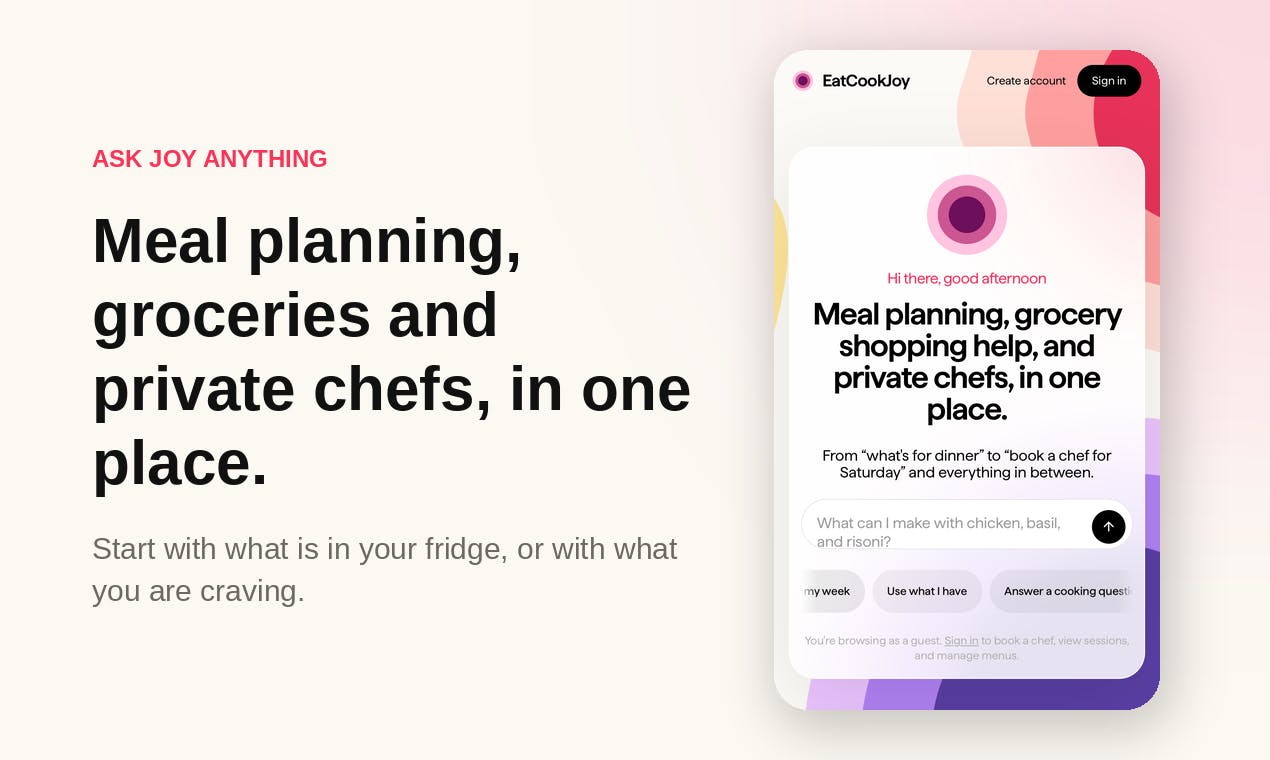
Joy's logic is straightforward: tell it what flavors you're craving today and what ingredients you already have in the fridge, and it generates a menu, matches recipes based on available ingredients, and automatically creates a shopping list. From a technical perspective, this involves solving a Constraint Satisfaction Problem — the system needs to find optimal solutions across multiple constraints including nutritional balance, taste preferences, ingredient availability, and cooking difficulty, leveraging the reasoning capabilities of large language models. Compared to general-purpose chatbots, vertical AI applications like this often require domain-specific fine-tuning data and evaluation criteria to ensure output quality.
This "start from inventory" approach stands in stark contrast to traditional recipe apps that follow a "pick a dish, then buy ingredients" model — it functions more like an assistant that understands how to balance real-world constraints, rather than a passive electronic cookbook. Notably, this "reverse recipe recommendation" logic also touches on a global issue: household food waste. According to the UN Environment Programme's 2024 report, approximately 1.05 billion tons of food are wasted globally each year, with about 60% coming from households. Traditional models often lead users to purchase large quantities of specialty ingredients for one-time use, with leftovers ultimately discarded. Planning menus from existing inventory could theoretically reduce ingredient waste significantly. Apps like Supercook and Plant Jammer have explored similar directions before, but Joy leverages its private chef experience to establish a differentiated edge in recommendation quality.
AI Cooking Software Born from a Real Kitchen
The most noteworthy aspect of Joy is that it's not an AI toy conjured from thin air. The team behind it, Eat Cook Joy, previously operated a real private chef service company for years, accumulating extensive experience in actual kitchens. According to their disclosed data, the team has cooked over 100,000 meals and paid $250,000 in compensation to local chefs.
The Significance Behind the Numbers
The value of these figures isn't in their impressive scale, but in what they signify: Joy's product logic has been validated through real-world offline scenarios. Software born from a private chef service naturally understands the complete chain of "how a menu becomes a meal on the table" — from ingredient pairing and cooking difficulty to procurement costs. This "heavy service first, light software second" path gives Joy domain know-how that most pure-play AI startups lack during the cold start phase.
This "heavy-to-light" entrepreneurial path has numerous precedents in the tech industry. The most classic example is Opendoor — which first bought and sold homes directly through a heavy-asset model to understand the full chain of pain points in real estate transactions, then gradually evolved toward a lighter platform model. The core advantage is that teams accumulate substantial tacit knowledge during the heavy-service phase, including user behavior patterns in real scenarios, common failure points, and the boundaries of standardization possibilities. For AI products, this tacit knowledge often determines the quality of training data and the granular detail of product design. Eat Cook Joy's experience with 100,000 meals essentially forms the starting point of a private data flywheel — every ingredient substitution, timing adjustment, and flavor tweak encountered during real cooking constitutes labeled data that pure internet teams would struggle to obtain.
Compared to the flood of similar products on the market that are essentially "LLM wrappers + recipe databases," Joy's differentiation lies precisely here: its AI recommendations are rooted in actual operational experience rather than mere corpus stitching.
AI Planning + Real Chefs: An Online-to-Offline Closed Loop
Joy has also retained and extended its private chef DNA — in the San Francisco area, users can directly book a real chef through Joy to come to their home and turn the AI-generated menu into an actual meal served at the table.
This is a highly imaginative O2O closed-loop design. AI handles the "brainwork" of decision-making and planning, while real chefs take on the "physical work" of execution. Together, they create a complete experience from "wanting to eat" to "actually eating." For time-strapped urban families who still pursue quality, this "AI copilot + on-demand chef" combination holds considerable appeal.
From an industry evolution perspective, the O2O model in lifestyle services has gone through multiple iterations: from early Groupon-style "online traffic, offline consumption," to Meituan/DoorDash-style "platform dispatch, instant delivery," to Joy's current attempt at "AI decision-making + human execution." The core evolutionary direction is front-loading more decision intelligence into the online layer. In the food space, meal kit services like Blue Apron previously attempted to standardize the process from menu selection to ingredient prep, but the pain point was fixed menus lacking personalization. Joy's model achieves "personalized for everyone" menu generation through AI while retaining quality control through human execution — essentially an AI upgrade to the meal kit model.
Of course, the real chef service currently only covers San Francisco, making it a typical regional pilot. It functions more as a probe for the team to validate high-value scenarios, while the software's AI features target a broader user base. The key challenge with this model lies in the cold start of a two-sided marketplace: it needs sufficient user demand density to support chefs' order frequency, while also requiring a stable chef supply to ensure consistent user experience.
Joy's Opportunities and Challenges: A Sober Analysis
Based on its Product Hunt performance, Joy ranked 20th on its launch day, receiving 10 upvotes and 2 comments — moderate to below-average traction. However, it's worth noting that Product Hunt's core user base skews toward developers and entrepreneurs, who typically show less voting enthusiasm for B2C lifestyle tools compared to developer tools or B2B SaaS products. Therefore, this data is better treated as a reference signal rather than a definitive judgment.
Despite a clear product vision, Joy still needs to answer several key questions in the fiercely competitive cooking and recipe space.
Core Questions Awaiting Validation
- Ingredient identification accuracy: Manually inputting fridge inventory is tedious. Without photo recognition or smart identification to lower the barrier, daily usage willingness may be limited. Currently, computer vision technology for identifying ingredients via smartphone cameras is relatively mature — tools like Google Lens achieve 85-90% accuracy on common ingredients. But the challenge lies in fridge scenarios where ingredients are often partially obscured, packaged differently, and require estimating remaining quantities rather than just identifying types. More advanced solutions include IoT integration with smart refrigerators that continuously track inventory changes through built-in cameras, but this depends on hardware adoption rates. In the short term, combining grocery receipt OCR recognition with usage estimation algorithms may be a more pragmatic approach to lowering input barriers.
- Recipe quality consistency: The taste-matching accuracy and operability of AI-generated menus directly determine user retention. Large language models may produce recipes that "look reasonable but are practically difficult" — for example, inaccurate cooking time estimates or misjudging ingredient substitution compatibility. This is precisely where Joy's private chef experience data could prove valuable — calibrating AI output with real cooking feedback.
- Scaling challenges: The real chef highlight is extremely difficult to replicate across regions. It's essentially a heavy-asset, low-margin service, and balancing it with the lightweight software business is a long-term proposition.
Conclusion: Joy Provides an Interesting Sample for AI Lifestyle Service Implementation
Joy represents a pragmatic approach to AI applications: rather than pursuing flashy technology, it embeds large language models into a clear, high-frequency household scenario, backed by real service experience. Its dual-layer design of "AI planning + human execution" also provides an interesting template for AI implementation in lifestyle services. Whether it can expand from its small-scale San Francisco experiment to broader markets will depend on its wisdom in polishing the software experience and making strategic trade-offs in its service model.
Related articles

Paritok: An Open-Source Tool That Saves 85% Token Costs Through Local Context Compression
Paritok is an open-source local tool that compresses coding agent tool definitions, file contents, and conversation history, saving up to 85% token costs and extending sessions 3x longer.

The AI Bubble Debate: Staying Clear-Headed Amid the Hype
Analyzing the AI bubble debate through a classic English pun. Exploring whether generative AI valuations are overheated and how tech professionals can stay rational amid the hype.

Will Outdated LLMs Become Nostalgia Symbols? The Cultural Value and Era Memory of AI Technology
Will ChatGPT and GPT-4 from 2023 become nostalgia symbols like retro game consoles? Exploring old LLMs' historical value, emotional significance, and how open-source models preserve AI history.