Judge Questions U.S. Government's Rationale for Banning Anthropic AI: A Deep Dive into the Government Procurement Dispute

Federal judge challenges U.S. government's ban on Anthropic AI, questioning whether the decision lacks proper justification.
A federal judge has questioned the U.S. government's decision to ban Anthropic's AI products from government procurement, arguing the government hasn't adequately justified the restriction. The case raises critical questions about procedural fairness in AI procurement, the standards used to evaluate AI vendors, and the boundaries of government regulatory authority in the rapidly evolving AI landscape.
Background: The U.S. Government AI Procurement Battle
A government procurement case involving AI company Anthropic has recently attracted widespread attention. A federal judge has explicitly questioned the U.S. government's decision to ban Anthropic's AI products, arguing that the government has not adequately justified the ban.
At the heart of this case is the question of what basis the government uses for decisions regarding AI technology procurement and deployment. As demand for large language models (LLMs) in government agencies continues to grow, determining which AI vendors can enter the government procurement pipeline—and by what criteria they are evaluated—is becoming an increasingly sensitive legal and policy issue.
Notably, U.S. federal technology procurement primarily follows the framework of the Federal Acquisition Regulation (FAR) and involves enormous sums—federal government IT spending exceeds $100 billion annually. In recent years, as AI technology has experienced explosive growth, the White House has issued multiple executive orders governing AI use in government, including the AI executive order signed by Biden in October 2023 and subsequent modifications by the Trump administration. When procuring AI tools, the government must consider multiple factors including security reviews (including FedRAMP cloud security certification), data sovereignty, and supply chain security—but the specific implementation of these standards frequently sparks controversy.
The Judge's Core Challenge: Does the Ban Lack Justification?
Based on available information, the presiding judge expressed skepticism about the government's approach to banning Anthropic AI. The judge's focus centers on whether the government provided sufficient evidence and reasonable argumentation to support its decision to impose the ban.
In judicial review, administrative agency decisions typically must meet the standard of being "not arbitrary and capricious." This standard derives from Section 706 of the U.S. Administrative Procedure Act (APA). Enacted in 1946, the APA is one of the cornerstones of American administrative law, establishing the framework for courts to review federal administrative agency decisions. Under the APA, courts may overturn administrative actions deemed "arbitrary, capricious, an abuse of discretion, or otherwise not in accordance with law." While this review standard accords some deference to administrative agencies (the so-called "Chevron deference" principle), it still requires agencies to provide reasonable explanations and evidentiary chains to support their decisions—they cannot act solely on policy preferences. This means the government cannot exclude a vendor from the procurement process based merely on subjective judgment or unsupported reasoning. The judge's challenge is essentially testing whether this decision can withstand the dual scrutiny of procedural justice and substantive legitimacy.
Why This Challenge Matters
For the AI industry, the government procurement market represents a massive and profoundly influential arena. According to estimates from multiple research institutions, the global government AI market is expected to reach tens of billions of dollars by 2030. For AI companies, government contracts represent not only substantial revenue streams but also carry a strategic endorsement effect—gaining government trust and adoption can significantly enhance a company's competitive position in the private sector. Additionally, AI applications in defense, intelligence, and similar fields often involve cutting-edge technical requirements that can drive a company's technological advancement in return.
Once an AI company is banned by the government, it means not only direct commercial losses but potentially cascading effects on market reputation and future collaborations. The damage far exceeds the level of mere contract losses. The judge's questioning of the ban's legitimacy provides affected companies with space to seek remedies through judicial channels.
What Is Anthropic: The AI Company Known for Safety
Anthropic is one of the most prominent companies in the current AI landscape, founded in 2021 by siblings Dario Amodei and Daniela Amodei. Its core team came from OpenAI, and the company is known for its Claude series of large models and its "AI safety" research philosophy.
The company's technical approach has several notable characteristics: First, its "Constitutional AI" methodology, which trains and constrains model behavior through a clear set of principles, making AI outputs more controllable and predictable. Second, its deep research investment in "Mechanistic Interpretability," attempting to understand the internal workings of large models rather than treating them as incomprehensible "black boxes." Third, its proposed "Responsible Scaling Policy," which sets safety thresholds for model capability improvements, ensuring that safety measures are upgraded in tandem as models become more powerful.
In the competitive landscape, Anthropic forms a three-way rivalry with OpenAI and Google DeepMind, with its Claude model performing notably well in coding, analysis, and similar tasks. The company's valuation has exceeded $60 billion, having received major investments from tech giants like Amazon and Google, and it has been actively expanding in enterprise markets and government partnerships.
Precisely because of Anthropic's positioning around AI safety, the government's decision to ban its products is particularly worth scrutinizing. If an AI company whose core selling point is safety and compliance faces a procurement ban, then the standards by which the government evaluates AI vendors become all the more in need of transparent explanation.
Deeper Implications: The Boundaries of AI Regulation and Government Procurement
This case reflects a broader question: In an era of rapidly evolving AI technology, how should governments establish fair, transparent, and evidence-based procurement and regulatory rules?
The Importance of Procedural Justice for AI Procurement
As more government agencies adopt AI tools, the fairness and transparency of procurement decisions will directly shape the competitive landscape of the entire industry. If the government can arbitrarily ban an AI vendor without adequate justification, this not only harms the company's interests but may also distort market competition and even impair the public sector's ability to access the best available AI technology.
In the tech sector, U.S. government bans or restrictions on vendors are not unprecedented. The most widely known cases include restrictions on Chinese technology companies such as Huawei and TikTok (ByteDance), which are typically based on national security considerations. However, imposing similar restrictions on a domestic U.S. AI company is relatively rare, which is one reason this case has attracted widespread attention. Internationally, the EU has established a risk-level-based AI regulatory framework through its AI Act, while China regulates AI services through a registration system and algorithm recommendation management provisions. The different approaches various countries take in balancing innovation promotion with risk prevention provide a comparative perspective for understanding the current U.S. AI procurement dispute.
Implications for the AI Industry
For AI companies, this case serves as a reminder that entering the government market requires not only technical prowess but also the ability to navigate complex compliance and legal environments. Obtaining security certifications like FedRAMP, establishing comprehensive data governance frameworks, and ensuring supply chain transparency are all necessary prerequisites for gaining government procurement access. At the same time, the judicial system's review of administrative decisions provides an institutional safeguard for companies to protect their legitimate rights and interests. This means that when companies believe a government decision lacks proper justification, they can challenge it through legal channels.
Case Outlook
This case is still ongoing, and the judge's questioning has not yet translated into a final ruling. But regardless of the outcome, it serves as a wake-up call for government procurement and regulatory practices in the AI era: any administrative decision that significantly impacts businesses should be grounded in adequate argumentation and evidence.
As AI technology penetrates deeper into the public sector, similar legal disputes are likely to become increasingly common. Striking a balance between safeguarding national interests, maintaining market fairness, and promoting technological innovation will be a long-term challenge faced jointly by regulators and the AI industry. This requires not only administrative agencies to establish more standardized AI evaluation processes but also legislators to provide clearer legal frameworks for government procurement in the AI era, to prevent an ever-growing number of judicial disputes arising from ambiguous rules.
Key Takeaways
Related articles
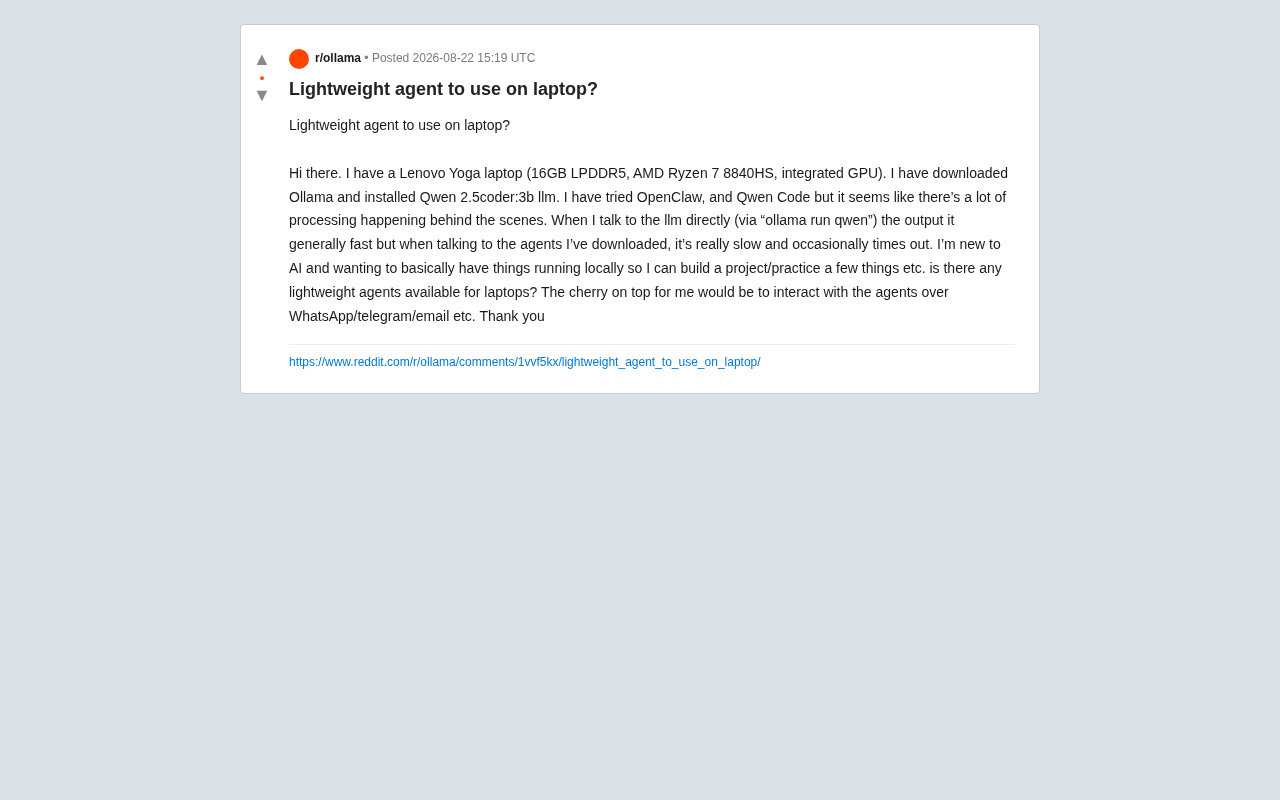
Local AI Agent Deployment Too Slow? A Lightweight Optimization Practical Guide
Local AI Agent deployment slow and timing out? This guide covers Agent framework overhead, hardware bottlenecks, and practical optimizations including context trimming, quantization, and Telegram Bot integration.

Choosing a Laptop for AI Studies: MacBook vs NVIDIA Laptop — An In-Depth Comparison Guide
In-depth analysis for AI students choosing laptops: MacBook Air M5 with remote GPU vs NVIDIA laptop, comparing CUDA support, portability, battery life, and value.

Self-Hosted LLM Tech Stack: A Complete Guide to Managing Your Local AI Cluster from the Terminal
A deep dive into self-hosting LLM tech stacks: inference engines, model management, vector databases, and how to manage your local AI cluster from the terminal.