Kalshi Co-Founder Faces Felony Charges: The Battle Over Prediction Markets and Gambling Regulation

Kalshi and its co-founder face felony charges for alleged violations of Utah gambling law, sparking a federal-state regulatory conflict.
Prediction market platform Kalshi and its co-founder face felony criminal charges for allegedly violating Utah gambling laws, distinct from typical regulatory fines. The core dispute is whether prediction contracts constitute gambling: Kalshi positions itself as federally regulated financial derivatives, while Utah views them as disguised betting. The Trump administration has sued Utah to block its blanket gambling ban, escalating the case into a direct federal-state regulatory confrontation. The outcome will affect compliance costs and market entry strategies for prediction market platforms in strictly regulated states and may set an important precedent for the industry's legal classification.
Prediction market platform Kalshi and its co-founder are facing felony charges for allegedly violating Utah's gambling laws. The case has pushed a long-standing industry controversy into sharper confrontation: when financialized prediction contracts collide head-on with traditional state gambling regulatory systems, who exactly should draw the legal boundaries?
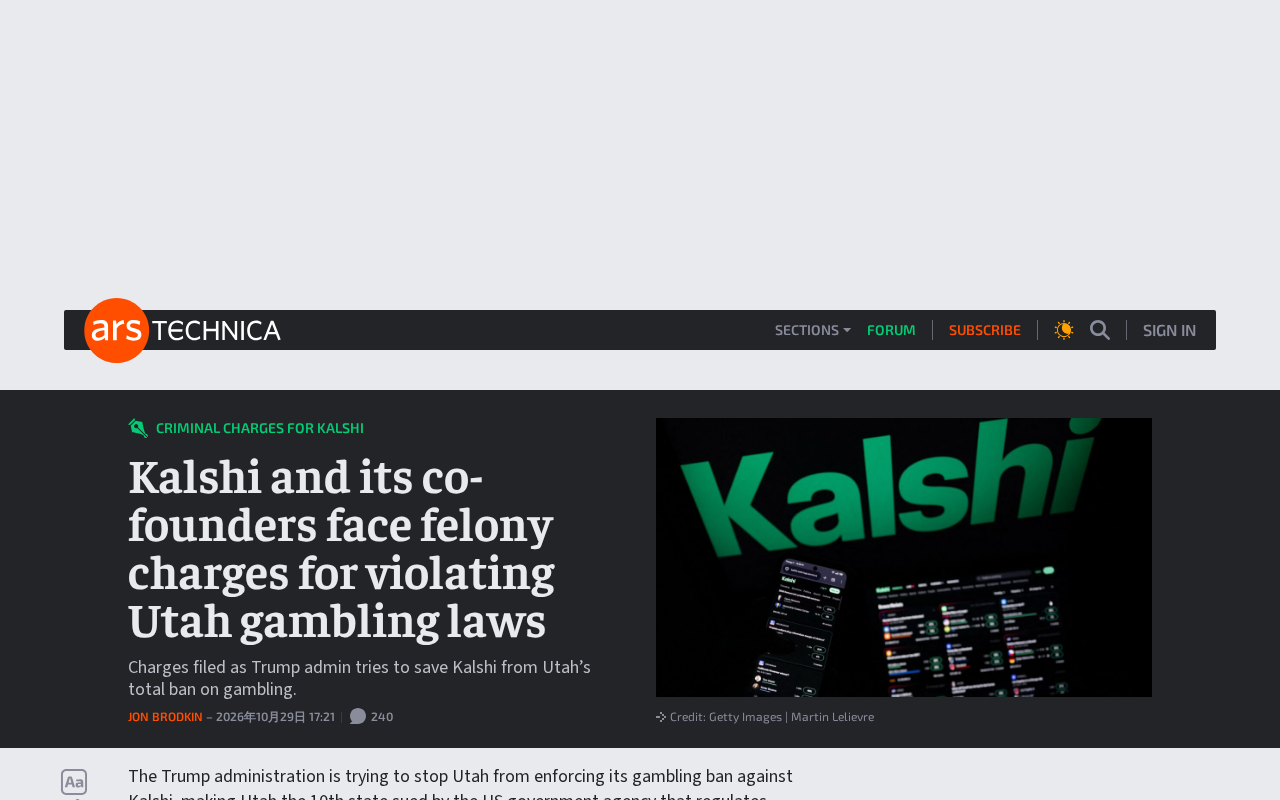
The Core Issue: Not Just Fines, But Criminal Liability
According to Ars Technica, Utah has filed criminal charges against Kalshi and its co-founder related to violations of the state's gambling laws, reaching felony level. This is fundamentally different from typical regulatory fines or civil litigation—felony charges directly target individuals, meaning the founding team could face substantial criminal risk.
The report also notes that the Trump administration has sued Utah over the matter, attempting to block the state's blanket gambling ban on Kalshi. This escalates the case from a mere corporate compliance issue to a conflict between state regulatory authority and federal-level positions.
Felony is a classification of serious crimes in U.S. criminal law, typically contrasted with misdemeanors, and may carry sentences of more than one year in prison. States define and sentence felonies differently, but they generally involve violent crimes, major property crimes, or serious breaches of public order. In the gambling context, operating or facilitating gambling without a license can be elevated to a felony in some states. In this case, the charges directly target the company's co-founder as an individual rather than just the corporate entity, indicating that prosecutors believe the individual bears direct responsibility for the alleged violations. This criminal accountability approach is uncommon in U.S. gambling enforcement, as most states handle unlicensed gambling operations through administrative penalties or civil injunctions. If felony charges are upheld, beyond imprisonment and fines, they may also carry consequences such as disqualification from certain professions, posing long-term impacts on the founder's personal reputation and career.
The Central Dispute: Are Prediction Contracts Gambling?
Kalshi's business model allows users to trade on the outcomes of real-world events, such as economic data and political events. The platform has consistently positioned itself as an "event contract trading market," emphasizing that its products are federally regulated financial derivatives rather than gambling products.
Utah takes a completely different stance: the state maintains a strict prohibition on gambling and views Kalshi's contracts as disguised betting. This cognitive divide is not an isolated case but a widespread dilemma facing prediction market products in the United States—the same product may receive completely opposite characterizations in different states.
The emergence of criminal charges indicates that some states are no longer satisfied with administrative-level restrictions and have chosen to draw red lines through criminal law. This places direct pressure on the compliance strategies of the entire prediction market sector.
Event contracts are derivatives whose value depends on whether a specific event occurs or on its outcome—for example, whether an economic indicator reaches a certain value or whether a political figure wins an election. In the United States, if such contracts are traded on a federally regulated Designated Contract Market (DCM), they are typically governed by the Commodity Exchange Act and regulated by the Commodity Futures Trading Commission (CFTC). Kalshi operates as a DCM and argues that its products are federally regulated financial derivatives. However, state gambling laws typically define "betting on an event with an uncertain outcome to win money" as gambling, regardless of whether it is packaged as a contract or a traditional wager. The key legal disagreement is whether federal derivatives regulation preempts state gambling law (the "preemption" issue) and whether event contracts fall within the "game of chance" category in the gambling definition. This classification issue has sparked litigation in multiple states, and there is currently no unified judicial conclusion.
The Federal-State Regulatory Tug-of-War
The Trump administration's lawsuit against Utah adds a new dimension to the case. Federal executive branch intervention in state-level gambling enforcement itself carries a strong policy signal: the federal level tends to leave room for prediction markets, while the state level seeks to maintain local autonomy over gambling regulation.
This kind of tug-of-war is not unfamiliar in U.S. regulatory history. Gambling, cryptocurrency, data privacy, and other fields have all seen jurisdictional disputes between federal and state authorities. What makes the Kalshi case unique is that the subject of the dispute is an emerging product form that sits between finance and gambling, and the existing legal framework lacks a clear classification for it.
According to discussion on Hacker News (the post received 254 points and 188 comments), community attention focused on the balance between regulatory consistency and room for innovation. The comment volume far exceeds that of typical tech news, reflecting the high controversy of this topic.
Federal preemption is a legal principle derived from the Supremacy Clause of the U.S. Constitution, under which federal law can replace or exclude the application of state law in certain areas. When a federal agency has comprehensive regulatory authority over an activity, conflicting state laws may be invalidated. In the gambling field, the federal level has long intervened through laws such as the Professional and Amateur Sports Protection Act (PASPA, overturned by the Supreme Court in 2018), but states retain broad gambling regulatory authority. One of the core legal issues in prediction market cases is whether federal CFTC regulation of event contracts constitutes preemption of state gambling laws. If courts find preemption exists, state-level bans may be overturned; conversely, state law will continue to apply. The Trump administration's lawsuit against Utah essentially asserts that federal regulatory interests take priority over state-level gambling enforcement—a relatively rare action in U.S. regulatory practice in which an administrative agency directly challenges state law. Its outcome will affect the future allocation of power between federal and state authorities over innovative financial products.
Chain Effects on the Prediction Market Industry
The outcome of the Kalshi case could have demonstration effects beyond a single company. If the criminal charges are upheld, other prediction market platforms will face a higher legal risk premium when entering strictly regulated states; conversely, if federal intervention successfully limits state-level bans, it could open up a more unified market space for the industry.
From an industry perspective, the core value proposition of prediction markets is aggregating dispersed information and forming market-based pricing of event probabilities. Supporters argue that such tools have public information value, while opponents worry about a slide toward gambling and consumer protection issues. Utah's hardline stance represents the latter.
The case is still ongoing, and its final direction depends on the interaction between criminal proceedings and federal litigation. What is certain is that the debate over the legal classification of prediction markets will not end with a single case.
Compliance cost structure refers to the direct and indirect costs that companies bear to meet regulatory requirements across different jurisdictions, including license application fees, legal consulting fees, compliance team building, technology system modifications, and potential litigation and penalty expenses. For prediction market platforms, U.S. state gambling laws vary enormously: some states maintain strict prohibitions on gambling (such as Utah), while others allow broad gambling but require licensed operations. To operate nationwide, platforms must assess the legal classification in each state individually and may be forced to exit some markets or adjust product design. The emergence of criminal charges significantly raises the compliance risk premium—companies must consider not only administrative fines but also the possibility of personal criminal liability, which may lead some platforms to adopt more conservative market entry strategies or accelerate efforts to push for clearer federal legislation.
Key Points to Watch
- Felony charges target individuals; the founding team's response strategy will influence the case's direction
- The legal basis and progress of the federal lawsuit against the state government are key variables for gauging industry trends
- Whether other states follow with criminal enforcement will determine the compliance cost structure for prediction market platforms
One-line Summary
Kalshi and its co-founder face felony charges for alleged violations of Utah gambling law, triggering a federal-state regulatory conflict.
Paragraph Summary
Prediction market platform Kalshi and its co-founder face felony criminal charges for allegedly violating Utah gambling laws, distinct from typical regulatory fines. The core dispute is whether prediction contracts constitute gambling products: Kalshi positions itself as a federally regulated financial derivative, while Utah views it as disguised betting. The Trump administration has sued Utah to block its blanket gambling ban, escalating the case into a direct confrontation between federal and state regulatory authority. The outcome will affect compliance costs and market entry strategies for prediction market platforms in strictly regulated states and may provide an important precedent for the industry's legal classification.
Related articles

Claude Sonnet 6 Suspected Leak: Anthropic's Internal Model Acceleration Is Astonishing
Anthropic suspected leak of Sonnet 6; Meter reports its AI R&D accelerated 1.9x; OpenAI releases GPT-6 Cyber, GPT-6.2 Astra may be coming; Google Gemini Omni 1.2 Flash tops video generation leaderboard; Meta stealth models and real-time avatars unveiled; despite market volatility, Google still invests $17 billion in data centers.

How Accurate Are Sci-Fi's Predictions About AI?
How accurate are sci-fi's predictions about AI? Drawing on a Hacker News discussion, this article analyzes sci-fi's foresight and blind spots in AI development, arguing its true value lies in inspiring thought rather than precise prediction.

SwarmEvolve: Latent-Space Agent Swarms Accelerate Evolutionary Search
SwarmEvolve lets hundreds of low-cost agents swarm-reason in latent space, sharing info via KV caches to achieve fast evolutionary search for math and science problems—reaching in a median of 3–8 minutes the best scores other frameworks need 60 minutes for.