Kamatera Launches One-Click Deployment for 3 AI Agents: Up to $100 Free Trial for 30 Days

Kamatera offers one-click deployment for three open-source AI Agents with a 30-day, up to $100 free trial.
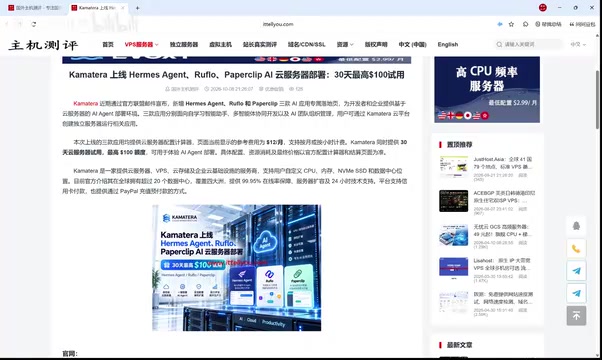
Kamatera has launched dedicated deployment environments for three open-source AI Agent apps: Hermes Agent (persistent memory and cross-platform messaging), Ruflo (multi-agent orchestration for Cloud Code), and Paperclip (hierarchical team management with budget controls). All three run on self-hosted Kamatera cloud servers with hourly or monthly billing from $12/month, backed by a 30-day trial worth up to $100. Watch out for auto-billing after trial expiry and separate third-party API costs.
Cloud provider Kamatera (phonetically rendered as "Cometra" or "Commatter" in some videos) recently announced via its official affiliate newsletter three dedicated deployment environments for AI applications: Hermes Agent, Ruflo, and Paperclip. All three focus on AI Agent deployment and runtime management, and developers can allocate a dedicated server on Kamatera's cloud platform for each one. This article breaks down their respective positioning, billing models, and hidden cost pitfalls to watch out for during deployment.
How the Three AI Apps Differ
Although all three revolve around AI Agents, they solve different problems. Hermes Agent is positioned as a self-learning intelligent assistant, emphasizing persistent memory and cross-platform message management. Ruflo leans toward multi-agent collaborative development and is specifically optimized for Cloud Code environments. Paperclip is an organizational and management tool for AI teams, with task assignment and budget control at its core.
In other words: if you need a personal assistant that stays online long-term and remembers context, Hermes is the better fit. If your focus is on writing code and improving development efficiency, Ruflo is more appropriate. And when you need to uniformly orchestrate multiple Agents while keeping an eye on budgets and operation audits, Paperclip is the go-to choice. All three are open-source projects with flexible configuration options on Kamatera.
Hermes Agent: A Self-Hosted Assistant That Gets Smarter Over Time
Hermes Agent is developed by North Research and is an open-source, self-hosted AI Agent project. Its biggest selling point is support for persistent memory and skill learning — every task accumulates experience, so in theory it gets smarter the more you use it.
In terms of integrations, it can connect with communication platforms such as Telegram, Discord, Slack, WhatsApp, Signal, and email, while preserving all conversation history and task context. It can also create or optimize skills based on past experience, supports scheduled task execution, connects to multiple AI model services, and can even spin up child agents to handle multiple tasks in parallel.
Kamatera provides a one-click deployment template for it, so users can quickly set up a long-running AI assistant or automated task platform without manually configuring the environment. For teams looking to host internal enterprise workflows, this eliminates considerable operational overhead.
"Self-hosted" means the application's code, data, and runtime environment are fully deployed on servers under the user's own control, rather than running on a shared instance managed by a SaaS provider. For AI Agent use cases, the core advantage of self-hosting lies in data sovereignty: all conversation history, task context, and accumulated skills are stored on your own servers and never pass through a third-party cloud. This is especially important when handling sensitive internal enterprise information or compliance-constrained workflows. The trade-off is that operational responsibility — including version upgrades, troubleshooting, and security patches — falls on the user, which is precisely the barrier that Kamatera's one-click deployment templates aim to lower.
Ruflo: Multi-Agent Orchestration for Cloud Code
Ruflo, formerly known as Cloud Flow, is an open-source multi-agent orchestration platform optimized for Cloud Code environments. Its core idea is to break a complex development task into subtasks and distribute them to AI Agents playing different roles — some handle research, some write code, some run tests, and some do code reviews.
At the workflow level, Ruflo supports both parallel and sequential execution, can pass context between tasks, and automatically tracks the status of each task. It retries automatically on errors and supports fallback agents that can take over if a primary agent fails — a valuable reliability feature for large projects.
Deploying Ruflo on Kamatera's cloud servers gives each Agent its own isolated runtime environment, making software development automation, code testing, and task management for large projects much smoother. Server resources can also be dynamically scaled based on load, preventing both waste and shortfalls.
Cloud Code is a suite of IDE plugins and toolchains for cloud-native development released by Google, integrated into VS Code and JetBrains editors, helping developers operate Kubernetes clusters and Cloud Run services directly from their local environment. Ruflo's optimization for this environment means its workflow design is tightly aligned with Cloud Code's containerized deployments, service meshes, and CI/CD pipelines — AI Agents can allocate and execute tasks directly on existing cloud-native infrastructure without needing to set up a separate runtime environment. For development teams already working within the Google Cloud ecosystem, this depth of integration can significantly reduce toolchain-switching costs.
Paperclip: Building Hierarchical Teams for AI Agents
Paperclip is also an open-source AI agent orchestration platform, with the distinctive ability to assign roles and responsibilities to each Agent and organize them into hierarchical teams with reporting relationships. This structure is naturally suited for automation projects requiring multi-role collaboration.
It can break down a large goal into specific Agent tasks, set budget caps for each agent, and maintain a complete record of task execution and operation logs. It also supports connecting to multiple AI models and runtime environments, making its applicable scenarios quite broad.
Through self-hosted deployment on Kamatera, users gain full control over Agent task scheduling, run logs, and all configurations on a dedicated cloud server. For AI teams that need long-term collaboration, cost oversight on model calls, and operation auditing, this level of controllability is especially critical.
Billing, Trials, and Hidden Cost Pitfalls
All three applications share the same billing model — monthly or hourly pricing — with a reference starting price of $12/month and separate purchase pages for each. Pages include a cloud server configuration calculator to help estimate costs. Kamatera supports direct credit card payment as well as PayPal prepaid top-ups.
The platform currently offers a 30-day trial with up to $100 in cloud server credits — just enough to deploy an AI Agent for a real hands-on evaluation. That said, there are a few things you must pay attention to:
- A valid credit card is required to activate the trial, and server configuration and bandwidth limits apply.
- Servers not manually shut down after the trial will be charged at standard rates — clean up unused servers promptly to avoid unexpected charges.
- Third-party model API costs are billed separately and are entirely independent of cloud server fees — this is easy to overlook.
The practical recommendation: if you plan to use the service long-term, run a real project on the trial credits first, observe actual resource consumption and model call costs, and only then lock in your server configuration.
Third-party model API costs are the most easily underestimated hidden expense when deploying AI Agents. Taking OpenAI GPT-4o as an example, input tokens cost approximately $2.50/million and output approximately $10/million. If an Agent is continuously online and frequently triggers tasks, daily API call volumes can far exceed expectations. Anthropic Claude, Google Gemini, and other models have similar pricing structures but vary in specifics. It's advisable to set individual usage limits on API keys during the trial phase (such as OpenAI's Usage Limits feature) and monitor actual call volumes in the model provider's dashboard — accounting for these separately from Kamatera server fees is the only way to arrive at a true total operating cost.
Kamatera's Underlying Infrastructure
Kamatera is a comprehensive cloud services platform primarily offering cloud VPS servers, cloud storage, and enterprise-grade cloud infrastructure. It allows users to fully customize CPU, memory, NVMe SSD storage, and data center location. The company claims to operate over 20 data centers across four continents, promises 99.95% uptime, and provides easy scaling and round-the-clock technical support.
For developers looking to deploy AI Agents on overseas servers, the combination of fully customizable configurations and one-click deployment templates lowers the barrier to experimentation. However, the final price still depends on the CPU, memory, SSD storage, data center location, and any additional services selected at checkout — always rely on the configuration calculator and the actual checkout page for accurate pricing.
How to Choose the Right Option for You
The key to choosing is being clear about your use case: want a personal assistant that remembers conversations and auto-replies across platforms? Choose Hermes Agent. Focused on code development and looking to boost efficiency through multi-agent specialization? Choose Ruflo. Need to coordinate multiple Agents, assign tasks, and maintain tight budget controls and audit trails? Choose Paperclip. All three can be flexibly scaled on Kamatera, so resource bottlenecks shouldn't be a concern.
One final note: much of the information above comes from vendor announcements and online sources. Specific pricing and policies are subject to change at any time — please verify independently before committing and keep a close eye on your actual bills.
Related articles

How Big Can Stars Really Get? The Physical Limits of the Largest Stars
Red supergiants are the largest stars by volume, with radii up to 2,000 times the Sun, engulfing the inner solar system. But there is no precise upper limit on stellar size—models predict up to 15,000 solar radii. The most massive blue stars are far smaller than red supergiants—biggest and heaviest are two different things.

Apple HomeView Smart Display Full Feature Breakdown: Wall-Mount or Desktop, $299
Apple launches HomeView, a $299 smart display with wall-mount and desktop options, 12MP camera for facial recognition, smart home control, music playback, and recipe step-by-step cooking. Full breakdown of watch faces, apps, privacy, and cooking integration.

Where Did the Promised New Studio Go? Craft Computing Answers After Five Years
Craft Computing's host responds to viewer questions: the new studio promised five years ago was shelved as construction costs soared from $30,000 to $75,000, and was replaced by a 168-square-foot garage conversion.