Karpathy Open-Sources autoresearch: A Deep Dive into the AI-Powered Automated Research Tool with 80K Stars
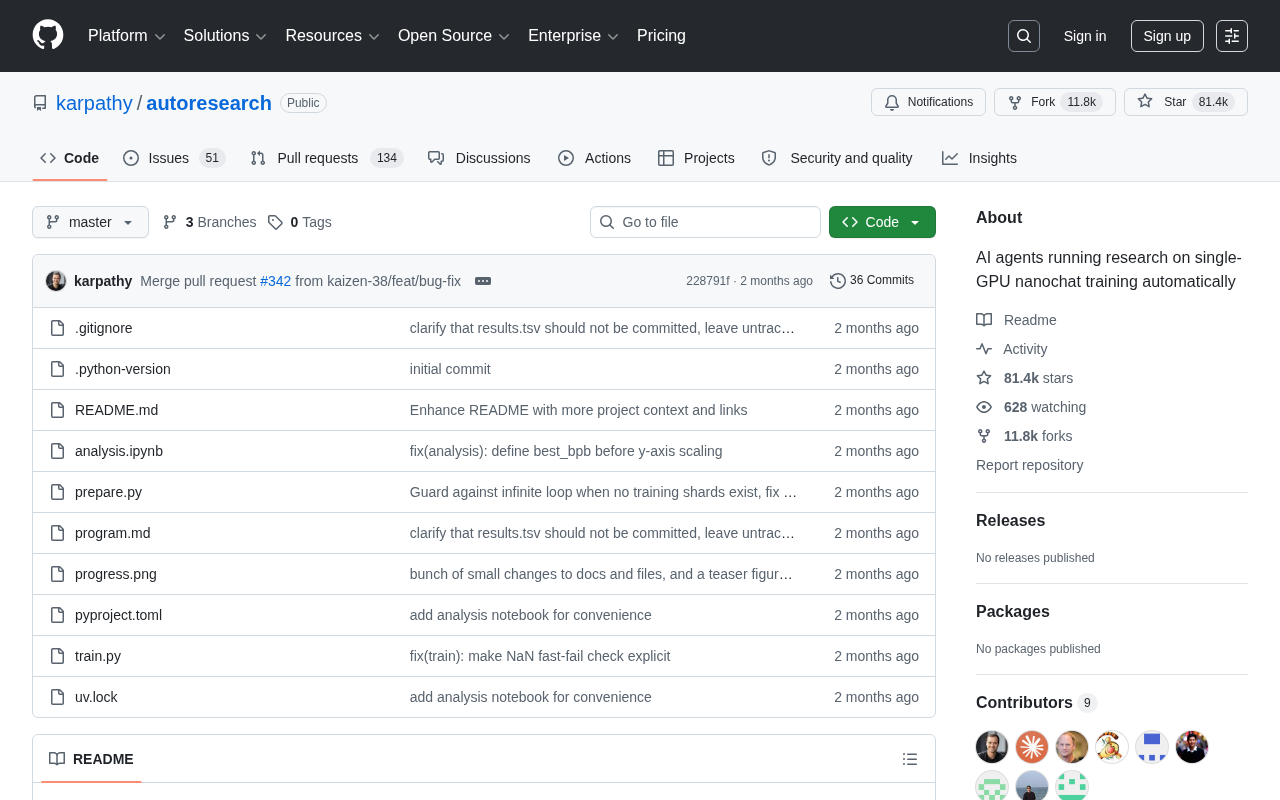
Karpathy open-sources autoresearch, automating AI research with Agents on a single GPU, earning 80K Stars.
Andrej Karpathy released the open-source project autoresearch, leveraging AI Agents to automatically run nanochat training experiments on a single GPU — creating a complete research loop from hypothesis generation and code writing to model training and result analysis. Staying true to his minimalist philosophy, the project dramatically lowers the barrier to entry and has surpassed 80K GitHub Stars. It represents the trend of AI evolving from research subject to research executor, offering independent researchers a new human-AI collaborative paradigm for scientific discovery.
Overview
Andrej Karpathy recently released an open-source project called autoresearch on GitHub, designed to leverage AI Agents to automatically run research experiments based on nanochat training in a single-GPU environment. The project went viral in the developer community immediately after launch, amassing over 80,000 Stars and more than 11,000 Forks to date, making it one of the most talked-about AI open-source projects in recent months.
What Is autoresearch?
Core Philosophy: Let AI Conduct Its Own Research
The idea behind autoresearch is remarkably bold — letting an AI Agent autonomously design experiments, execute training runs, analyze results, and iteratively refine research directions. This isn't a simple automation script; it's a complete AI-driven research closed-loop system.
The AI Agent referred to here is an AI system capable of autonomously perceiving its environment, making decisions, and taking actions to achieve specific goals. Unlike traditional single input-output models, Agents possess capabilities such as planning, memory, tool invocation, and self-reflection. In recent years, as large language model (LLM) capabilities have taken a quantum leap, LLM-based Agent frameworks (such as AutoGPT, LangChain Agent, CrewAI, etc.) have proliferated. These frameworks can decompose complex tasks into sub-steps and execute them sequentially. The Agent in autoresearch is a natural extension of this technical approach, applying an Agent's autonomous decision-making capabilities to scientific research — one of the most complex cognitive tasks there is.
A traditional machine learning research workflow typically requires researchers to manually complete a series of steps: formulating hypotheses, designing experiments, writing training code, running experiments, analyzing results, adjusting plans, and repeating. autoresearch aims to hand this entire process over to an AI Agent, with researchers only needing to set the initial direction and constraints.
Single-GPU Friendly: Continuing Karpathy's Minimalist Philosophy
The "single-GPU" in the project description is a key design decision. Karpathy has consistently championed a "start small" research philosophy — from his earlier nanoGPT and nanogpt-lecture to llm.c, all embodying the idea of producing meaningful research with minimal resources.
Looking at Karpathy's lineage of open-source projects, a clear minimalist technical trajectory emerges: nanoGPT implemented GPT-2 training in roughly 600 lines of code; llm.c implemented GPT-2 training in pure C without any dependency on frameworks like PyTorch; minbpe provided a minimal BPE tokenizer implementation. The common thread across these projects is stripping away engineering complexity to get straight to the core algorithmic essence, enabling learners and researchers to quickly understand and modify the underlying logic. nanochat, as the latest member of this family, extends the focus from pre-training to conversational fine-tuning scenarios.
autoresearch carries on this tradition by constraining the experimental scope to nanochat training tasks that can be completed on a single GPU, yielding three immediate benefits:
- Dramatically lower barrier to entry: No need for expensive multi-GPU clusters — a single consumer-grade GPU is enough to get started
- Faster experiment iteration: Small-scale experiments can validate ideas in a short amount of time
- Sharper research focus: Exploring training techniques and architectural improvements at a manageable scale, without being overwhelmed by engineering complexity
autoresearch Technical Architecture in Detail
AI Agent-Driven Research Workflow
autoresearch is built in Python, with one or more AI Agents at its core capable of performing the following tasks:
- Automatically generating research hypotheses: Proposing new experimental directions based on existing results and domain knowledge
- Writing and modifying training code: Automatically adjusting model architecture, hyperparameters, or training strategies based on hypotheses
- Executing training tasks: Running nanochat model training on a single GPU
- Analyzing experimental results: Automatically evaluating training metrics and determining whether experiments succeeded or failed
- Iterative optimization: Deciding the next research direction based on result feedback
The entire process forms an autonomously operating closed loop that continuously produces experimental conclusions without human intervention.
nanochat: An Experimental Foundation Tailor-Made for Automated Research
nanochat is a lightweight chat model training framework within the Karpathy ecosystem. It's small enough to complete training quickly on a single GPU, yet covers the core elements of modern LLM training — Transformer architecture, dialogue format handling, commonly used optimization strategies, and more. This "small but complete" characteristic makes nanochat an ideal platform for automated research experiments.
To understand nanochat's technical foundation, it helps to know several key concepts behind it. The Transformer is a neural network architecture proposed by Google in the 2017 paper "Attention Is All You Need," with self-attention as its core mechanism, efficiently capturing dependencies between arbitrary positions in a sequence. Modern LLM training typically involves several key stages: pre-training on massive text corpora (learning general representations of language), instruction tuning (teaching the model to follow instructions), and an optional RLHF (Reinforcement Learning from Human Feedback) alignment phase. Dialogue format handling involves special template tokens (such as the ChatML format) used to distinguish system prompts, user inputs, and model responses. Common optimization strategies include the AdamW optimizer, cosine learning rate scheduling, gradient clipping, mixed-precision training, and more. nanochat distills all these elements into a framework that runs on a single GPU, providing an ideal experimental foundation for autoresearch's automated experiments.
Why Did autoresearch Hit 80K Stars?
Riding the Wave of AI Research Automation
autoresearch represents an accelerating trend: AI is not just the subject of research — it's becoming the one conducting it. This aligns closely with the recent exploration of the "AI Scientist" concept in both academia and industry.
The core proposition of the "AI Scientist" concept is having AI systems take on the core creative work in scientific research. In August 2024, Sakana AI, in collaboration with multiple universities, published the paper "The AI Scientist: Towards Fully Automated Open-Ended Scientific Discovery," showcasing a system capable of autonomously generating research ideas, writing code, running experiments, visualizing results, and producing complete papers — at a cost of only about $15 per paper. However, the system also revealed certain limitations, including inconsistent paper quality, occasional factual errors, and over-interpretation of experimental results. The key difference between Karpathy's autoresearch and that work is its sharper focus on automating the experiment execution layer, while ensuring controllability and reproducibility by constraining the scope to the specific nanochat scenario — bridging the gap between concept and real-world implementation.
Amplified by Karpathy's Personal Influence
As a former Tesla AI Director and founding member of OpenAI, every open-source project Karpathy releases quickly becomes a focal point for community learning and discussion. But autoresearch's explosive popularity isn't just about personal prestige — it's because the project touches on one of the most cutting-edge and exciting propositions in AI: recursive self-improvement.
Recursive self-improvement is one of the core concepts in AI safety and AGI research, referring to an AI system's ability to improve itself or improve the process used to create it, forming a positive feedback loop of capability enhancement. This concept can be traced back to I.J. Good's "intelligence explosion" hypothesis proposed in 1965. In the context of autoresearch, the recursive aspect manifests as follows: an AI Agent discovers better training methods through experimentation, and those methods could in turn enhance the AI's own capabilities, enabling it to design even better experiments. While autoresearch's current scale is far from achieving true recursive self-improvement, it provides an observable, controllable miniature experimental arena where researchers can safely explore this frontier direction.
Practical Value for Independent Developers and Small Teams
For resource-constrained independent researchers and small teams, autoresearch offers a genuinely viable new research paradigm:
- Set up the research framework and experimental directions during the day, let the AI run experiments overnight
- Check the next morning to see what valuable results the AI discovered
- Conduct deeper manual analysis and paper writing based on the AI's findings
This "human-AI collaboration" research model has the potential to significantly boost individual researchers' output efficiency, giving a single person the research capacity of a small lab.
Future Outlook and Open Questions
autoresearch currently focuses on the specific nanochat scenario, but its architectural approach is highly generalizable. Foreseeable directions for expansion include:
- Supporting more model and task types: Expanding from chat models to vision, multimodal, and other domains
- Introducing multi-Agent collaboration mechanisms: Multiple AI Agents working together with division of labor to improve research efficiency. Multi-Agent collaboration is a hot topic in current AI engineering, inspired by how human teams divide and coordinate work. Typical frameworks like Microsoft's AutoGen and CrewAI allow multiple Agents with different roles and specializations to communicate, negotiate, and divide tasks. In a research scenario, one could envision one Agent handling literature review and hypothesis generation, another handling code implementation and experiment execution, a third handling statistical analysis and result interpretation, and yet another handling paper writing and peer review feedback. This division of labor not only improves efficiency but also enhances research quality through cross-validation between Agents, reducing the biases or errors that a single Agent might produce.
- Integrating paper writing and literature review: Achieving end-to-end automation from experiments to papers
- Supporting multi-GPU and distributed experiments: Breaking through the single-GPU constraint to explore larger-scale research problems
Of course, AI-automated research also raises some questions that deserve serious consideration: Are AI-generated research results reliable enough? How can we ensure experimental reproducibility? Could large-scale automated research lead to a flood of low-quality papers? These questions need to be gradually explored and answered by the community through practice.
Conclusion
Karpathy's autoresearch is more than just a tool — it's a banner signaling that the era of AI-driven automated research is accelerating. With its single-GPU-friendly design philosophy and fully open-source spirit, it gives every developer the opportunity to personally participate in this paradigm shift in research. Whether you're a seasoned researcher or an AI enthusiast just getting started, autoresearch is well worth your attention and experimentation.
Key Takeaways
- Karpathy released the autoresearch project, using AI Agents to automatically run nanochat training research on a single GPU, surpassing 80K GitHub Stars
- The project implements a complete AI-driven research closed loop: automatic hypothesis generation, code writing, training execution, result analysis, and iterative optimization
- Continuing Karpathy's signature minimalist style, the single-GPU design dramatically lowers the barrier to entry, letting ordinary developers experience automated research
- Represents a significant trend of AI transitioning from research subject to research executor, closely aligned with the "AI Scientist" concept
- Pioneers a new human-AI collaborative research paradigm that could significantly boost individual researchers' experimental efficiency and output
Related articles
 Tech Frontiers
A Rare Quiet Day in AI: Recursive Self-Improvement Stirs Beneath the Surface
A rare quiet day in AI sees multiple sources go silent simultaneously. Behind the calm, Recursive Self-Improvement (RSI) research continues. What this means for the industry.
 Tech Frontiers
Reve 2 vs. Ideogram 4: A Deep Dive into Layout Control in AI Image Generation
A deep comparison of Reve 2 and Ideogram 4's layout control capabilities, covering technical approaches, real-world use cases, and industry trends for designers and creators.
 Tech Frontiers
In the Weights: Check Your Influence Score in the AI World
In the Weights is an AI influence search engine that quantifies your presence in the AI world with a score. Explore how it evaluates practitioners and what it means for digital identity.