Kauldron: A Modular and Extensible ML Model Training Library

Kauldron enters the ML training library track with modularity and extensibility as selling points, but public details are limited.
The article introduces Kauldron, a new open-source ML training library recently exposed on Hacker News, whose core positioning is to provide modular, extensible model training capabilities. It notes that script-style training code suffers from high coupling among the data pipeline, model, optimizer, and training loop, and that modular design can lower change costs and improve component reuse and experimental efficiency. For "extensible," it distinguishes engineering-level horizontal scaling from architectural-level user-defined extension, judging that Kauldron focuses more on the latter. Since the post received only 3 points and no comments, the project is still in an early exposure stage, with API design, module boundaries, and distributed training support not yet public. The article ends with three dimensions for evaluating new training libraries: clarity of abstraction, exit cost, and community and documentation ecosystem, and advises readers to consult the source code and run small-scale tests before deciding.
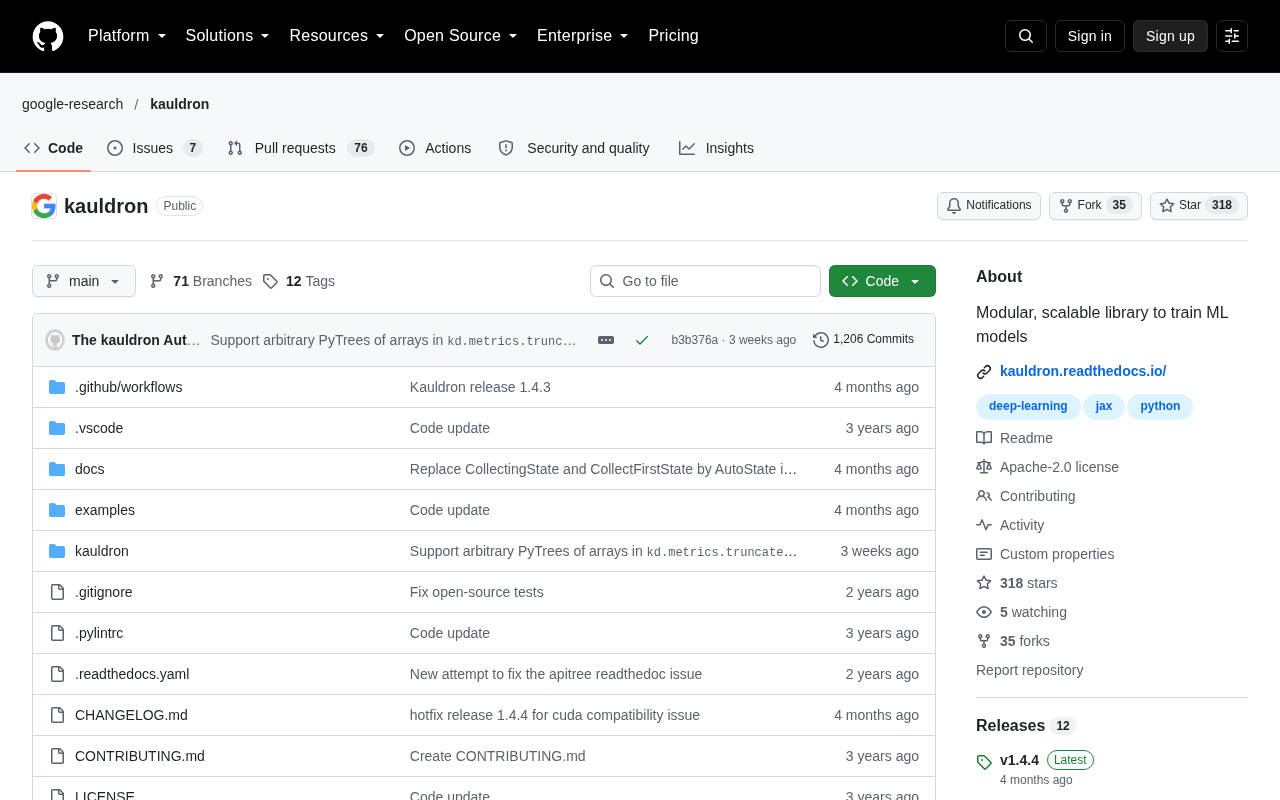
In machine learning engineering, the reusability and extensibility of training code have long been pain points in team collaboration. A new open-source library called Kauldron was recently mentioned on Hacker News, and its positioning directly targets this core problem—providing modular, extensible ML model training capabilities.
Why does training code need to be "modular"?
The lifecycle of an ML project often begins with an experimental script, but when it truly enters production or large-scale research, script-style training code reveals obvious limitations: the data pipeline, model structure, optimizer configuration, and training loop are coupled to one another, so changing one part may affect everything.
Kauldron describes itself as a "modular, extensible library," which means it attempts to break the training process into composable units. For teams that need to reuse components across multiple tasks or want to quickly replace a particular part, this design approach has practical value. The essence of modularity is reducing the cost of change: once data loading is decoupled from training logic, researchers can conduct controlled experiments more safely.
However, it should be noted that the currently public information is limited to positioning descriptions at the title level. Details such as the library's specific API design, how module boundaries are divided, and whether distributed training is supported are not elaborated in the original material.
The training loop is a foundational concept in machine learning engineering, referring to the control flow that drives iterative updates of model parameters: it usually includes the loop of forward propagation to compute loss, backward propagation to compute gradients, and optimizer updates to parameters. In script-style code, the training loop is often intertwined with data loading, logging, checkpoint saving, and other logic in the same file. A common approach in modular frameworks is to abstract the training loop into the framework core and inject the data pipeline, model, optimizer, metrics, and so on as pluggable components, so that researchers only need to focus on the parts that change. This "inversion of control" design is also the shared approach of libraries such as PyTorch Lightning and Keras.
Two interpretations of extensibility
In the context of ML training, "extensible" usually points to two dimensions. The first is horizontal scaling at the engineering level, that is, whether training tasks can scale smoothly as data volume and compute power grow. The second is architectural extensibility, that is, whether users can add custom components without modifying the library core.
Kauldron's naming and positioning suggest that it focuses more on the latter—a framework that allows users to extend as needed. This is consistent with the current evolution of the ML toolchain: rather than providing an all-encompassing but hard-to-customize black box, it is better to provide a clear set of abstractions on which teams can build their own training systems.
Judging from the feedback on Hacker News, the post received 3 points and has no comments yet, indicating that the project is still in an early stage of exposure and community discussion has not yet formed. For developers concerned with choosing a training framework, this means both that information is limited and that they can evaluate early whether its design philosophy fits their own needs.
Data parallelism and distributed training are typical implementations of extensibility at the engineering level. Data parallelism means replicating the same model onto multiple devices, each processing a different data shard, and then keeping parameters consistent through gradient synchronization (such as All-Reduce); in addition, there are strategies such as model parallelism and pipeline parallelism for large models that cannot fit in the memory of a single GPU. To judge whether a training library supports horizontal scaling, the key is whether it has built-in encapsulation of distributed communication backends (such as NCCL and Gloo) and whether it supports sharded data loaders and gradient accumulation. The original article mentions that Kauldron's public information does not cover distributed training details, which is precisely the technical point that needs to be confirmed when evaluating its engineering extensibility.
How to view new training libraries rationally
Faced with an endless stream of training frameworks, whether a library is worth investing time in can be judged from several angles. First, whether the level of abstraction is clear: if the module division is consistent with the team's existing mental model, migration costs will be significantly reduced. Second, exit cost: when the library no longer meets needs, can control be easily taken back rather than becoming deeply locked in. Third, community activity and documentation completeness, which directly determine efficiency in solving problems when they arise.
The information currently disclosed about Kauldron is not yet sufficient to answer all of the above questions. The direction of "modular, extensible" it proposes addresses a real long-standing need in training tools, but its ultimate value depends on implementation quality and ecosystem building. Interested readers are advised to consult the project documentation and source code directly and validate it through small-scale experiments in their own projects.
Exit cost (also called lock-in risk) is an often underestimated dimension in framework selection. It measures how much code needs to be rewritten and how much configuration needs to be migrated when a team decides to abandon a library. Common designs for reducing exit cost include: the framework provides only a thin wrapper, core logic is still expressed in native code of a standard framework (such as PyTorch), and configuration is separated from code. In contrast, projects that depend deeply on a framework's proprietary abstractions often require large-scale refactoring during migration. When evaluating, pay attention to whether the library exposes underlying tensor and optimizer objects and whether custom components follow common interfaces; these details directly determine the replaceability of the technology stack.
Conclusion
Kauldron enters the ML training library track with modularity and extensibility as its core selling points, and its direction hits the long-standing pain points of training code reuse and customization. At present, its discussion热度 in the community is limited, and its specific capabilities still need to be verified by more public materials. For teams looking for alternatives to training frameworks, it can serve as a new option worth watching, but it is not advisable to rashly replace the existing technology stack without actual testing.
One-line Summary
Kauldron enters the ML training library track with modularity and extensibility as selling points, but public details are limited.
Paragraph Summary
The article introduces Kauldron, a new open-source ML training library recently exposed on Hacker News, whose core positioning is to provide modular, extensible model training capabilities. The article points out that script-style training code has the problem of high coupling among the data pipeline, model, optimizer, and training loop, and that modular design can reduce change costs and improve component reuse and experimental efficiency. Regarding "extensible," the article distinguishes between horizontal scaling at the engineering level and user-defined extension at the architectural level, and judges that Kauldron focuses more on the latter. Because the post received only 3 points and has no comments yet, the project is still in an early stage of exposure, and details such as API design, module boundaries, and distributed training support are not public. The article concludes with three dimensions for evaluating new training libraries: whether the level of abstraction is clear, the level of exit cost, and the community and documentation ecosystem, and recommends that readers consult the source code and conduct small-scale actual testing before making decisions.
Related articles

Vibe Coding Full-Stack in Practice: AI Programming from Beginner to Enterprise Deployment
From Cursor to Claude Code, this Bilibili AI programming course uses four progressive projects to cover full-stack development, open-source secondary development, and team collaboration. The article analyzes the shock to frontend roles, the efficiency shift from 50 people to 5, and the methodology required for enterprise-grade projects.

David Blaine's Global Quest for Real Magic: From South Africa to Japan and India
David Blaine travels to South Africa, Japan, and India in his Do Not Attempt special, documenting Spinning drivers, black mamba rescuers, iaijutsu masters, and ascetics—exploring the boundary between magic and real human极限 challenges.

Is a Touchscreen MacBook Coming? Vergecast Reveals Apple Executive's Response
Vergecast podcast reveals a conversation between a reporter and Apple executive John Ternus about a touchscreen MacBook and Apple Pencil support. Ternus says iPad is the best device for a stylus, while the reporter bets MacBook will eventually support Apple Pencil.