Keeping LLM Agents on Track: A New Steering Agent Supervision Framework

A new paper proposes the Steering Agent, a fast-slow dual-pathway supervision mechanism to combat goal drift in LLM agents and multi-agent systems.
The article introduces research addressing "goal drift" in LLM agents and multi-agent systems. The proposed Steering Agent uses fast-slow dual pathways—the fast path judges when to intervene at low cost, while the slow path decides how to intervene at high cost. Training combines pairwise ranking objectives with GRPO reinforcement learning. Experiments show improved performance and efficiency in both single-agent and multi-agent systems, with cross-task generalization, cross-executor transfer, and controllable intervention frequency. Its core value is decoupling supervision from execution capability.
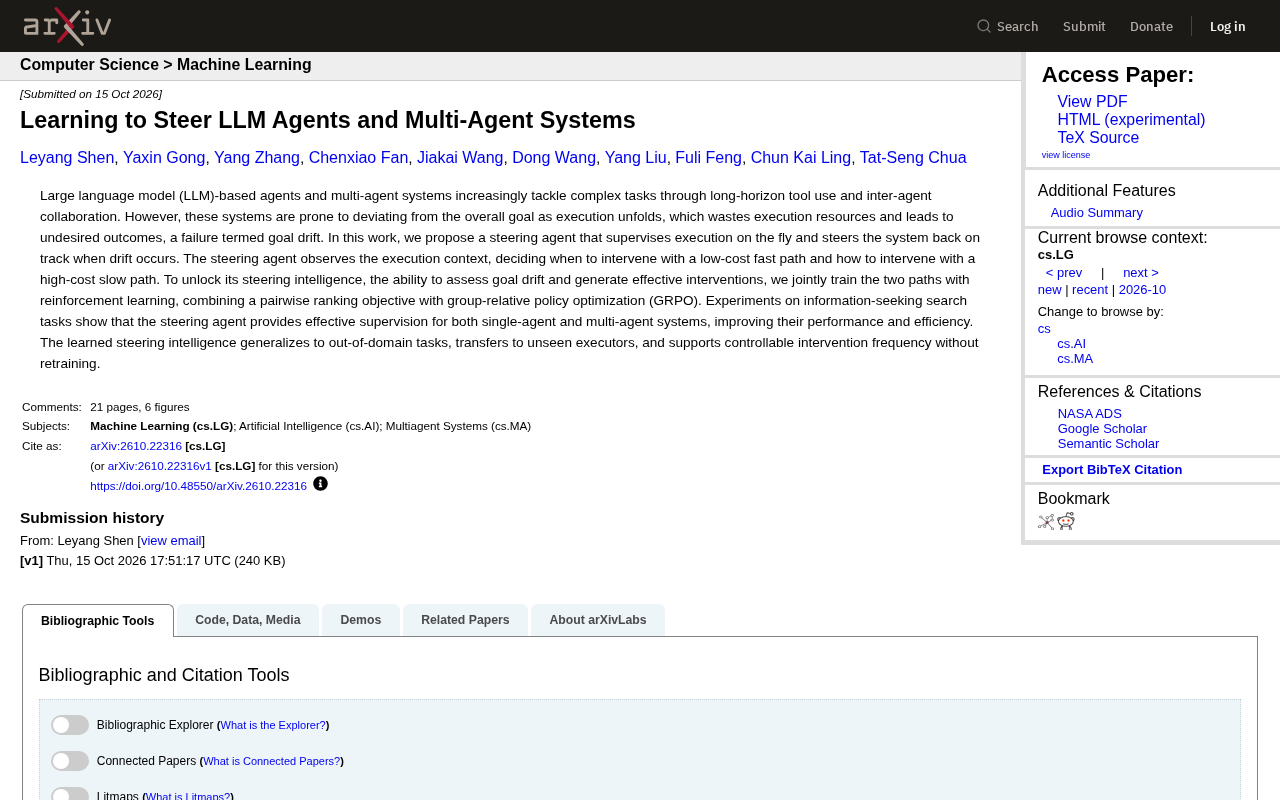
The stronger the collaboration capabilities of multi-agent systems and the longer the task chains, the more likely a hidden problem is to surface: midway through execution, the entire system has quietly drifted away from its original goal. Researchers call this phenomenon "Goal Drift" and have proposed a new supervision approach to address it—the Steering Agent.
What Is Goal Drift and Why Does It Matter
LLM-based agents are taking on increasingly complex tasks—they can call tools, span multiple rounds of dialogue, and even divide work among other agents. But the paper points out that as execution unfolds, these systems tend to deviate from the overall objective, wasting execution resources and leading to unintended outcomes.
This deviation is not an obvious error at any single step, but a subtle drift that accumulates gradually through execution. In long-horizon tasks, an early small deviation can be amplified by subsequent steps, and by the time the system "realizes" it, a large amount of compute and API calls have already been consumed. The paper defines this as a failure mode: goal drift.
Notably, drift exists in both single-agent and multi-agent systems, and may be more severe in multi-agent collaboration scenarios—because each agent makes decisions based on other agents' outputs, errors propagate and amplify along the collaboration chain.
Long-Horizon Tasks are the key context for understanding goal drift. They refer to tasks that require multiple rounds of decision-making, multiple tool calls, or long chains of reasoning to complete, such as multi-step information retrieval, complex code generation, or cross-document report writing. Unlike single-step Q&A, the intermediate outputs of long-horizon tasks serve as inputs for subsequent steps, so early small deviations are not automatically corrected—they are inherited and amplified by later steps. LLM agents generate actions based on the current context at each step, lacking a continuous alignment mechanism with the global objective, and thus easily drift from their original intent after dozens of execution steps. Goal drift is precisely the typical failure mode under this kind of task structure.
How the Steering Agent Works: Dual Fast-Slow Pathways
The paper's core proposal is a supervisory agent that observes the execution context in real time, determines whether goal drift has occurred, and decides whether to intervene to bring the system back on track.
The key design of this Steering Agent lies in its dual-pathway intervention mechanism:
- Fast path: Low-cost judgment that decides "when to intervene." It continuously monitors the execution state, quickly identifying potential drift signals with relatively low computational overhead.
- Slow path: High-cost judgment that decides "how to intervene." Once the fast path triggers, the slow path generates specific corrective actions or guidance.
This division of labor keeps the system running lightweight most of the time, invoking expensive large-model inference only when truly needed. This design philosophy resembles the behavior pattern of human supervisors—not needing to intervene in every routine execution, but requiring deep involvement when anomalies are detected.
Training Method: Joint Optimization with Reinforcement Learning and Ranking Objectives
To train an agent with "steering intelligence"—the ability to assess goal drift and generate effective interventions—the paper adopts a joint training strategy.
Both pathways are trained together via reinforcement learning, with an objective function combining two components: a pairwise ranking objective and Group Relative Policy Optimization (GRPO). The ranking objective helps the model learn to distinguish degrees of deviation, while GRPO optimizes the intervention policy itself. This combination enables the agent to learn both when to intervene and how to intervene effectively.
Interestingly, the goal of this training framework is not to have the Steering Agent replace the original executor, but to supervise alongside it, improving overall performance while keeping the original system architecture unchanged.
GRPO (Group Relative Policy Optimization) is a reinforcement learning algorithm used to train LLM policies. It does not rely on a separate value network; instead, it samples a group of candidate outputs for the same prompt and estimates advantages using relative rewards within the group, thereby reducing training overhead and improving stability. In Steering Agent training, GRPO is used to optimize the slow-path policy for generating intervention actions. The Pairwise Ranking Objective requires the model to make relative comparisons between two candidate states or intervention plans, learning to judge which is more off-target and which intervention is more effective. Together, they enable the model to both distinguish degrees of deviation and generate high-quality interventions.
Experimental Findings: Both Single-Agent and Multi-Agent Systems Benefit
The paper validated its approach on information-retrieval search tasks. Experimental results show that the Steering Agent can provide effective supervision for both single-agent and multi-agent systems while improving their performance and efficiency.
More notably, the generalization results:
- Cross-task generalization: The learned supervisory capability can transfer to out-of-domain tasks.
- Cross-executor transfer: The supervision policy can transfer to unseen executors.
- Controllable intervention frequency: The intervention frequency can be adjusted without retraining, providing flexibility for real-world deployment.
These three points together point to a practical value: the Steering Agent is more like a general supervisory capability than a patch tied to a specific task or model.
Cross-Executor Transfer refers to the ability of a supervision module, after being trained on one or more executors, to generalize to executors unseen during training. Here, executors can be LLM agents of different scales, different prompt templates, or different tool configurations. This capability matters because in real-world deployment, executors often change due to cost, version, or task requirements—if the supervision policy is bound to a specific executor, it becomes hard to reuse. The Steering Agent judges drift by observing the execution context rather than the executor's internal parameters, giving it a degree of model-agnosticism, which is an important basis for viewing it as a general supervisory capability.
Implications for Multi-Agent System Design
This work exposes a problem that has been less systematically discussed before: there is a gap between an agent's execution capability and its self-supervision capability. Current LLM agents excel at execution but are not good at "judging whether they are still on track," especially in long-horizon tasks and multi-agent collaboration.
The Steering Agent approach offers a modular solution: decoupling supervisory capability from execution capability, using a dedicated, reinforcement-learning-trained supervision module to fill this gap. For engineering teams building multi-agent systems, this "bypass supervision" architectural design is worth considering.
At the same time, the fast-slow dual-pathway design also addresses a practical constraint—supervision cannot be too expensive. If every intervention requires repeatedly invoking the largest model for inference, the supervision cost could exceed the benefits of the task itself. This tiered intervention approach is an important step toward making supervision mechanisms truly deployable.
One-line Summary
The paper proposes the Steering Agent, a fast-slow dual-pathway supervision mechanism to address goal drift in LLM agents and multi-agent systems.
Paragraph Summary
This article introduces research addressing "goal drift" in LLM agents and multi-agent systems. Goal drift refers to a failure mode where agents gradually deviate from the overall objective during long-horizon task execution, and it becomes more severe in multi-agent collaboration due to error propagation. The proposed Steering Agent uses a fast-slow dual-pathway mechanism: the fast path makes low-cost judgments about when to intervene, while the slow path makes high-cost decisions about how to intervene. Training combines a pairwise ranking objective with GRPO reinforcement learning, enabling the supervisory agent to assess drift and generate effective corrections. Experiments show that this approach improves both single-agent and multi-agent system performance and efficiency, with cross-task generalization, cross-executor transfer, and controllable intervention frequency. Its core value lies in decoupling supervisory capability from execution capability, providing a modular bypass supervision approach for multi-agent systems.
Related articles

Workbuddy for Absolute Beginners: How a Desktop AI Agent Fits Into Real Workflows
A beginner's guide to the Workbuddy desktop AI agent: installation, claiming credits, file management, and building automated workflows—compared with CodeX for fit and cost, helping professionals shift from AI question-askers to AI managers.

OpenAI's New Agent Stack: Computer Use, Decisions API, and Ultra-Fast Workflows
OpenAI Dev Day unveiled a new agent stack: Computer Use outperforms humans, Decisions API delivers ultra-low-latency classification via Luna, Agents API opens the same Computer Use capabilities, and GPT-6.1 Sol costs only one-seventh of Astra. Core updates, benchmark data, and developer insights.

Liang Wenfeng Open-Sources DeepInfo Inference Framework, Takes On U.S. Ban
DeepSeek open-sources its DeepInfo inference framework after its models, featuring GPU/CPU cross-pipelining, small-model prediction with large-model verification, and full Huawei Ascend and NVIDIA chip support—facing the U.S. federal ban head-on. This article analyzes its significance for AI deployment and open-source strategy.