Keet: Generate Interactive Video Courses on Any Topic with AI

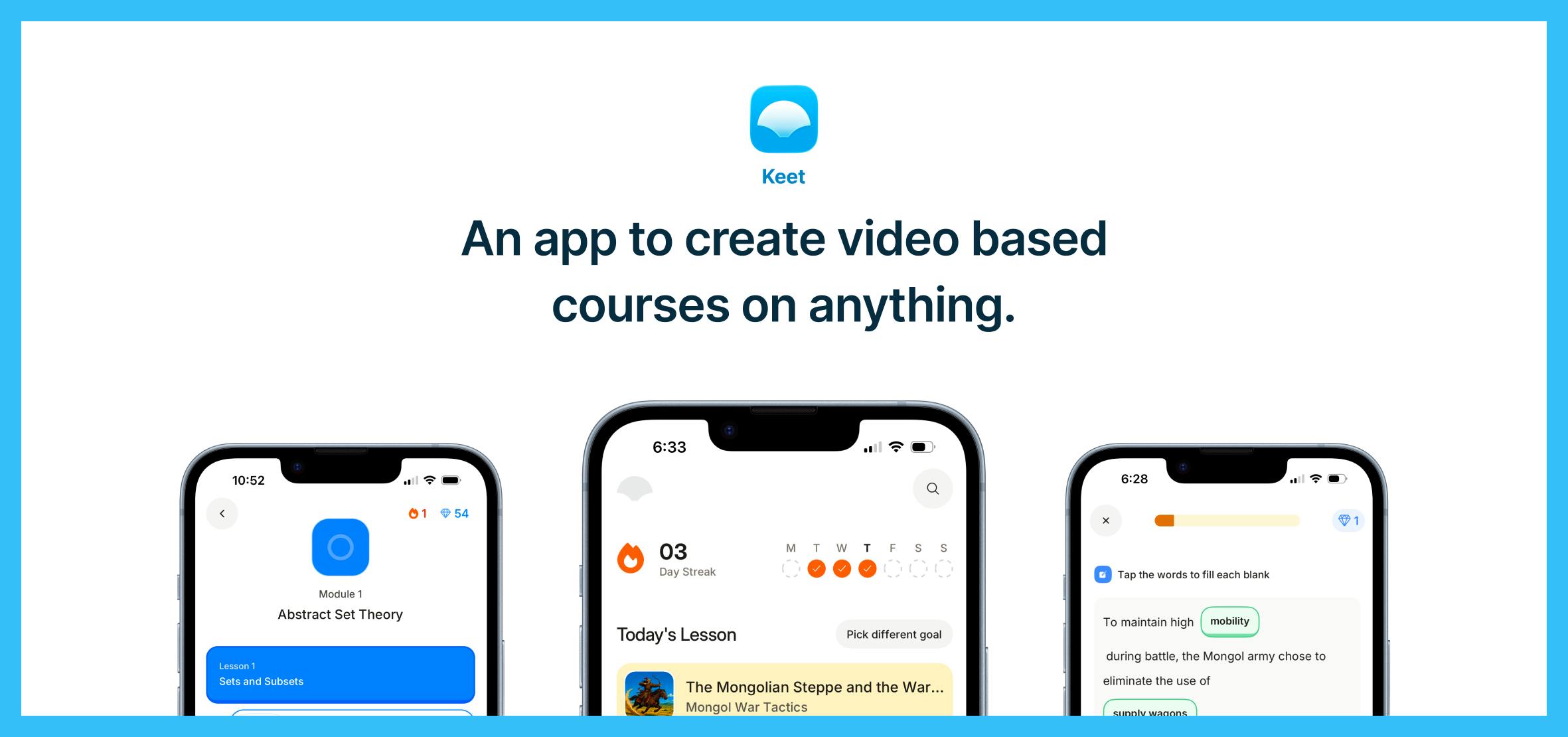
Keet uses AI to instantly generate interactive video courses on any topic, on demand.
Keet is an AI education tool on Product Hunt that lets users enter any topic and instantly receive an interactive video course, addressing the long production cycles and limited topic coverage of traditional online learning platforms. It targets the "AI + online education" space, using interactivity as its key differentiator — aligned with active learning principles that improve knowledge retention. Currently at 87 upvotes, it's an early-stage product. Its real value hinges on content accuracy, professional depth, and the effectiveness of its interactive design — challenges shared by all AI-generated educational content.
What Is Keet
Keet is an AI education product that launched on Product Hunt with a simple, direct promise: generate interactive video courses on any topic. Its slogan, "Video Courses on Anything," practically spells out the entire value proposition — whatever you want to learn, you get a corresponding video course.
The product has received 87 upvotes on Product Hunt, ranking 8th on the daily leaderboard, and sits under three categories: Education, Artificial Intelligence, and Online Learning. The intersection of these three tags makes its ambition clear — Keet is staking a claim in the "AI + online education" space, a lane that has been repeatedly validated yet continues to evolve.
The Problem It's Trying to Solve
The core pain point of traditional online course platforms lies in content supply. A single course — from planning and recording to publishing — can take weeks or even months to produce, and topic coverage is constrained by the availability of instructors. Meanwhile, learners' needs are long-tail and immediate. You might just want to quickly understand a niche concept, only to find there's no structured video content covering it.
Keet's approach is to automate "course creation" with AI. A user enters a topic, and the system instantly produces an interactive video course — bypassing the high cost and long timelines of manual production. This "generate on demand" model essentially packages advances in generative AI — text, voice, and video synthesis — into an application built specifically for learning.
The Value and Challenges of "Interactive Video Courses"
The product description repeatedly emphasizes the word "interactive," which is the key distinction from ordinary AI-generated video. Plain video is passive consumption, while interactive courses imply elements like Q&A, quizzes, and branching paths — participatory design that aligns with the educational psychology concept of "active learning." The idea is that the more engaged a learner is, the better their knowledge retention tends to be.
That said, AI-generated educational content faces unavoidable challenges. First is accuracy: generative models carry the risk of "hallucination," and in a teaching context, the cost of misinformation is far higher than in entertainment. Second is depth: whether AI-generated courses can match the professional rigor of content carefully crafted by domain experts remains to be seen through real-world use. Third is the authenticity of interaction: whether AI-generated interactive elements genuinely serve learning objectives — rather than just appearing interactive on the surface — is critical to whether the product can retain users.
The "active learning" theory in educational psychology has solid empirical backing. Cognitive scientist Richard Mayer's multimedia learning theory suggests that when learners are asked to make judgments, answer questions, or choose paths during a video, the brain's deeper encoding mechanisms are activated — improving knowledge retention by 20%–40% compared to passive viewing. "Hallucination" is a systemic flaw in current large language models, where the model generates content that appears plausible but is factually incorrect — with high confidence. In creative writing this may be tolerable, but in educational contexts, a wrong physics formula or historical fact that a learner memorizes carries a high correction cost. As a result, AI education products typically need to incorporate a fact-checking layer or constrain knowledge sources (e.g., using RAG — Retrieval-Augmented Generation) to reduce the probability of misinformation.
Positioning and Market Observations
Built by Zachary Ashen and fellow makers, Keet's categorization and positioning suggest it targets fragmented, on-demand learning needs — "anyone, any topic, anytime." This aligns with the broader trend in AI education tools: a shift from fixed course libraries toward personalized, on-demand content generation.
Its current Product Hunt metrics (87 votes, 3 comments) place it in the moderate-heat tier for an early-stage product, without yet generating significant user feedback at scale. For practitioners and learners following AI education applications, Keet represents a direction worth watching — when the cost of producing video courses is driven down to near-zero by AI, what happens to the content ecosystem of online learning?
The "AI + on-demand course generation" niche already has competitors approaching from multiple directions. Traditional platforms like Coursera and Khan Academy are using AI for personalized learning path recommendations, but content production still relies on humans. AI video generation tools like Synthesia and HeyGen can produce videos quickly but aren't designed for educational use cases and lack course structure or interactive logic. Keet's differentiating attempt is to integrate "topic input → structured course → interactive video" into an end-to-end pipeline. Whether this can form a competitive moat ultimately hinges on the quality of generation and the completeness of the interactive experience — not on the technical architecture alone — because underlying model capabilities are increasingly commoditized across most players in this space.
Summary
Keet focuses generative AI's capabilities on the specific use case of "on-demand video course generation," combining "any topic" with "interactive format" to enter the online education market. The concept rides the current wave of AI content generation, but the product's real value ultimately depends on the accuracy, depth, and practical effectiveness of its interactive design. As an early-stage product, Keet offers more of a proof-of-concept than a proven solution — its actual performance and reputation still need time to be tested.
Related articles

Chain of Thought Isn't Just for AI: How Humans Can Use CoT to Improve Thinking Quality
Chain of Thought isn't just a prompt trick for large models. Starting from a Hacker News discussion, this article analyzes why CoT works for human thinking too, breaks down actionable ways to transfer it, and highlights the key differences between human CoT and machine CoT.
Cloudflare Teams Up with OpenAI: Closi…
Cloudflare Teams Up with OpenAI: Closing the Loop from Vulnerability Discovery to Defense with AI
Cloudflare uses OpenAI Daybreak to investigate security vulnerabilities and generate reviewable remediation plans, while developers use Codex to boost coding efficiency and quality.

Orca Multi-Agent Orchestration in Practice: A Guide to Parallel Collaboration with Claude and Codex
Orca is Stable AI's free open-source agent workbench supporting 34 agents like Claude Code and Codex in parallel. Learn its Git worktree isolation, multi-model orchestration, and mobile management.