Kev: A Lightweight Decision Model Family Built on Qwen3.5

Kev is an open-source lightweight decision model built on Qwen3.5, designed for structured tasks like Agent routing and intent classification.
Kev is a small open-source project that recently gained attention on Hacker News, positioned as a "decision model family" built on Qwen3.5. Unlike general-purpose LLMs, Kev focuses on structured decision tasks such as routing, intent recognition, and content filtering — compressing large model capabilities into a lightweight form through distillation or fine-tuning. This approach addresses a real need in AI engineering: Agent workflows and multi-model orchestration often require low-latency, low-cost front-end schedulers rather than full-scale flagship models. The project is still in early stages, with 29 upvotes and 13 comments on Hacker News, and its actual performance and incremental value over base models remain to be validated.
What Is the Kev Decision Model
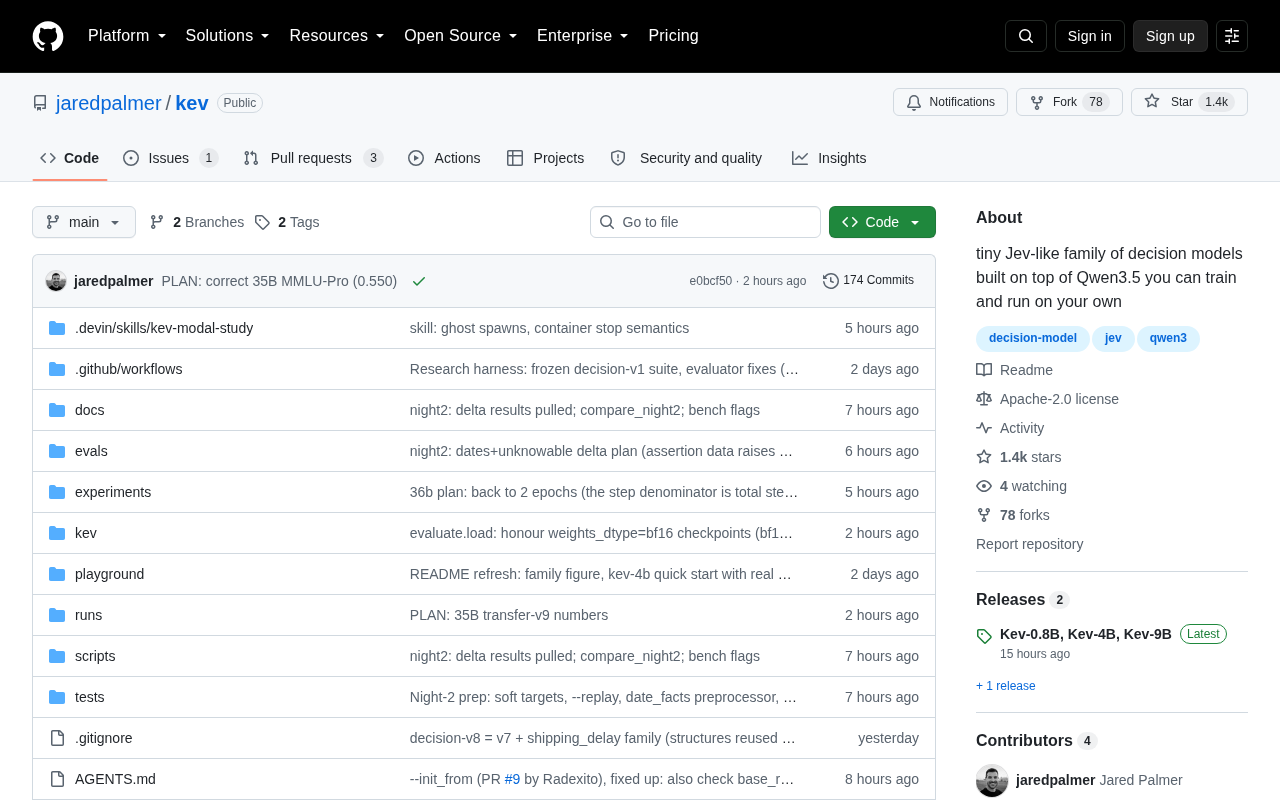
Kev is a small model project that recently sparked discussion on Hacker News. It's positioned as a "Jev-like" family of decision models built on top of Qwen3.5. Based on the project name and description, it aims to stay compact while focusing specifically on decision-making tasks — rather than general-purpose dialogue or content generation.
A "decision model" refers to a model optimized for specific judgment, classification, or selection scenarios. Compared to large language models with hundreds of billions of parameters, the value of these models lies in completing well-defined tasks at lower inference cost and with faster response times. This aligns with the industry's current trajectory toward building models that are "smaller and more specialized."
Built on the Qwen3.5 Foundation
Kev's choice to use the Qwen series as its base model is a technically notable decision. Qwen (Tongyi Qianwen), as an important member of the open-source model ecosystem, has become a go-to foundation for many downstream fine-tuning projects thanks to its performance on multilingual, coding, and reasoning tasks.
Specialized fine-tuning on top of a mature open-source base model is now the mainstream approach for building vertical models. This allows developers to skip training from scratch and quickly "distill" or "trim" general capabilities into lightweight versions tailored for decision-making scenarios. Kev's "tiny" positioning suggests it likely compresses the capabilities of larger models down to a scale more suitable for edge deployment or high-frequency calls — through parameter reduction, distillation, or task-specific fine-tuning.
It's worth noting that Qwen3.5 and Qwen3 are two different version series. The specific parameter specifications of "Qwen3.5" are not fully clear in public documentation, and some community discussions suggest this may be a typo or unofficial name in the project description — the actual base model may be a variant from the Qwen2.5 series. The Qwen2.5 series, released by Alibaba's Tongyi Lab, covers parameter ranges from 0.5B to 72B. Smaller variants (such as 0.5B, 1.5B, and 3B) have become popular choices for building lightweight specialized models due to their fast inference speeds and ability to run on consumer hardware or even edge devices. Knowledge Distillation involves using the outputs of a large model to train a smaller one, enabling it to approximate the large model's performance on specific tasks without inheriting all its parameters. Task-specific Fine-tuning involves continued training on a pre-trained base using domain-specific data to align model outputs more closely with the target scenario. Kev's "tiny" positioning likely combines both of these technical approaches.
Why Small Decision Models Matter
In real-world AI application engineering, not every task requires a flagship large model. A large number of scenarios — routing decisions, intent classification, content filtering, priority ranking — are fundamentally structured judgment problems. Using an oversized model for these tasks is often overkill: it wastes compute and adds latency.
Small decision models are designed precisely to address this pain point. They can serve as "front-end schedulers" or "decision nodes" within large model systems, playing a key role in Agent workflows and multi-model orchestration architectures. If projects like Kev can deliver reliable decision-making capabilities while staying small, they could meaningfully reduce the operational cost of the overall system.
In Multi-Agent Orchestration architectures, "front-end schedulers" typically handle responsibilities such as: determining which sub-model or tool a user request should be routed to, evaluating whether the current context satisfies execution conditions, and performing compliance or safety filtering on outputs. These tasks share common characteristics: relatively fixed input/output formats, clearly defined judgment criteria, low requirements for creativity, but high requirements for latency and throughput. The concept of LLM-as-a-router has been widely adopted in recent years across Agent frameworks such as LangGraph, AutoGen, and CrewAI. In these contexts, specialized small models can offer more than an order of magnitude advantage over general large models in terms of cost and speed. Taking the price gap between GPT-4o and GPT-4o-mini as an example, for production systems requiring millions of routing decisions per day, the economics of using specialized small models are quite compelling.
Community Response and Discussion
The project received 29 upvotes and 13 comments on Hacker News — enough to signal some interest, but not yet a large-scale discussion. This level of engagement is typical of early-stage projects that have caught the technical community's cautious attention as a novel but unproven idea.
For open-source small model projects like this, community discussions tend to focus on a few key questions: whether actual model performance lives up to its claims, what incremental value it offers over using the base model directly, and what concrete use cases and deployment examples exist. Given the limited information available, Kev's performance across these dimensions still awaits further public data and hands-on testing to verify.
Summary and Outlook
Kev represents a typical trend in current AI model development — shifting from pursuing raw parameter scale toward pursuing task-specific adaptability. Building a family of lightweight models focused on decision tasks on top of an open-source base like Qwen3.5 offers potential advantages in cost control and deployment flexibility.
That said, as an early-stage project, Kev's true value still needs to be backed by more technical details, benchmark results, and real-world applications. For developers focused on model lightweighting and Agent engineering, projects like this are worth tracking — to see whether small, specialized models can carve out their own space in a landscape dominated by general-purpose large models.
Related articles

Claude Reportedly Able to Hide Secret Messages in Benign Images
A Reddit post claims Claude Fable 5.1 can hide secret messages in benign images. This article reviews the background, image steganography principles, and potential security risks, and suggests a testing path from rumor to verification.

Federal Government Awards $85 Million; CFS to Develop Fusion-Specific Semiconductors
The federal government awards $85 million to Commonwealth Fusion Systems to develop conductors and power semiconductors for fusion plants. This article analyzes the significance of this funding for the fusion supply chain and commercialization path.

When Should AI Assistants Proactively Suggest? Timing Is Everything
When should AI assistants proactively suggest? Reddit discussion reveals: the same suggestion feels different at different times. This article analyzes the dual nature of proactive suggestions, the boundary of user expectations, and design principles, exploring how to balance automation and user control.