Kilo Code Lands on JetBrains: A Deep Dive into the Open-Source AI Coding Agent
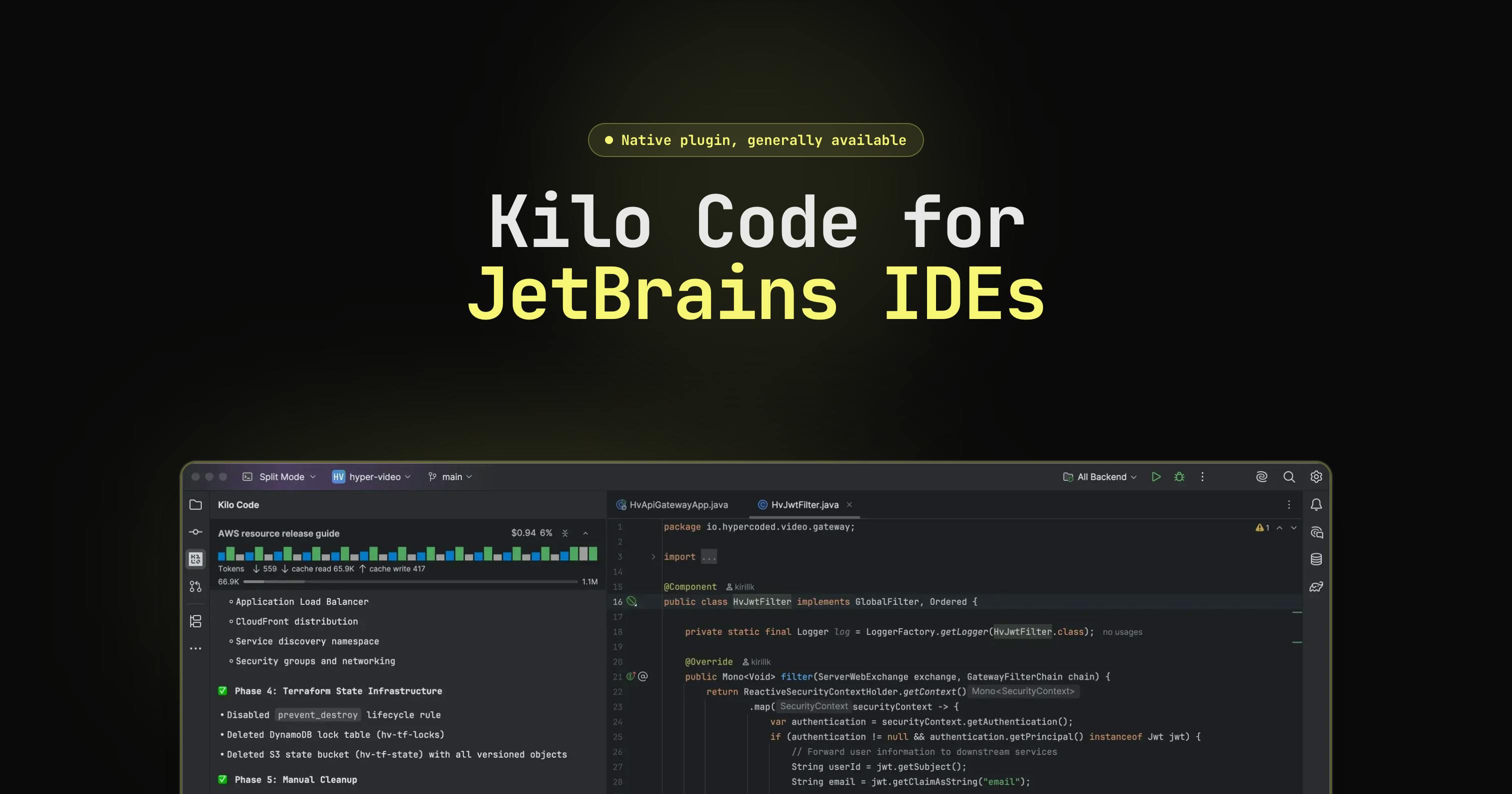
Kilo Code brings a fully native, open-source AI coding Agent to the entire JetBrains IDE family.
Kilo Code for JetBrains is an open-source AI coding Agent natively built for IntelliJ IDEA, PyCharm, WebStorm, and other JetBrains IDEs. It features parallel Agents running in isolated Git worktrees, inline GitHub PR reviews, support for 500+ AI models to avoid vendor lock-in, and compatibility with both local and remote development environments. It debuted at #1 on Product Hunt, addressing strong demand for native AI coding tools in the JetBrains ecosystem.
An AI Coding Assistant Built from the Ground Up for JetBrains
As the AI coding tool battleground expands beyond VS Code into the broader development ecosystem, the massive user base of JetBrains IDEs has long been waiting for a truly native solution. Recently, Kilo Code for JetBrains made its official debut on Product Hunt, claiming the #1 spot of the day with 245 votes and becoming a focal point in the open-source and developer tools space.
Kilo Code for JetBrains has a clear positioning: a fully native, open-source coding Agent that covers virtually every JetBrains IDE — IntelliJ IDEA, WebStorm, PyCharm, GoLand, Rider, PhpStorm, CLion, RubyMine, and more. This means whether you're a Java, web frontend, Python, Go, or C++ developer, you can invoke this AI coding capability directly within your familiar development environment without switching toolchains or suffering from plugin incompatibility.
Why "Native Integration" Matters So Much
Many AI coding tools, when ported to the JetBrains platform, resort to simple Webview wrappers or feature-stripped approaches, resulting in a fragmented experience. Kilo Code's emphasis on being "fully native" means it deeply integrates with JetBrains' IDE architecture — from code completion and context awareness to seamless fusion with the IDE's native UI.
To understand what "native integration" means technically, you need to know the underlying architecture of JetBrains IDEs. All JetBrains IDEs are built on the IntelliJ Platform, a highly modular development platform that provides core components such as PSI (Program Structure Interface) syntax trees, VFS (Virtual File System), and a powerful code indexing engine. Native plugins must deeply interact with these underlying APIs through JetBrains' Plugin SDK to achieve true code-aware capabilities. By contrast, Webview-based approaches essentially embed a browser window inside the IDE, unable to directly access the IDE's syntax analysis results, symbol tables, or type inference information — creating an inherent limitation in the depth of code context understanding. This is precisely why, for developers who rely heavily on JetBrains' powerful code indexing and refactoring capabilities, native integration is the key factor determining whether a tool can truly become part of their daily workflow.
Core Capabilities: Parallel Agents and Isolated Worktrees
One of Kilo Code's most technically impressive features is its support for running parallel Agents in isolated worktrees. This is a significant design choice oriented toward modern development practices.
What Problem Do Parallel Agents Solve?
Traditional AI coding assistants typically operate in single-threaded interactions: you submit a request, wait for the Agent to finish, and only then proceed to the next step. In real-world development scenarios, however, engineers often need to push forward on multiple tasks simultaneously — fixing a bug while refactoring another module, or exploring multiple implementation approaches in parallel.
Kilo Code leverages the Git worktree mechanism to let multiple Agents run independently in isolated workspaces without interfering with each other. Git worktree is a feature introduced in Git 2.5 that allows checking out multiple working directories from the same repository, each corresponding to a different branch. Traditionally, developers had to use git stash or clone multiple copies to achieve parallel development, which wastes disk space and adds management complexity. The worktree mechanism shares the same .git directory, with each worktree independently maintaining its own HEAD, index, and working directory files — enabling true parallel branch operations with minimal resource overhead. Kilo Code combines this mechanism with AI Agents, essentially having each Agent complete code modifications in its own independent worktree with its own branch context. This avoids the file conflicts and state confusion that arise when multiple Agents operate on the same workspace simultaneously, while achieving genuine parallel development efficiency. This architecture is particularly valuable for complex projects and teams requiring multi-task collaboration.
Support for Both Local and Remote Development
The official team specifically emphasizes that Kilo Code is designed for both local and remote development scenarios. With the proliferation of cloud-based development environments, remote containers, and distributed teams, the ability to run AI Agents reliably in remote environments has become essential.
Remote development has become one of the mainstream practices in modern software engineering. JetBrains itself launched the Gateway remote development solution in 2021, supporting connections to remote servers or cloud-based IDEs (such as JetBrains Space, Gitpod, and GitHub Codespaces) via SSH. This model offloads compute-intensive tasks like compilation, indexing, and code analysis to remote high-performance machines, while the local client handles only UI rendering and interaction. Under this architecture, an AI Agent needs to be able to execute file operations, terminal commands, and code analysis within the remote backend process, rather than relying solely on the local file system — placing higher demands on plugin architecture design. Kilo Code's support for remote development makes it suitable not only for individual developers but also for enterprise-level team deployments.
Deep GitHub Workflow Integration
Another noteworthy highlight is that Kilo Code brings GitHub PRs and code diffs inline directly within the IDE. Developers can view Pull Requests and review code changes right in their coding environment without constantly switching to the browser.
This integration reflects the tool designers' understanding of a complete development loop — AI coding shouldn't stop at code generation but should extend to code review, collaboration, and version management across the entire workflow. Traditional code review workflows require developers to frequently context-switch between the IDE and web platforms like GitHub, and cognitive science research shows that the cost of context switching is extremely high — developers need an average of 15 to 25 minutes to re-enter a state of deep focus. Embedding PRs and diffs directly in the IDE effectively reduces this cognitive overhead. GitHub itself has been pushing similar trends, with tools like GitHub CLI and gh-dash attempting to bring more GitHub operations into the terminal and local environment. When Agent-generated code modifications can be presented in standard diff format directly within the IDE, developers can review line by line, selectively accept or reject changes — a much more granular interaction model compared to the coarse-grained all-or-nothing approach, significantly improving the efficiency and controllability of human-AI collaboration.
500+ Model Support: Rejecting Vendor Lock-In
In terms of model selection, Kilo Code supports over 500 AI models — a remarkably aggressive open strategy.
In today's AI coding tool market, many products lock users into a single model or a single vendor's ecosystem. Vendor lock-in for AI models is becoming one of the core concerns for enterprises adopting AI tools. Different models show significantly varying performance across different tasks: for example, Claude excels at long-context code understanding, GPT-4o has advantages in multimodal interaction, while open-source models like DeepSeekAd Coder and Qwen Coder are more attractive for cost control and private deployment. Supporting 500+ models typically means the tool achieves broad model access by being compatible with the OpenAI API standard, Anthropic API, Google Vertex AI, and local inference frameworks like Ollama. Kilo Code's multi-model support means developers can freely choose based on task characteristics, budget constraints, and performance requirements — flexibly matching the most suitable model for different programming languages, task complexity, or even compliance requirements, without being constrained by a single vendor's pricing strategy or service availability.
Combined with its open-source nature, this design philosophy demonstrates full respect for developer autonomy. Users don't need to worry about being locked into a single vendor, and they can audit, modify, or even extend the tool itself based on their own needs. For teams that prioritize data privacy and technical controllability, the combination of open source and multi-model support is extremely compelling.
Summary: A New AI Coding Option That Can't Be Ignored in the JetBrains Ecosystem
The arrival of Kilo Code for JetBrains fills a gap in the JetBrains ecosystem for native AI coding Agents. Its core selling points — full IDE coverage, native integration, parallel Agents, inline GitHub workflows, 500+ model support, and being fully open source — together form a product positioning that is both modern and pragmatic.
Judging from its #1 finish on Product Hunt that day, market demand for this type of tool is clearly strong. For developers who have long used JetBrains IDEs and wanted to incorporate AI coding capabilities but found their options limited, Kilo Code offers an open-source option worth serious evaluation. Of course, as a newly released product, its real-world stability, model invocation costs, and performance on large-scale projects still need to be validated in actual development scenarios.
Related articles

Chain of Thought Isn't Just for AI: How Humans Can Use CoT to Improve Thinking Quality
Chain of Thought isn't just a prompt trick for large models. Starting from a Hacker News discussion, this article analyzes why CoT works for human thinking too, breaks down actionable ways to transfer it, and highlights the key differences between human CoT and machine CoT.
Cloudflare Teams Up with OpenAI: Closi…
Cloudflare Teams Up with OpenAI: Closing the Loop from Vulnerability Discovery to Defense with AI
Cloudflare uses OpenAI Daybreak to investigate security vulnerabilities and generate reviewable remediation plans, while developers use Codex to boost coding efficiency and quality.

Orca Multi-Agent Orchestration in Practice: A Guide to Parallel Collaboration with Claude and Codex
Orca is Stable AI's free open-source agent workbench supporting 34 agents like Claude Code and Codex in parallel. Learn its Git worktree isolation, multi-model orchestration, and mobile management.