Kimberly Guilfoyle Hit by New Scandal: $100,000 Credit Card Bill and Ambassador Nomination Controversy

Guilfoyle reportedly asked a donor to pay off $100k in credit card debt before her confirmation, offering government favors in return.
U.S. Ambassador to Greece Kimberly Guilfoyle is accused of sending urgent Signal messages to Trump donor Dieters six days before her confirmation, asking him to pay a $100,000 credit card bill. Dieters says he was promised IRS connections and government help with a medical lawsuit in return, but all requests went unfulfilled. Guilfoyle's lawyer denies the messages' authenticity without evidence. The program also criticized her flat performance in an embassy PR video, questioning her ambassadorial competence. The incident highlights ethical boundaries in political appointments and money politics.
The U.S. political sphere has been rocked by yet another controversy. According to a recent segment on the YouTube channel Last Week Tonight, a nomination scandal from the Trump administration era is continuing to escalate—Kimberly Guilfoyle, nominated as U.S. Ambassador to Greece, is alleged to have sent an urgent plea to a major Trump donor just six days before her confirmation, asking him to pay off a $100,000 American Express credit card bill.
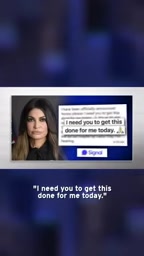
The Core of the Incident: A "Sweet" Plea on Signal
According to the program, the Trump donor in question, Eric Dieters, had previously run for governor of Kentucky. He claims that Guilfoyle sent him multiple messages via the encrypted messaging app Signal, with urgent wording and affectionate terms.
"Please, honey, please," one message read. Another was even more blunt: "I need you to get this done for me today."
Dieters said the timing of these messages was extremely sensitive—just six days before Guilfoyle was officially confirmed as Ambassador to Greece. The host commented sarcastically: "If you wire the money directly to American Express, it won't show up on any records."
Guilfoyle's lawyer subsequently disputed the authenticity of the messages but provided no specific evidence. That response only drew more attention to the details of the incident.
Quid Pro Quo: From the IRS to a Medical Lawsuit
Dieters claims he wasn't providing the money for free. In exchange, he wanted Guilfoyle to help him with several things.
According to the program, these requests included: connecting him with the IRS, which was reviewing a tax deduction he had taken several years earlier; and requesting government assistance with a medical malpractice lawsuit against a doctor who had fled the country.
Dieters explained why he was coming forward now: the government never delivered on that last promise—in fact, not a single thing he asked Guilfoyle to help with ever got done.
The program catalogued these "unfulfilled promises" with its signature humor: no appearance arranged on Tucker Carlson's show, no Fox interview set up, and even—as the host put it—"you couldn't even get Kid Rock to sing a song I wrote."
The Internal Revenue Service (IRS) is the federal government's tax collection agency, and its review process typically involves verifying the legality of deductions claimed by taxpayers. If a politician directly intervenes in an IRS case, it could violate provisions of the federal anti-corruption statutes regarding abuse of power to influence government decisions. Additionally, requesting government assistance with a medical malpractice lawsuit against a doctor who has fled the country involves coordination mechanisms between the State Department and the Department of Justice; if an ambassadorial position is used to advance a private lawsuit, it could constitute non-official use of public resources. The core of these allegations is whether official influence was exchanged for personal financial gain, thereby crossing the ethical boundaries of political appointments.
Why Kid Rock Not Singing That Song Became a Punchline
The program used this as a springboard for an impromptu riff: "You know how bad a song has to be for even Kid Rock to think it's not good enough?"

The host pointed out that Kid Rock had written and performed a song for the children's film Osmosis Jones, with highly controversial lyrics. "When a song becomes the most uncomfortable track on an album—and that album also features an R. Kelly song—you know how bad it is."
This digression may seem off-topic, but it actually reinforces the overall narrative: the favors Guilfoyle promised ranged from serious government resource connections to referrals in the pop culture world—a staggering span.
Kid Rock (real name Robert Ritchie) is an American musician known for blending rock, country, and hip-hop, famous for his rough style and controversial lyrics, and was once an outspoken Trump supporter. His 2001 song "Cool Daddy Cool," written and performed for the animated film Osmosis Jones, drew criticism for its explicit lyrics and strong sexual innuendo, and was even seen by some critics as an outlier on a children's movie soundtrack. The program mentioned R. Kelly because he is likewise known for sexual misconduct allegations and controversial work; pairing the two was meant to emphasize that even in a music landscape full of controversy, that song still stood out as especially distasteful. This analogy was used to mock the fact that Guilfoyle's promised "resource referrals" couldn't even deliver the most basic cultural connections.
The Ambassador's "PR Disaster": From Text to Camera
The controversy wasn't limited to financial dealings. The program also criticized Guilfoyle's basic performance as ambassador—representing the United States in public relations abroad.
They played a video released by the U.S. Embassy in Greece, showing Guilfoyle giving a speech at a Fourth of July event, intended to fire up the audience. Instead, the effect was the opposite.
In the video, Guilfoyle reads from a teleprompter in a flat tone: "As President Trump has said, this anniversary is a time for us to be proud of our past, but also a time to raise our sights, expand our ambitions, and raise our expectations for what America should look like."
The host then mimicked her tone and joked: "What happened? Did the teleprompter suddenly say 'please read this section like a Disney animatronic running out of batteries'?"
The Deeper Issues Behind the Incident
While this scandal has a strong entertainment flavor, the issues it reflects are worth noting.
A nominee for a key government position was accused, on the eve of confirmation, of seeking personal financial assistance from a donor and allegedly offering government resources in exchange—regardless of whether the messages are authentic, this points to questions about ethical boundaries in political appointments.
The tug-of-war between Guilfoyle's lawyer denying the messages' authenticity and Dieters's specific allegations creates a standoff over the facts. The program's decision to report on this now also indicates that the controversy continues to attract media attention.
For readers interested in American political ethics, diplomatic appointments, and the relationship between politics and money, the subsequent developments in this case are worth following.
U.S. ambassadorial appointments are generally divided into two categories: career diplomats and political appointees. The latter are often used by presidents to reward political allies or donors, but they require Senate confirmation. Political appointees often lack diplomatic experience, and their competence and integrity are easily questioned. The ethical boundary issue lies in this: if a nominee seeks personal financial assistance from a donor before confirmation and hints at repaying with government resources, even if ultimately unfulfilled, it may violate provisions of the Government Ethics Act regarding conflicts of interest and standards of official conduct. Such incidents are typically investigated by the Senate Foreign Relations Committee or the Office of Government Ethics, but in practice, accountability is often difficult due to high evidentiary thresholds and political protection.
Background
Signal is an instant messaging app known for end-to-end encryption, widely praised by privacy advocates for not retaining metadata and enabling private conversations by default. However, this encryption feature also makes it a double-edged sword in political scandals: on one hand, users can claim confidentiality of communications; on the other hand, once screenshots of conversations are disclosed by the other party, encryption itself cannot prevent information leaks. In this case, Dieters claims to have received Guilfoyle's messages via Signal, which both reinforces the sense of secrecy of a "private plea" and sets the stage for subsequent disputes over authenticity—screenshots in an encrypted environment are difficult to verify technically unless both parties provide original device data.
One-line Summary
Guilfoyle reportedly sought a donor's help to pay off credit card debt before confirmation, offering government resources in exchange, and the controversy continues to escalate.
Paragraph Summary
U.S. Ambassador to Greece Kimberly Guilfoyle is alleged to have sent urgent messages via Signal to Trump donor Dieters six days before her confirmation, asking him to pay a $100,000 credit card bill. Dieters claims he was promised connections with the IRS and government help with a medical lawsuit in return, but none of the requests were fulfilled. Guilfoyle's lawyer denies the messages are authentic but offers no evidence. The program also criticized her flat performance in an embassy PR video, questioning her ambassadorial competence. The incident reflects ethical boundaries in political appointments and money-driven politics, and its后续 developments are worth watching.
Related articles

Workbuddy for Absolute Beginners: How a Desktop AI Agent Fits Into Real Workflows
A beginner's guide to the Workbuddy desktop AI agent: installation, claiming credits, file management, and building automated workflows—compared with CodeX for fit and cost, helping professionals shift from AI question-askers to AI managers.

OpenAI's New Agent Stack: Computer Use, Decisions API, and Ultra-Fast Workflows
OpenAI Dev Day unveiled a new agent stack: Computer Use outperforms humans, Decisions API delivers ultra-low-latency classification via Luna, Agents API opens the same Computer Use capabilities, and GPT-6.1 Sol costs only one-seventh of Astra. Core updates, benchmark data, and developer insights.

Liang Wenfeng Open-Sources DeepInfo Inference Framework, Takes On U.S. Ban
DeepSeek open-sources its DeepInfo inference framework after its models, featuring GPU/CPU cross-pipelining, small-model prediction with large-model verification, and full Huawei Ascend and NVIDIA chip support—facing the U.S. federal ban head-on. This article analyzes its significance for AI deployment and open-source strategy.