Kimi K2.6 Tops OpenRouter in One Week: The Developer Migration Logic Behind 1.88T Tokens

Kimi K2.6 tops OpenRouter in one week with 1.88T tokens, surpassing Claude Sonnet 4.6 by 40%.
Just one week after launching on OpenRouter, Kimi K2.6 surged to #1 with 1.88T tokens in API calls — a 7683% week-over-week increase — surpassing Claude Sonnet 4.6 by nearly 40%. Its core competitiveness lies in the triangle match of long-form code writing, stable Agent execution, 256K context window, and competitive pricing. This reflects a fundamental shift in AI model competition from launch races to retention races, as a multi-polar landscape emerges with developers choosing models by scenario.
Topping the Charts in One Week: The Real Signal Behind 1.88T Tokens
Just one week after launching on OpenRouter, Kimi K2.6 surged to the platform's #1 position with 1.88T tokens in API calls — a staggering 7683% week-over-week increase — directly surpassing Claude Sonnet 4.6 by nearly 40%. This isn't a marketing-driven flash of hype. It's a choice made by developers with real money spent on token consumption.
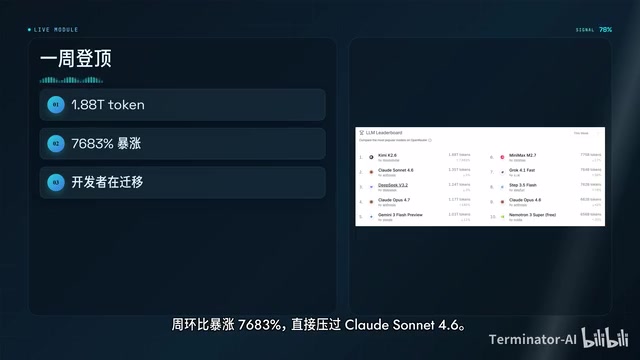
OpenRouter is a unified AI model routing platform that allows developers to access hundreds of models from dozens of providers — including OpenAI, Anthropic, Google, and Mistral — through a single API interface. Its core value lies in abstracting away the complexity of multi-provider integration, eliminating the need for developers to maintain separate SDKs and authentication systems for each model. This is precisely why OpenRouter's usage leaderboard carries unique reference value — it aggregates substantial real production traffic rather than experimental calls, providing a relatively objective reflection of model performance and developer preferences under actual workloads. Whether a model can hold its position here depends on whether developers are willing to use it consistently in production environments. The fact that Kimi K2.6 managed to shift some developers' calling habits in such a short time indicates it has genuinely addressed certain real-world needs.
Why Are Developers Choosing to Migrate to Kimi K2.6?
Precise Product Positioning: Long-form Code and Agent Execution
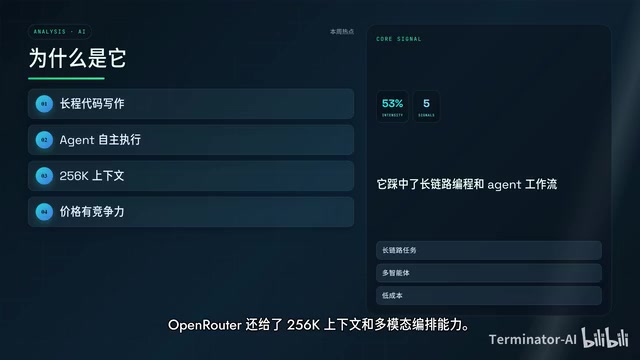
Moonshot's positioning for Kimi K2.6 is crystal clear: emphasis on long-form code writing capabilities and more stable autonomous Agent execution. These two directions happen to address the most critical pain points in current AI programming and automated workflows.
Autonomous Agent execution refers to an AI model's ability to independently plan, invoke tools, and execute multi-step tasks without requiring human intervention at each stage. This scenario places demands on models far exceeding those of single-turn conversations: the model needs to maintain instruction consistency across long contexts, correctly process return results from tool calls, self-correct when encountering errors, and ultimately complete the original objective. Models with poor stability are prone to "hallucinated tool calls," mid-task goal drift, or getting stuck in loops within Agent chains — every failure means developers need to manually intervene and restart the process, dramatically increasing operational costs. What developers need isn't a "jack of all trades" general-purpose model, but a tool that's sufficiently reliable in specific scenarios.
The Triangle Match: Capability, Price, and Workflow
OpenRouter provides Kimi K2.6 with a 256K context window and multimodal orchestration capabilities. Combined with its highly competitive pricing, these three elements form a complete migration driver.
The context window determines the total amount of information a model can "see" during a single inference. A 256K token window is approximately equivalent to 2 million English characters, capable of accommodating all source files of a medium-sized codebase, hundreds of pages of technical documentation, or a complete multi-turn conversation history. For code generation scenarios, a large context window means the model can simultaneously perceive cross-file dependencies, historical change records, and test cases, thereby generating more consistent code. Early GPT-3.5 had only a 4K context window, while current mainstream models have generally expanded to 128K or higher — this technological evolution has directly advanced AI's practicality in complex engineering tasks.
The specific advantages of these three elements are:
- Capability: 256K context is sufficient for handling large codebases and lengthy documents, meeting the full-context requirements of complex projects
- Price: Clear cost advantages over competitors like Claude, lowering the barrier for large-scale API calls
- Workflow: Agent execution stability reduces developers' debugging costs and minimizes the frequency of manual intervention
When all three conditions are met simultaneously, Kimi K2.6 easily becomes developers' "default choice."
A Multi-Polar AI Model Landscape Is Taking Shape
Here's a notable detail: Anthropic still holds three spots on this week's OpenRouter leaderboard, indicating that the Claude series remains a stable choice for a large number of developers. However, the overall landscape is showing a more pronounced multi-polar trend — developers aren't locked into a single provider but are choosing models in layers based on use cases.
Several structural forces are driving this multi-polar trend: open-source models have lowered technical barriers, cloud providers' model hosting services have reduced deployment costs, and capability differentiation across models for different tasks has become increasingly pronounced. Before 2023, the AI large model market was highly concentrated, with OpenAI's GPT series being virtually the only choice for production environments. As Anthropic's Claude, Google's Gemini, Meta's open-source Llama series, and Chinese AI companies continued to push forward, the market landscape underwent fundamental transformation between 2024-2025, giving developers the conditions to "choose models by scenario" rather than being forced to accept a single provider's capability boundaries and pricing strategies.
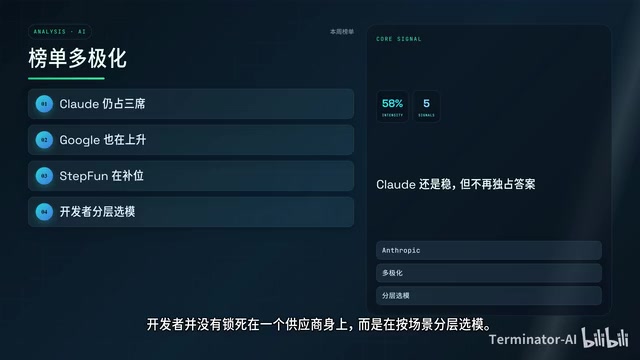
This layered logic might look like:
- General conversation and reasoning: Continue using Claude or GPT
- Long-form code generation and Agent tasks: Switch to Kimi K2.6
- Specific vertical scenarios: Choose other specialized models
This means the dimensions of model competition are shifting. In the past, it was about "who launches first" and "who scores higher on benchmarks." Now it's about "whether you can retain call volume after launch."
From Launch Races to Retention Races: A Fundamental Shift in Competition
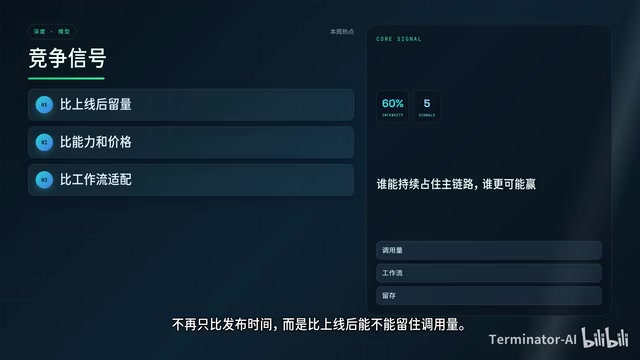
OpenRouter's data reveals an important trend: model competition is shifting from "launch races" to "retention races." There's an enormous gap between paper capabilities and actual choices, and real token consumption is the only reliable measure.
There's clear economic logic behind this: under API billing models, every token consumed corresponds to real monetary expenditure. When developers choose a model in production, it means they've already completed a cost-benefit assessment — the model's output quality is sufficient to support its position in the business pipeline, and the price is within acceptable range. This differs fundamentally from academic benchmarks: benchmark scores measure a model's peak capability on standardized tasks, while token consumption measures a model's sustained reliability under real workloads. From an economics perspective, call volume is a form of "Revealed Preference" — more reflective of developers' true judgment than surveys or user ratings.
For Kimi K2.6, topping the charts in one week is just the beginning. The real test lies in:
- Whether it can sustain call volume: After the initial hype fades, will developers still choose it as their primary model?
- Whether it can expand use cases: Extending from code generation to more automated workflows
- Whether it can build ecosystem stickiness: Getting developers to build systems around it that can't be easily replaced
Whoever can consistently hold their position in developers' primary workflows is more likely to win this competition. This isn't merely a leaderboard event — it's a signal that developer usage is beginning to concentrate around new models. Call volume is a vote, and the voting results are reshaping the competitive landscape of AI models.
Key Takeaways
- Kimi K2.6 topped OpenRouter with 1.88T tokens within one week of launch, with 7683% week-over-week growth, surpassing Claude Sonnet 4.6 by nearly 40%
- Its core competitiveness lies in the combination of long-form code writing, stable Agent execution, 256K context window, and pricing advantage
- The OpenRouter leaderboard shows a multi-polar trend, with developers choosing models by scenario rather than locking into a single provider
- Model competition is shifting from launch races to retention races, with real call volume as "revealed preference" becoming the core metric for measuring model value
Related articles
 Industry Insights
IRS Fully Embraces Claude AI, Accelerating Federal Government's AI Adoption
The IRS is recruiting staff with 24/7 Claude AI access, marking Anthropic's breakthrough into the federal government. Explore the strategic implications and tax use cases.
 Industry Insights
Nadella Introduces the Loopcraft Framework: Building AI Ecosystems Through Feedback Loops
Microsoft CEO Satya Nadella's Loopcraft framework explains how to build frontier AI ecosystems through nested feedback loops across technology, business, and ecosystem dimensions.
 Industry Insights
OpenAI's Internal Codex Usage Surges 56x — AI Coding Is Eating Everything
OpenAI reveals internal Codex usage data: Research up 56x, Customer Support 32x, Engineering 27x, Legal 13x since Nov 2025. AI coding tools are penetrating every department faster than expected.