Kimi K2.7 Code Hands-On Review: What Makes This Trillion-Parameter Open-Source Coding Model Stand Out?

Hands-on testing reveals Kimi K2.7 Code's strengths in 3D generation and coding at 1/12.5 the cost of closed-source rivals.
Moonshot AI's Kimi K2.7 Code is a trillion-parameter open-source MoE coding model with 32B active parameters, 256K context, and vision capabilities. Testing across 6 scenarios — including 3D game development, frontend design, and STL parsing — shows significant improvements over K2.6, with 30% fewer chain-of-thought tokens. At 1/12.5 the price of Claude Fable, it approaches Pro-tier performance on many tasks, though engineering stability issues remain.
Overview: Kimi K2.7 Code Quietly Arrives
Moonshot AI recently released the Kimi K2.7 Code model weights on Hugging Face, marking another iterative upgrade following Kimi K2.6 Code. As an open-source coding-specific model, K2.7 Code launched without much official fanfare, but its technical specifications and real-world performance have already attracted widespread attention from the developer community.
In terms of technical specs, Kimi K2.7 Code is a 1-trillion-parameter Mixture of Experts (MoE) model with 32 billion active parameters, supporting 256K context length and featuring vision understanding capabilities. The most notable improvement: chain-of-thought token usage is reduced by approximately 30% compared to K2.6, meaning inference costs are significantly lower while maintaining or even improving performance.
On pricing, K2.7 Code maintains the same rates as its predecessor — 95 cents per million input tokens and $4 per million output tokens. This is 12.5x cheaper than top-tier closed-source models like Claude Fable, offering an outstanding cost-performance advantage.
Test 1: Neon OS Desktop System
The first test was the classic browser-based operating system generation task. K2.7 Code in Build mode directly generated a desktop system called "Neon OS," complete with a clock, notepad, drawing board, browser, calculator, file manager, terminal, and other full application suites.
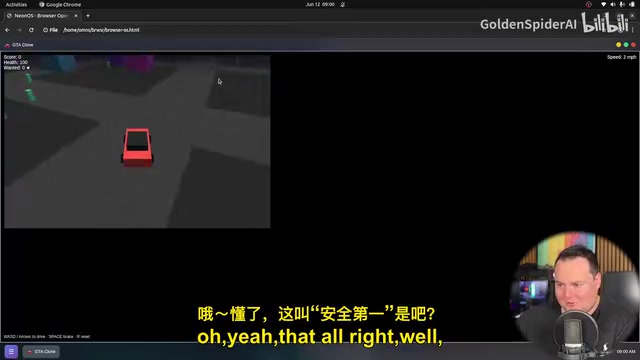
Some detail issues were discovered during testing: the drawing board canvas doesn't resize when the window is scaled, the right-click menu is missing, and the file search function is incomplete. But overall completeness was solid — the clock displayed the correct local time, the calculator performed accurate operations, and there was even a built-in GTA-style mini game called "Neon City Crime." While the car speed was absurdly slow, there were indeed drivable vehicle models, buildings, roads, and moving pedestrians.
Test 2: Subway Scene & FPS Shooter Conversion
This was a two-stage test: first create an elaborate static subway station scene using Three.js, then convert it into an FPS shooter game.
The subway scene was impressive — walls had individual tile textures, trains featured graffiti effects, and floating particles with lighting created a nice atmospheric feel. The "West Fourth Street" station sign was rendered quite clearly. More interestingly, train cars had actual physical separation between them, preventing players from walking through walls — something uncommon in AI-generated 3D scenes.
After conversion to an FPS shooter, movement fluidity was good, weapon models were clearly identifiable, and defeating enemies triggered particle effects. What surprised the tester most was that bullets left bullet holes in the environment — an extremely rare detail in AI-generated games. Pillars and trains in the scene all had mesh colliders set up, physically blocking the player — a significant improvement over K2.6.
Test 3: Multimodal 3D Modeling & the Caveman Grammar Phenomenon
The tester provided 14 photos of a 3D-printed mini laptop taken from different angles, asking K2.7 Code to create an accurate Three.js model with an interactive keyboard.
The model exhibited an interesting phenomenon in its chain-of-thought — the so-called "Caveman Talk" — reasoning in extremely minimal phrases like "since file large" and "need picture of device." This phenomenon sparked lively discussion in the community and is believed to be a manifestation of the model optimizing token efficiency.
The final result had obvious geometry inversion issues, but there were highlights: the screen had a functional terminal, keyboard keys could input characters, and there was even a laptop lid open/close animation — a feature not seen when previously testing MiniMax M3. However, the test couldn't be fully completed because the model repeatedly got stuck during its autonomous QA check phase.
Test 4: C++ Game Development Capability Verification
Skateboarding Game
When generating a California beachside-style C++ skateboarding game in Plan mode, K2.7 Code encountered obvious engineering difficulties — file edits failed three times before succeeding. But the final result showed significant improvement over K2.6: smoother skateboard animations, more NPCs with limb animations, better map layouts, and even a visible "pushing" motion simulation for the skater.

Rally Racing Game
The low-poly retro rally racing game generated in Build mode, while visually unimpressive at first glance, implemented physics details like the steering wheel rotating with turns and the vehicle undulating with terrain — on par with results from previously tested top-tier models.
Test 5: Frontend Design & Automatic 3D Asset Generation
This test required the model to create a high-end website for a fictional watch brand called "Slappus," with the key requirement that the model must generate the 3D watch assets itself and implement cinematic rotation showcases — no photography or stock images allowed.
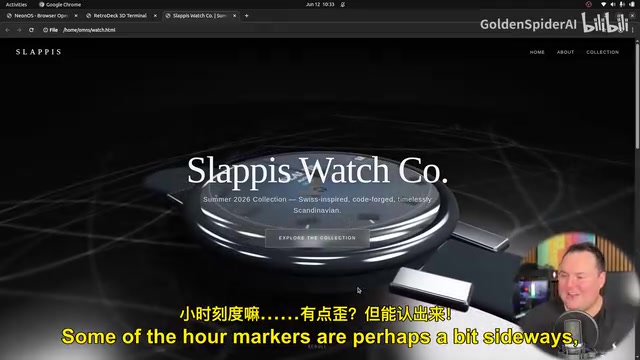
The results were unexpectedly good — the watch model had a fabric-like textured strap, the dial featured the "Slappus" brand name, a date window, and hour markers, and the table surface displaying the watch had artistic line designs. The website also showcased rotating renders of two different watch styles, including the $5,400 "Ember Gold" edition.
Considering K2.7 Code's output token price is only 1/12.5 of Claude Fable's, the tester concluded that the gap between the two isn't nearly as large as the price gap, representing an impressive cost-performance showing.
Test 6: 3D Printer Simulation & STL File Parsing
In the 3D printer simulation test, the printer itself was poorly rendered, but the additionally requested STL file upload and printing functionality was perfectly implemented. After uploading an STL file of an RC car engine block, the model correctly performed slice calculations (336 layers) and accurately printed the 3D model layer by layer.
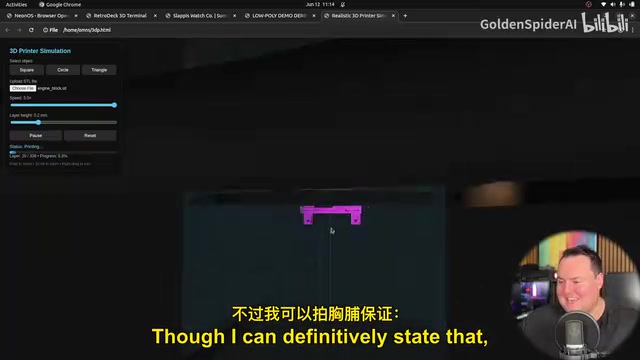
The tester noted that correctly implementing STL parsing and printing logic is arguably more technically challenging than rendering the printer's appearance — this is a feature typically only tested on Pro-tier models.
Shortcomings Revealed During Testing
Testing also revealed some noteworthy issues:
- Flight combat simulator and motorcycle racing game performed poorly, with overly simplistic models and the motorcycle game even exhibiting severe physics bugs
- Demolition derby game (based on image replication) failed to achieve normal vehicle movement and soft-body collision physics even after multiple iterations
- Drum kit simulator completely stopped working after extended runtime
- Frequent engineering stability issues in Plan mode, including repeated file edit failures and autonomous QA checks getting stuck
Conclusion: Clear Progress but Still Room for Polish
Kimi K2.7 Code shows quantifiable and significant improvement over K2.6 — the collision system in the subway FPS scene, animation quality in the skateboarding game, and 3D asset generation for the watch website are all clear upgrades. The 30% token efficiency improvement also means actual usage costs are further reduced.
But objectively speaking, the model gives a sense of being "slightly undercooked." Issues like repeated file edit failures and autonomous QA processes getting stuck in some tasks affected the overall experience. Of course, the tester acknowledged having just tested Claude Fable 5, a top-tier closed-source model, which may have raised expectations.
As an open-source, open-weight coding model, Kimi K2.7 Code's competitiveness in the cost-performance dimension is undeniable. The capabilities it demonstrates on certain tasks (such as STL file parsing, 3D asset generation, and physics collision systems) already approach or match the level of some closed-source Pro models. For developers with limited budgets who need powerful coding capabilities, this is undoubtedly one of the most noteworthy open-source coding models available today.
Related articles

Network Doctor: An Open-Source Terminal Tool for Network Fault Diagnosis
Network Doctor is an open-source terminal network diagnostic tool that integrates ping, dig, curl, and traceroute, automatically detecting connectivity in stages and outputting fault conclusions in natural language.

LangChain Guardrails Explained: Building Safe and Controllable AI Agents
A detailed guide to LangChain Guardrails covering layered ecosystem architecture, middleware implementation, deterministic and model-driven protection for building production-grade secure AI Agents.

Deep Dive into Microsoft's AI Security Tools: Does Performance Really Surpass the Competition?
Microsoft launches enterprise AI security tools claiming superior performance. This deep analysis examines core capabilities, ecosystem advantages, and risks to guide enterprise security decisions.