Kimi K3 Free Trial: A New Benchmark for AI Coding and a Potential Claude Code Alternative

Kimi K3 enters the flagship model race with free access and an 81.2% frontend benchmark, rivaling Claude Code.
Kimi has launched K3, available as the general-purpose K3 Max and the multi-agent-optimized K3 Swarm Max. Benchmark highlights include a 77.8% coding score edging out OpenAI's latest, a top-ranked 42% on long-horizon coding tasks, and an 81.2% frontend score nearly 10 points ahead of competitors. K3 Max is currently free, positioning it as a low-cost alternative to paid tools like Claude Code. In testing, K3 used interactive Q&A to clarify requirements before generating a complete dark-themed SaaS landing page with hero, pricing, and FAQ sections. Note: all data comes from a single creator's demo and some competitor names were misstated — independent verification is recommended.
Kimi K3 Arrives: A New Contender in the Flagship Model Wars
As AI vendors continue rolling out flagship models — Anthropic with a new Claude, OpenAI following up with the latest GPT — Kimi has quietly launched its next-generation model, Kimi K3. Based on a hands-on demo by a Bilibili creator, K3's frontend code generation is genuinely impressive: a single prompt produces a fully structured, visually polished SaaS landing page.
More importantly, the model is currently free to use, making it a compelling potential alternative to paid tools like Claude Code for many developers. This article draws from that demo to break down Kimi K3's positioning, benchmark results, and real-world output quality.

Two Flagship Tiers: K3 Max and K3 Swarm Max
Head to the Kimi website and you'll find two new flagship variants: K3 Max and K3 Swarm Max.
They serve distinct use cases:
- K3 Swarm Max: Optimized for multi-step, batch-oriented agent workflows — ideal for complex tasks requiring sequential decision-making and multi-component coordination.
- K3 Max: The core general-purpose version. As the creator put it, for standard frontend generation or building single-page applications, K3 Max is "more than enough."
For most users focused on frontend development and page building, K3 Max is the right choice — no need to wrestle with the more complex Swarm variant.
"Swarm" in the AI context refers to a multi-agent collaborative architecture: multiple relatively independent AI agents each handle a sub-task and coordinate to complete a complex goal together. This is fundamentally different from a single model completing everything in one pass. OpenAI's Swarm framework, open-sourced in 2024, is one of the most prominent implementations, allowing different agents to dynamically hand off control to one another. Kimi's K3 Swarm Max draws on this concept, making it better suited for tasks that need to be broken into multiple steps with repeated calls across tools or data sources — such as automated code review pipelines, multi-round data processing, or cross-system report generation. For more linear tasks like everyday coding and page generation, standard K3 Max is sufficient.
Benchmarks: Competitive Across Multiple Coding Metrics
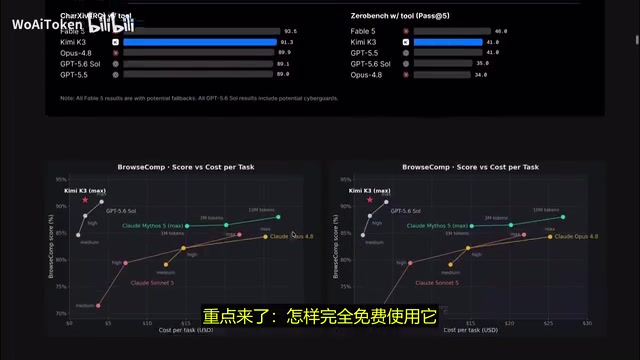
What's really generating buzz around Kimi K3 is its performance across several coding benchmarks. Note that these figures come from the creator's cited test results, and some competitor names were misspoken in the video — they're presented here as-is for reference only.
Coding Benchmark
On the general coding benchmark, Kimi K3 scored 77.8%, slightly ahead of the comparable OpenAI model (approximately 77.6%) and another competitor (approximately 76.8%). The margin is narrow, but it places K3 firmly in the top tier.
Long-Horizon Coding Tasks
On tests emphasizing sustained, multi-step coding ability, Kimi K3 ranked first with 42%, ahead of competitors at 39% and 35%. These tasks better reflect a model's ability to maintain context and make incremental progress in real projects — an area where K3 stands out.
Long-horizon coding benchmarks (typically represented by evaluations like SWE-bench) test whether a model can handle software repository-level tasks the way a real engineer would: reading an existing codebase, locating bugs, making cross-file edits, and passing tests. This requires the model to maintain consistent intent across extremely long context windows — not just writing code, but understanding structural relationships and dependency logic. K3's 42% score leading competitors at 39% and 35% means it produces fewer errors and deviations when handling real-world multi-file, multi-step engineering tasks. For teams embedding AI models into CI/CD pipelines or automated operations workflows, this is a more meaningful metric than raw code completion ability.
Frontend-Specific Benchmark
On the frontend-specific benchmark, Kimi K3 scored 81.2%, significantly ahead of the comparable model at 71.3%. This gap aligns with its strong showing in the landing page demo — frontend generation is clearly K3's forte.
Overall, K3 matches or beats several mainstream frontier models across multiple benchmarks. That said, benchmark scores don't always translate directly to real-world experience, so results should be interpreted in context.
How to Use Kimi K3 for Free
Accessing it for free is straightforward: open the generation tool's homepage, and K3 Max is already selected by default. You can use it immediately or switch to another version as needed.
In the demo, the creator typed a simple "hello" and the model began thinking and responding at a normal speed — no paid setup required. This zero-cost entry point is its core advantage over subscription-based tools like Claude Code.

Real-World Test: A Complete SaaS Landing Page from a Single Prompt
The real test came during the generation phase. The creator asked the model to build a landing page — and interestingly, rather than diving straight into output, the model first asked a few clarifying questions:
- Page purpose: Options included SaaS, mobile app, portfolio, event, etc. — SaaS was selected.
- Visual style: Dark modern vs. clean minimal — dark was chosen.
- Page sections: Hero, features, CTA, pricing, testimonials, FAQ, etc. — selected as needed.
This interactive requirement-gathering approach is far closer to a real development workflow than a single-shot prompt, and it meaningfully reduces the need for iterative revisions.

The final output included:
- A dark-themed hero section
- Card components with hover effects
- A dashboard interface showcase
- A pricing module with annual/monthly toggle
- An FAQ section and image areas
The creator gave the result high marks, saying the frontend design was "in a completely different league." From the demo footage, the component hierarchy, interaction details, and overall layout all appeared production-ready.
CTA (Call to Action) is a core conversion element in landing page design — typically a button or prominent section that guides users to complete a specific action, such as "Start your free trial" or "Get a demo." The quality of CTA placement in a SaaS landing page directly impacts conversion rates, so whether an auto-generated page positions and styles CTAs correctly is an important measure of frontend generation capability. The fact that K3 listed the CTA as a distinct, selectable section during generation suggests the model has a solid understanding of SaaS page structure conventions — rather than simply stacking HTML elements together.
Takeaway: A Free Coding Option Worth Watching
Kimi K3's appeal comes down to two things: strong frontend generation and currently free to use. For budget-conscious developers looking to quickly build landing pages or prototypes, it offers a low-barrier entry point.
That said, the data and conclusions here are drawn from a single creator's demo. Some competitor names were misidentified in the benchmark discussion, and the model's long-term stability, performance on complex projects, and whether the free tier will last all require further independent testing. If you're curious, the best approach is to try it yourself before deciding whether it's right for your workflow.
Related articles

Chain of Thought Isn't Just for AI: How Humans Can Use CoT to Improve Thinking Quality
Chain of Thought isn't just a prompt trick for large models. Starting from a Hacker News discussion, this article analyzes why CoT works for human thinking too, breaks down actionable ways to transfer it, and highlights the key differences between human CoT and machine CoT.
Cloudflare Teams Up with OpenAI: Closi…
Cloudflare Teams Up with OpenAI: Closing the Loop from Vulnerability Discovery to Defense with AI
Cloudflare uses OpenAI Daybreak to investigate security vulnerabilities and generate reviewable remediation plans, while developers use Codex to boost coding efficiency and quality.

Orca Multi-Agent Orchestration in Practice: A Guide to Parallel Collaboration with Claude and Codex
Orca is Stable AI's free open-source agent workbench supporting 34 agents like Claude Code and Codex in parallel. Learn its Git worktree isolation, multi-model orchestration, and mobile management.