Kimi K3 Released: How a 2.8 Trillion Parameter Open Model Reshapes AI Cost-Effectiveness

Kimi K3: a 2.8T parameter open model matching top labs at a fraction of the cost.
Moonshot AI's Kimi K3 is a 2.8 trillion parameter, 1M context, natively multimodal open-weight model. Through KDA architecture innovation and MoE efficiency, it rivals GPT-5.6 and Fable 5 across coding, knowledge work, and agent benchmarks—all at dramatically lower cost, redefining the AI competition.
Moonshot AI has officially released Kimi K3, a highly anticipated open model that demonstrates capabilities on par with top-tier models from Anthropic and OpenAI across multiple benchmarks. More importantly, as a model whose weights will soon be open-sourced, Kimi K3 achieves equal or even stronger performance at a cost far below that of frontier labs. This may be one of the most significant model releases to date—not because it's the absolute strongest, but because it redefines the weight of "cost-effectiveness" in the AI race.
Some background is worth understanding first. Moonshot AI, founded in 2023, is one of the flagship startups in China's large language model space, initially making its name with ultra-long context capabilities. Its Kimi product line first targeted consumers as an intelligent assistant, then gradually expanded into foundational model capabilities. It's important to distinguish "open weights" from "fully open source": the former makes model parameters publicly available for download and self-deployment, but does not necessarily disclose training data or complete training code. In recent years, Chinese labs represented by DeepSeek, Qwen, and GLM have released open models in rapid succession, forming a force that counterbalances the closed-source approach of OpenAI and Anthropic, profoundly reshaping the global AI supply landscape.
Core Specifications and Architectural Innovations of Kimi K3
According to Moonshot AI's official blog, Kimi K3 is a model with 2.8 trillion parameters and a 1 million context length, with native multimodal support. It's worth emphasizing that Kimi K3's multimodal capabilities are not bolted on after the fact but natively integrated at the foundational level, directly boosting the model's performance in scenarios such as game development and visual understanding.
To clarify, 2.8 trillion parameters is an extraordinarily large number, but models of this ultra-large scale typically use a Mixture of Experts (MoE) architecture—where the model consists of multiple "expert" sub-networks, and only a small portion of parameters is activated during each inference. This means that although the total parameter count reaches the trillion level, the actual computational cost per token is far lower than that of a dense model of equivalent scale. This is precisely one of the key mechanisms enabling K3 to keep inference costs low while maintaining high performance.

At the architectural level, K3 introduces two key updates: Kimi Delta Attention (KDA) and Attention Residual. The former achieves up to 6.3x decoding acceleration in million-token contexts, while the latter delivers a 25% training efficiency improvement at less than 2% additional cost. Both improvements revolve around the same core goal—improving the flow of information across sequence length and model depth, thereby making the model more efficient.
To understand the value of these innovations, it helps to review the evolution of attention mechanisms. The self-attention mechanism of standard Transformers has a computational complexity that grows quadratically with sequence length, making long-context processing a compute bottleneck. In recent years, the industry has produced various optimization approaches, such as FlashAttention, linear attention, and state space models (like Mamba), all aimed at reducing the computation and memory overhead of long sequences without significantly sacrificing performance. KDA is a product of this trend—it achieves decoding acceleration in million-token scenarios by improving the way attention is computed, while Attention Residual borrows the idea of residual connections to improve gradient and information flow in deep networks.
Overall, compared to the previous generation K2, Kimi K3's overall scaling efficiency has improved by about 2.5x. This is a remarkable figure, indicating that Moonshot AI is not simply winning by stacking compute and capital, but has invested genuine intelligence in architectural research. This continues the active momentum of Chinese labs in AI research in recent years—solving problems with smarter methods rather than more money.
Kimi K3 Benchmarks: Not First Across the Board, But Strong Enough
To be objective, Kimi K3 does not comprehensively beat GPT-5.6 or Fable 5. It leads in some areas and lags in others. But the real point of interest is not whether it ranks first, but rather how high an open model can reach.
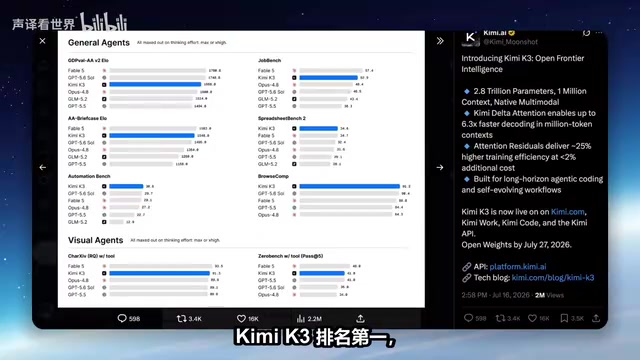
In programming-related tests, Kimi K3 shines:
- Deep Software Engineering: 67.5, higher than GPT-5.5 and Opus 4.8, slightly below Fable 5 and GPT-5.6
- Frontier Software Engineering: 81.2, actually surpassing GPT-5.6
- Terminal Bench 2.1: 88.3, ranking second, only 0.5 behind the top score
- Program Bench: 77.8, ranking first, surpassing GPT-5.6's 77.6
Overall, K3 essentially beats Anthropic's Opus 4.8 across the board. For users waiting for Opus 5, K3 already offers a highly compelling alternative. Of course, some of these figures come from Kimi's internal testing (such as the Kimi Code Bench 2.0 score of 72.9), and it's reasonable to maintain a degree of caution about such results. In fact, AI benchmarks generally face scrutiny over "data contamination" and "benchmark overfitting"—meaning models may have seen test questions during training, or been specifically optimized for particular leaderboards. As a result, there is often a gap between internal self-evaluation data and independent third-party assessments.
Beyond Programming: Knowledge Work and Visual Agents
Kimi K3's ambitions are not limited to the developer community. In tests aimed at knowledge workers, it also performs prominently:
- Automation Bench: Ranked first, higher than GPT-5.6
- BrowserComp: 91.2, ranked first
- Spreadsheet Bench 2: Ranked first
For financial professionals and knowledge workers who frequently handle spreadsheets and create presentations, this is good news. In internal tests such as Online Expense, Deck Bench, and Finance Bench, K3 also ranks first; in visual agent tests (including chart understanding and tool use), it ranks second. The term "agent" here refers to an AI system that can autonomously invoke tools, browse the web, operate software, and plan multi-step tasks. It represents a leap in large model capabilities from "conversational answering" to "actually executing tasks," and is also one of the core directions of current industry competition.
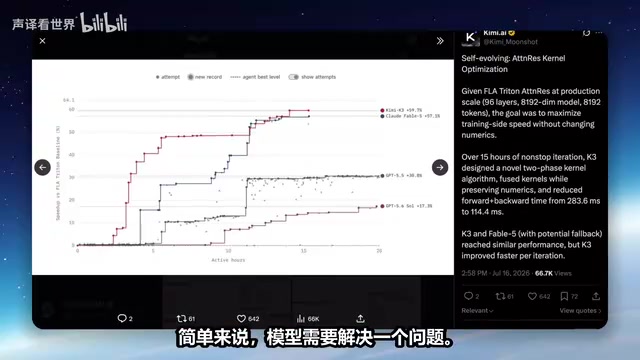
Even more striking is the demonstration of self-evolution capabilities. In an uninterrupted iterative task lasting over 15 hours, K3 designed a novel two-phase kernel algorithm, optimizing the forward-backward time from 28.36ms to the corresponding level. Moonshot AI claims that K3 achieved similar performance to Fable 5, but K3 improved faster with each iteration. While this is still an internal benchmark, it demonstrates the model's potential in autonomously optimizing workflows.
Real User Votes: Independent Validation from LM Arena
Internal benchmarks are inevitably subject to "blowing one's own horn," while third-party platforms like LM Arena provide more credible corroboration—these are the results of real users using models and voting, which cannot be manipulated by vendors. LM Arena (formerly Chatbot Arena) uses a "blind battle" mechanism: users ask questions to two models simultaneously without knowing their identities, then select the better response, ultimately ranking models through an Elo scoring system similar to chess. Since evaluations are completed anonymously by a massive number of real users, it is widely recognized as an important reference for measuring the actual experience of a model, effectively avoiding overfitting to static test sets.
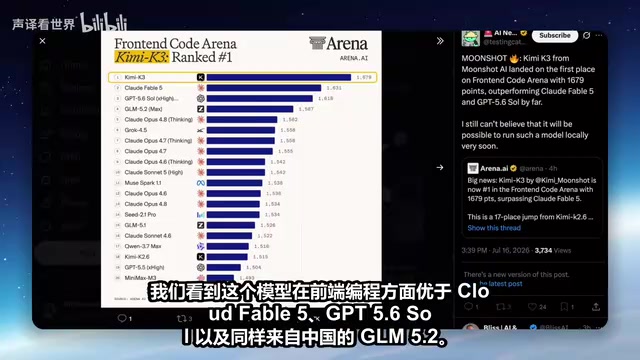
In front-end code tests measuring design capabilities, Kimi K3 actually ranks first, surpassing Cloud Fable 5, GPT-5.6, and the equally Chinese GLM 5.2. This result from real user votes provides independent validation for the claims in the official blog. Of course, as more people use it, the situation may still change, but at least for now its performance is genuinely felt, not merely on paper.
Cost Revolution: How Kimi K3 Redefines the Competitive Landscape
If performance is only half the story, then cost is the key to the other half. Kimi K3 is reportedly priced roughly on par with Sonnet—meaning you can obtain a model that outperforms Fable 5 and GPT-5.6 in certain areas at an extremely low cost.
The industry significance of this far exceeds the model itself. Over the past few months, the frontier AI field has almost formed a "duopoly" of OpenAI and Anthropic. The sudden emergence of Kimi K3 sends a direct signal to all frontier labs: you can build the best models, but your models are too expensive, and we can do the same thing at a lower cost.
It's worth adding that large model costs are typically billed by input/output price per million tokens, and behind this price lies the combined reflection of training costs, inference compute, memory usage, and operational overhead. Open-weight models have a natural advantage in cost because enterprises can deploy them themselves, avoiding ongoing API call fees, while the MoE architecture further reduces the compute consumption of each inference. When model capabilities converge, price becomes the key lever determining procurement decisions.
This will inevitably put pressure on OpenAI and Anthropic. They now must explain why their products still command such high prices when models like K3 exist. The upcoming Opus 5 and GPT-6 not only need to surpass Fable 5 and GPT-5.6 in performance, but must also match or beat them on price to prove the correctness of their direction. In fact, we have already seen this efficiency-oriented shift with GPT-5.6.
Conclusion: Efficiency Is the New Moat in AI Competition
The importance of Kimi K3 lies not in it being the strongest current model, but in proving a different path: through architectural innovation and efficiency optimization, open models can fully reach frontier levels at a fraction of the cost of closed-source solutions.
According to official announcements, Kimi K3's open weights will be released on July 27, 2026, which is another major boon for users who deploy models themselves. When competition shifts from "whose model is stronger" to "who can be equally strong at a lower cost," the rules of the entire AI industry are being rewritten. And Moonshot AI stands at the center of this transformation.
Key Takeaways
Related articles

The Truth Behind Codex 'Build a Website in 5 Minutes': AI Isn't Creating Sites—It's Helping You Copy Them
Exposing the truth behind viral Codex 5-minute website videos: creators aren't building original sites with AI—they're copying shared prompts or scraping others' work. Learn AI coding tools' real limits.

Getting Started with AI Agent Development: A Complete Guide from Concept to Practice
A comprehensive guide to AI Agent architecture and development, covering automated marketing, intelligent customer service, and investment analysis scenarios with single and multi-agent collaboration.

The Truth Behind Codex 'Build a Website in 5 Minutes': AI Isn't Creating Sites — It's Helping You Copy Them
Exposing the truth behind viral Codex 5-minute website videos: creators aren't building original sites with AI — they're copying shared prompts or scraping others' work.