Kimi K3 vs Claude Real-World Test: Near-Equal Performance at 1/8 the Price
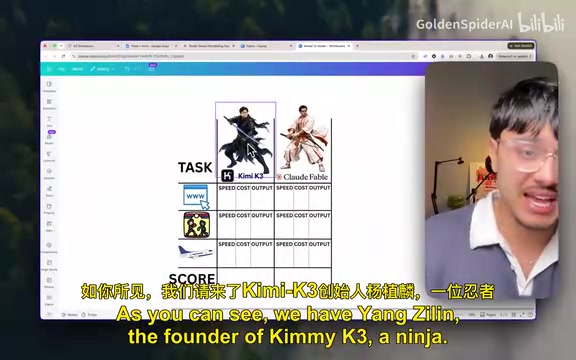
Kimi K3 matches 90% of Claude's output quality at 1/8 the cost across three demanding coding tasks.
A rigorous one-shot comparison of Kimi K3 and Claude across three complex front-end tasks — an e-commerce product page, a 3D fighting game, and a flight simulator — reveals that the open-source Kimi K3 delivers roughly 90% of Claude's output quality while being 6.7–10x cheaper and faster. With local deployment via Ollama and its MoE architecture, Kimi K3 redefines the cost-performance equation for AI-assisted development.
The World's Largest Open-Source Model Enters the Arena
Just hours after its release, Kimi K3 quickly became the center of industry attention — officially dubbed the world's largest open-source model currently available. This "largest" title is closely tied to its Mixture of Experts (MoE) architecture. Unlike traditional dense models that use all parameters for every inference, MoE architecture distributes parameters across multiple expert sub-networks, activating only a small subset each time. Reportedly, K3's total parameter count exceeds the trillion-level, but the activated parameters per inference are far fewer, allowing the model to possess enormous "knowledge capacity" while maintaining reasonable inference costs — effectively decoupling "brain capacity" from "operational energy consumption."
Even more striking is that in the Front-end Code Arena, it reportedly defeated Claude's flagship models directly. The Front-end Code Arena differs from traditional algorithm benchmarks (like HumanEval) in that it requires models to generate complete, visual front-end applications — including HTML structure, CSS styling, JavaScript interaction logic, and even WebGL 3D rendering. This evaluation method more closely mirrors real product development scenarios, as it simultaneously tests a model's design aesthetics, engineering architecture capabilities, and understanding of user experience. Defeating Claude in this arena means Kimi K3 is not only competitive in pure logical reasoning but has also reached top-tier levels in creativity and visual expression.
The core conclusion of this test can be summarized in one sentence: Sonnet-level pricing for near-flagship-level intelligence.
This real-world test employed extremely rigorous comparison rules: both models had MaxEffort (maximum compute) mode enabled, received identical prompts, were allowed only one-shot output with no revisions permitted, and results were deployed directly. MaxEffort mode is a setting in AI coding tools like Cursor that allows the model to use its maximum computational budget to generate responses, without any token output truncation or early termination, enabling the model to perform deeper chain-of-thought reasoning and generate more complete, refined code. The one-shot rule represents an extreme test of model capability — in real development, developers typically iterate through multiple rounds of dialogue to refine code, but one-shot requires the model to produce a deployable complete application in a single generation, placing extremely high demands on architectural understanding, code organization, and attention to detail.
The test covered three highly challenging build tasks: a futuristic e-commerce product page, a playable 3D arena fighting game, and a cinematic 3D flight simulator.
Scoring rules centered on the three dimensions users care about most: speed, cost, and output quality, with one point awarded for each win, and the highest total score determining the winner. This concise scoring system precisely reflects the core decision-making logic developers face in real production environments.
Round 1: Futuristic E-Commerce Product Page
The first task was to create a high-end product landing page for a fictional limited-edition wireless headphone called "Nova X1," requiring Apple-website-style scroll animations and 3D-sculpted product visuals built entirely from scratch. This task simultaneously tests design taste, 3D graphics, animation capabilities, and "conversion psychology" — the ability to turn visitors into paying customers. "Conversion psychology" in front-end design manifests as CTA (Call to Action) button placement, visual hierarchy for price anchoring, social proof element layout, and more — all requiring the model to have an implicit understanding of consumer psychology.
In terms of actual performance, both outputs were quite impressive. Claude's output featured extremely rich animations, with interactive button shake feedback and an "anatomy of silence" breakdown display that were exquisite. Kimi K3's output was equally clean and polished, with smooth color switching and component expansion animations, and it even implemented an "add to cart" micro-animation that Claude didn't have.
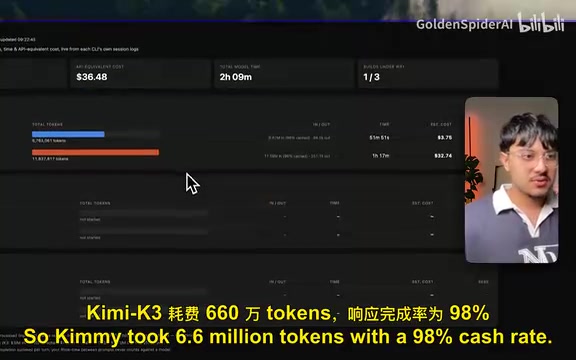
What truly widened the gap was the cost and efficiency data: Kimi K3 consumed 6.6 million tokens (98% cache hit rate), took 51 minutes, with a total cost of only $3.75; Claude consumed 11.5 million tokens (96% cache hit rate) and took 1 hour and 17 minutes.
The cache hit rate here is key to understanding the cost differential. Tokens are the basic unit of measurement for how large language models process text, and API pricing typically distinguishes between cached and non-cached tokens, with the former potentially costing one-tenth or less of the latter. A 98% cache hit rate means only 2% of input requires fresh computation, dramatically reducing actual computational costs. The fact that Kimi K3 can maintain a 98% cache hit rate at such massive token consumption demonstrates deep optimization in its inference architecture for long-context reuse — likely related to the sparse activation characteristics of MoE architecture and targeted KV Cache optimizations.
When converted, Kimi's cost was a full 8.7 times cheaper.
The reviewer's assessment is representative: Claude does edge slightly ahead in pure output quality, but Kimi delivers roughly "90% of the effect" at one-eighth the price. Thus the speed and cost points both went to Kimi, while Claude only took the output quality point.
The Pace of Chinese AI Models Is Being Severely Underestimated
This test also brings a thought-provoking industry observation. Just days earlier, well-known science newsletter author Scott Alexander had published a piece asserting that "Chinese models are 6 to 12 months behind." Kimi K3's release made that assertion age rapidly.
According to the video, Kimi's CEO Yang Zhilin stated in an interview that their models previously required 6 to 12 months to train, and this has now been compressed to 3 months. Yang Zhilin is the founder of Moonshot AI, a graduate of Tsinghua University and Carnegie Mellon University, who studied under several renowned scholars in the deep learning field. Moonshot AI initially gained prominence in China's AI landscape with its ultra-long context window technology (2-million-character level), and its Kimi product has accumulated a large user base in consumer applications. From K2 to K2.6 to K3, the dramatic compression of training cycles reflects not only improved engineering efficiency but also suggests a systematic advantage in their data flywheel, training infrastructure, and algorithm optimization. Considering that Kimi K2.6 only launched a few months ago, releasing a model with near-flagship intelligence at such low prices represents a truly remarkable iteration speed.
The reviewer also pointed out the profound implications for the competitive landscape. Just last month, Anthropic was promoting the narrative that "top-tier models will only be available to those who can afford premium prices." The emergence of such a powerful open-source model undoubtedly poses substantial pressure on their upcoming commercialization path. When open-source models can deliver 90% of flagship-level results, the premium space for closed-source models gets squeezed dramatically, forcing business models to shift from "selling intelligence" to "selling integrated services" and "selling safety and compliance."
Round 2: 3D Arena Fighting Game Development
The second task was to create a fully playable 3D arena fighting game. The test once again confirmed the same pattern.

On the numbers side, Kimi took 53 minutes at a cost of $3.68; Claude took nearly double the time, consumed nearly triple the tokens, and cost approximately $37 — Kimi was roughly one-tenth the price.
In terms of gameplay experience, Kimi's fighting game featured character selection, combo counting, slow-motion KO close-ups, and responsive controls. The reviewer described it as "like a real Mortal Kombat" and even noted that Kimi's camera tracking quality was better. Claude's version excelled with background music, higher-contrast color schemes, and more polished art assets.
Both models generated genuinely challenging AI opponents, which itself demonstrates the maturity of current models in game logic construction. Generating a competent fighting game AI opponent requires implementing State Machine management, attack frame collision detection, difficulty-adaptive Behavior Trees, and smooth animation state transitions — all systems that traditionally require weeks of manual coding in game development. Ultimately, the reviewer gave the output quality point to Claude (for its sound and better assets), but emphasized that Kimi's competitiveness is already extremely strong.
Local Deployment: The True Game Changer
A point repeatedly emphasized in the video: in the real world, most people may not be able to afford the steep subscription fees for flagship models, which is why models like Kimi K3 that are cheaper and can be downloaded and run locally via Ollama hold more practical significance.

Ollama is an open-source local LLM runtime framework that packages model downloading, quantization, and inference engines into simple command-line tools, enabling ordinary users to run open-source models locally as easily as installing software. For large MoE architecture models, local deployment typically requires substantial VRAM (such as multiple RTX 4090s or professional-grade GPUs), because even though activated parameter counts are limited, model weights still need to be loaded into memory. However, the community has developed various quantization techniques (such as GGUF format 4-bit quantization) that can compress VRAM requirements to consumer-grade hardware levels with only minor precision trade-offs. The core advantages of local deployment are: zero API costs, complete data privacy, no network latency, and immunity to any provider's censorship or service discontinuation.
As with previous versions of Kimi, given appropriate hardware, users can run a model with near-flagship intelligence on their local machine. The reviewer captured the core value of open source with a somewhat emotional statement: "Governments can take closed-source models away from us, but no one can take your Kimi K3 away from you." This is precisely the irreplaceable strategic value of open-source models — they provide developers with a technological safeguard independent of any single vendor, and in today's landscape of growing geopolitical risks, this "technological sovereignty" holds significance far beyond the cost dimension.
Round 3: Cinematic 3D Flight Simulator
The final task was a cinematic 3D flight simulator. This time the gap narrowed noticeably: Kimi consumed 4.8 million tokens in 38 minutes; Claude took 44 minutes, making the time difference quite close. In terms of cost, Claude was approximately 6.7 times more expensive than Kimi.
In output quality, Claude truly "shone" this round — with brilliant color schemes, impressive lighting and thunderstorm effects, and stunning visual quality. Achieving such a flight simulator requires the model to possess deep understanding of WebGL Shader Programming, including terrain generation in vertex shaders, atmospheric scattering simulation in fragment shaders, and real-time Phong lighting model calculations. Kimi's version was equally cool, featuring lightning effects and a minimap, but its overall artistic polish was slightly less refined. The reviewer acknowledged that with minor prompt adjustments, Kimi could likely match or even surpass the result.
Final Verdict: Who's the Winner?
The final conclusion depends on what you prioritize:
- If you demand the absolute best final visual quality: Claude held the edge in output quality across all three tasks.
- If you care about speed and cost: Kimi K3 dominated almost across the board, with prices typically 6.7 to 10 times cheaper.
By total score, Kimi K3 won the overall competition through its dual advantages in speed and cost, while Claude retained the honor of "best output."
The true insight from this showdown may not be about who won, but rather: an open-source, locally deployable model priced at one-tenth of flagship pricing can already deliver 80%-90% of flagship-level results. For developers and teams that need frequent iteration and cost control, this value proposition is redefining the selection logic for AI coding tools. In real production environments, developers rarely execute code generation just once — they typically iterate dozens or even hundreds of times, at which point a 10x cost difference means: with the same budget, using Kimi K3 allows 10x the number of experiments. More experiments mean more exploration space, often producing better final results than a single "perfect generation." This is the deeper logic behind how affordable, high-quality models truly change the game.
Key Takeaways
Related articles

Mecanum Wheel Motion Simulation Platform: A Detailed Guide to Low-Cost VR Haptic Solutions
A detailed look at a Mecanum wheel-based omnidirectional motion simulation platform using VR trackers for 3-DOF motion simulation and recentering correction — a viable low-cost VR immersion solution.

LangChain Managed DeepAgents: Hosted Agent Infrastructure So You Can Focus on Core Logic
LangChain launches Managed DeepAgents public beta, hosting evals, memory, OAuth, Slack integration, and sandbox infrastructure so developers can focus on Agent core logic.

Stripe's In-House AI Platform Architecture Explained: A Practical Guide to Enterprise AI Implementation
Deep dive into how Stripe built its internal AI platform, covering unified model access layers, RAG knowledge integration, security governance frameworks, and lessons for enterprise AI implementation.