Kimi OK Computer Hands-On Review: In-Depth Evaluation of AI Agent Performance Across Four Scenarios

Kimi launches AI Agent OK Computer; hands-on tests show strong performance across four real-world scenarios.
Kimi officially launched its AI Agent product OK Computer, equipped with over 20 built-in tools for autonomous complex task completion. Hands-on testing covered website building, data analysis, audio picture book generation, and PPT creation. Website building and data analysis earned perfect scores, the audio picture book impressed with character consistency and source code access, while PPT creation delivered great aesthetics but limited page count. OK Computer signals Chinese model companies joining the Agent race as AI evolves from answering questions to solving problems.
On September 25, Kimi officially launched its Agent mode — OK Computer. This isn't a simple chatbot upgrade, but rather a "virtual computer." The company claims it has over 20 built-in tools capable of autonomously completing complex tasks like data analysis, deep research, web development, and PPT creation.
AI Agent is one of the most important development directions in the artificial intelligence field today. Unlike traditional large language models (LLMs) that can only engage in text-based conversations, AI Agents possess the ability to perceive their environment, make autonomous decisions, invoke tools, and execute actions. Their core architecture typically includes: a planning module (breaking complex tasks into subtasks), a memory module (maintaining context and historical information), a tool-calling module (connecting to external APIs and software), and a reflection module (evaluating execution results and self-correcting). The coordinated operation of these four modules enables Agents to handle tasks far more complex than single-turn conversations — for example, when a user requests "analyze the investment value of gold over the past 30 years," the planning module breaks it down into subtasks like data acquisition, data cleaning, statistical analysis, and visualization. The tool-calling module invokes search engines, Python interpreters, and front-end rendering tools respectively, while the memory module maintains data states and intermediate results throughout the process, and the reflection module checks output quality after each step to determine if a retry is needed. Since 2024, leading companies like OpenAI, Anthropic, and Google have all launched Agent products, and an industry consensus is forming: Agents represent the critical leap for large models from "being able to talk" to "being able to do." The release of OK Computer marks the official entry of Chinese model companies into this Agent race.
When model companies build AI Agents themselves, how good is the product really? This article provides an in-depth hands-on evaluation of Kimi OK Computer across four dimensions: website building, data analysis, audio picture book generation, and PPT creation.
Website Building: Nearly Fully Automated from Design to Deployment
The first test scenario was having OK Computer generate a Schnauzer-themed pet website with three modules: an AI photo calendar, a dog care encyclopedia, and a merchandise store.
After inputting the requirements, OK Computer automatically generated a task list (todo list), then progressively completed research, UI design, code development, and AI image generation. Throughout the process, it generated posters and hoodie designs with a clean style and solid aesthetics. It also automatically established the project structure, downloaded assets, and launched the web service — the workflow was seamless.
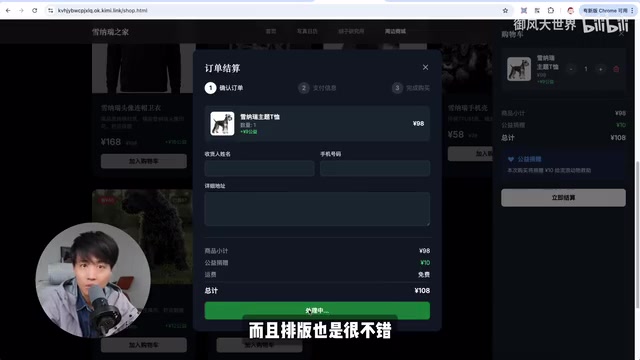
The final website included AI image generation functionality, knowledge blocks, a shopping cart, and an order system, all with a coordinated style and refined layout. During testing, the issue of "homepage images not being centered" was raised, and OK Computer quickly optimized the layout. This interactive modification capability demonstrates an important Agent characteristic — closed-loop feedback: users don't need to re-describe the entire requirement, they only need to point out the specific issue, and the Agent can understand the intent within the existing context and make precise corrections. This is fundamentally different from the traditional "regenerate from scratch" approach.
Overall, Kimi OK Computer demonstrated clear logic and accurate execution in website building, capable of independently completing nearly the entire process from design to deployment.
Practical Tip: Structured Prompts Yield Better Results
Hands-on testing revealed that first using AI to convert conversational requirement descriptions into structured prompts, then handing them to OK Computer for execution, significantly improves results.
Structured Prompting is an advanced technique in Prompt Engineering. Its core idea is to transform vague natural language requirements into well-organized, comprehensive formatted descriptions, typically including role definition, task objectives, output format, constraints, and examples. For instance, rather than saying "make me a pet website," it's better to specify: "Target users: Schnauzer owners; Core modules: AI photo calendar (supports uploading photos to generate monthly calendars), dog care encyclopedia (categorized by age stages), merchandise store (with shopping cart and order system); Design style: minimalist modern, primary colors in Morandi blue-gray; Technical requirements: responsive layout, mobile-friendly." Research shows that structured prompts significantly reduce comprehension ambiguity for large models, improving task completion accuracy and consistency. In Agent scenarios, this technique is especially important — because Agents need to decompose prompts into multiple subtasks and assign them to different tools for execution, the clearer the structure, the lower the error rate in task orchestration. A vague prompt can cause the planning module to deviate during the task decomposition phase, and this deviation gets amplified at each subsequent step. This tip applies equally to the data analysis tasks that follow.
Data Analysis: Stunning Financial Data Visualization
The second test had OK Computer perform an in-depth analysis of gold's value and risk characteristics as an investment tool, based on real market data from 1995 to 2025.
OK Computer's execution flow was very clear: first listing the task checklist, then searching financial websites for real data, using Python for backend data processing, and finally presenting the analysis results as a static website. It's worth noting that "searching financial websites for real data" isn't simple web scraping — the Agent needs to assess data source reliability (e.g., prioritizing authoritative sources like Yahoo Finance and the World Gold Council), handle parsing issues across different data formats, and perform reasonable interpolation or annotation when data is missing. This data acquisition capability is one of the key differentiators between Agents and ordinary code generation tools.
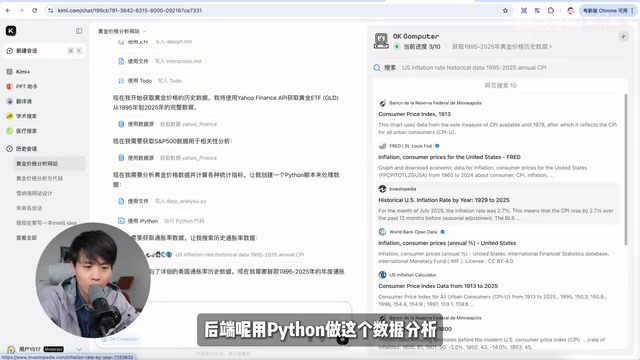
Data visualization is the technology of transforming abstract data into graphical representations, with the core goal of helping users quickly discover patterns, trends, and anomalies in data. In the Python ecosystem, commonly used visualization libraries include Matplotlib (basic plotting, suitable for academic paper-level static charts), Seaborn (a statistical visualization wrapper built on Matplotlib), Plotly (dynamic charts supporting interactions like zooming and hover tooltips), and ECharts (Baidu's open-source front-end visualization library, excelling at real-time rendering of large-scale data). OK Computer combines Python data processing with front-end visualization, presenting analysis results as a static website. The advantage of this approach is that users can view interactive charts through a browser without installing any software, while retaining data download and report export capabilities. This "backend computation + frontend presentation" architecture essentially reproduces a professional data analyst's complete workflow — in traditional scenarios, this typically requires collaboration among three roles: a data engineer (responsible for data acquisition and cleaning), a data analyst (responsible for statistical modeling), and a front-end developer (responsible for visualization).
The final product includes the following sections:
- Key Metrics Overview: Core data at a glance
- Price Trend Analysis Charts: Smooth interactive experience
- Return Comparison and Return Analysis: Multi-dimensional presentation of investment performance
- Correlation Analysis and Investment Insight Recommendations: Decision-making reference
- Complete Annual Data and Analysis Report: Direct download support
- Data Sources and Calculation Methodology: Ensuring analytical transparency
Among these, correlation analysis is one of the core methods in financial data analysis. It measures the synchronicity of price movements between different assets by calculating their correlation coefficients (typically using Pearson's correlation coefficient, ranging from -1 to 1). For example, gold and the US Dollar Index are usually negatively correlated, while gold and inflation rates are positively correlated — these relationships are crucial for portfolio risk diversification strategies. OK Computer's ability to automatically complete such professional analyses and present them in intuitive charts significantly lowers the barrier to financial data analysis.
The overall layout and color scheme are aesthetically pleasing, and the interactive experience of the data visualizations is excellent. From data acquisition and cleaning to visualization, OK Computer demonstrated complete data analysis pipeline capabilities — something many AI Agent products still can't achieve.
Audio Picture Book Generation: A Double Surprise in Aesthetics and Functionality
The third test was generating an English picture book audiobook. The prompt was translated into English before being given to OK Computer.
The final product was also a static website, but the layout, color scheme, and typography all demonstrated excellent aesthetic sensibility.
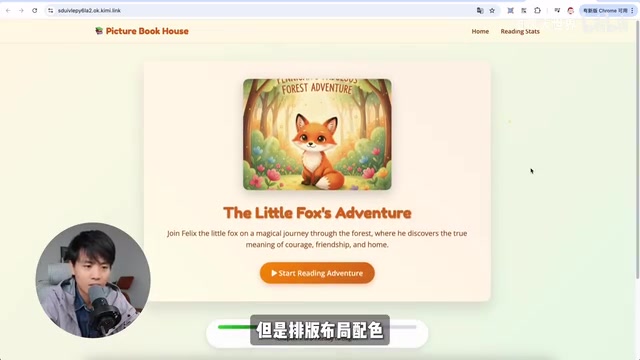
Clicking a button starts the reading experience — illustrations on the left were independently generated by OK Computer, and both the story plot and voice narration were completed automatically. The narration feature relies on Text-to-Speech (TTS) technology. Modern TTS systems have evolved from early concatenative synthesis to deep learning-based end-to-end synthesis, capable of generating natural, fluent speech with emotional expression. In picture book scenarios, TTS also needs to handle character differentiation (different voices for different characters), speed control (matching page-turning rhythm), and emotional rendering (adjusting tone based on story plot).
Notably, the cartoon characters maintain consistent visual features across multiple illustrations — this is no small technical challenge in the AI image generation field.
Character Consistency is a major technical challenge in AI image generation. Mainstream text-to-image models (such as Stable Diffusion, DALL-E, and Midjourney) are based on Diffusion Model architecture. They work by learning to progressively add Gaussian noise to images during training, then during generation, starting from pure random noise and repeatedly denoising to "recover" an image matching the text description. Since each generation starts from a different random noise point, even with identical text descriptions, the generated characters often exhibit significant differences in facial features, clothing details, and body proportions. Current industry solutions include: IP-Adapter (injecting character feature vectors through reference images so the model "remembers" character appearance during generation), LoRA fine-tuning (Low-Rank Adaptation, training a lightweight model adaptation layer for specific characters using a small number of images), and end-to-end solutions based on consistency encoders (encoding character identity information as a fixed vector, used as conditional input during each generation). OK Computer's ability to maintain consistent character appearances across multiple picture book illustrations indicates it has integrated a relatively mature character consistency solution — this has significant practical value for creative scenarios like picture books, comics, and animation storyboards where characters need to appear repeatedly.
Additionally, the website includes built-in reading statistics, and Kimi provides the complete source code for download. This means users can build their own picture book reading website based on this code, then continuously generate new content using OK Computer. This "productivity tool + content factory" combination has enormous potential — it essentially transforms content creation from "one-time delivery" to "sustainable production." Users receive not just a picture book, but a complete content production pipeline.
PPT Creation: Great Aesthetics but Limited Page Count
The final test was creating a PPT themed around Van Gogh's Starry Night.

The PPT generated by OK Computer can be viewed directly in the browser or downloaded locally for further editing. All background images were autonomously generated by AI, with excellent overall aesthetics and style control. The typography is refined, and the content specifically covers Van Gogh's painting technique innovations, with illustrations on the left generated based on specific painting techniques — demonstrating a deep connection between content and visuals. This "content-driven visual" design logic is more intelligent than the traditional PPT workflow of "choose a template first, then fill in content" — after understanding the text semantics, the Agent generates highly relevant illustrations for each page rather than simply applying generic stock materials.
The only shortcoming is that the overall page count is limited, potentially requiring multiple runs to meet formal presentation requirements. This issue is fairly common among current Agent products, with the root cause being the context window limitation of large models — the more content generated, the more context information the model needs to simultaneously maintain, and the greater the difficulty of keeping everything consistent. As long-context technology continues to advance (building on Kimi's previous technical work in long-text processing), this issue is expected to improve in future versions. However, in terms of individual page quality, the results are essentially ready to use directly.
Summary: Kimi OK Computer Scores Across Four Scenarios
Based on hands-on testing across four dimensions, OK Computer is clearly no longer just a chatbot — it's an Agent that can genuinely get work done. It demonstrated solid task comprehension and tool coordination capabilities across different task types:
| Test Dimension | Completion | Highlights | Shortcomings |
|---|---|---|---|
| Website Building | ★★★★★ | Full-process automation, supports interactive modifications | — |
| Data Analysis | ★★★★★ | Real data acquisition + interactive visualization | — |
| Audio Picture Book | ★★★★☆ | Good character consistency, source code provided | — |
| PPT Creation | ★★★★☆ | Great aesthetics, supports download and editing | Limited page count |
Over the past year, AI Agents have moved from concept to product, from third-party frameworks to model companies building them directly. Early Agent development mainly relied on open-source frameworks like LangChain and AutoGPT, where developers had to manually combine LLM APIs, tool interfaces, and orchestration logic, resulting in inconsistent stability and user experience. When model companies build Agent products themselves, they can optimize for tool calling at the model level (such as improving Function Calling precision), achieve tighter tool integration at the system level, and deliver smoother user experiences at the product level. The release of OK Computer represents a clear trend: AI is evolving from "answering questions" to "solving problems."
When AI can autonomously invoke over 20 tools, understand complex requirements, and coordinate multi-step tasks, it's no longer just a dialog box — it's more like an operating system. Comparing AI Agents to "operating systems" isn't rhetorical exaggeration but reflects the industry's actual evolution. Traditional operating systems (like Windows, macOS) have core functions of managing hardware resources (CPU, memory, storage), scheduling applications (process management, task switching), and providing unified user interfaces (GUI or command line). AI Agents are replicating this logic at the software level: they manage various AI tools and API resources, schedule "applications" like code execution, web search, image generation, and file processing, and provide natural language as the most intuitive interface. From a technical architecture perspective, an Agent's tool-calling mechanism resembles an operating system's system calls, an Agent's task planning resembles process scheduling, and an Agent's memory module resembles file systems and memory management. Anthropic named its Agent product "Computer Use," OpenAI launched Operator, and Kimi chose "OK Computer" — these names all point to the same vision: AI will become the universal operating layer between users and the digital world. This also explains why the tech industry views Agents as the next platform-level opportunity after mobile internet.
In the future, everyone may have their own "Jarvis" — you just need to tell it your goal, and it handles the entire process for you. And Kimi OK Computer might just be a noteworthy milestone in that direction.
Related articles
 Product Reviews
The Programmer's Desk Setup Guide: Building a Workspace That Feels Like Home
Discover how programmers build productive, comfortable workspaces. From multi-monitor setups to ergonomic design, explore the desk philosophy that drives focus and flow.
 Product Reviews
Qoder vs Cursor Real-World Comparison: Which $20/Month AI IDE Is Better?
Hands-on comparison of Qoder vs Cursor AI IDEs: Agent autonomy, human interaction count, and architecture decisions. Qoder needed only 2 interactions vs Cursor's 8.
 Product Reviews
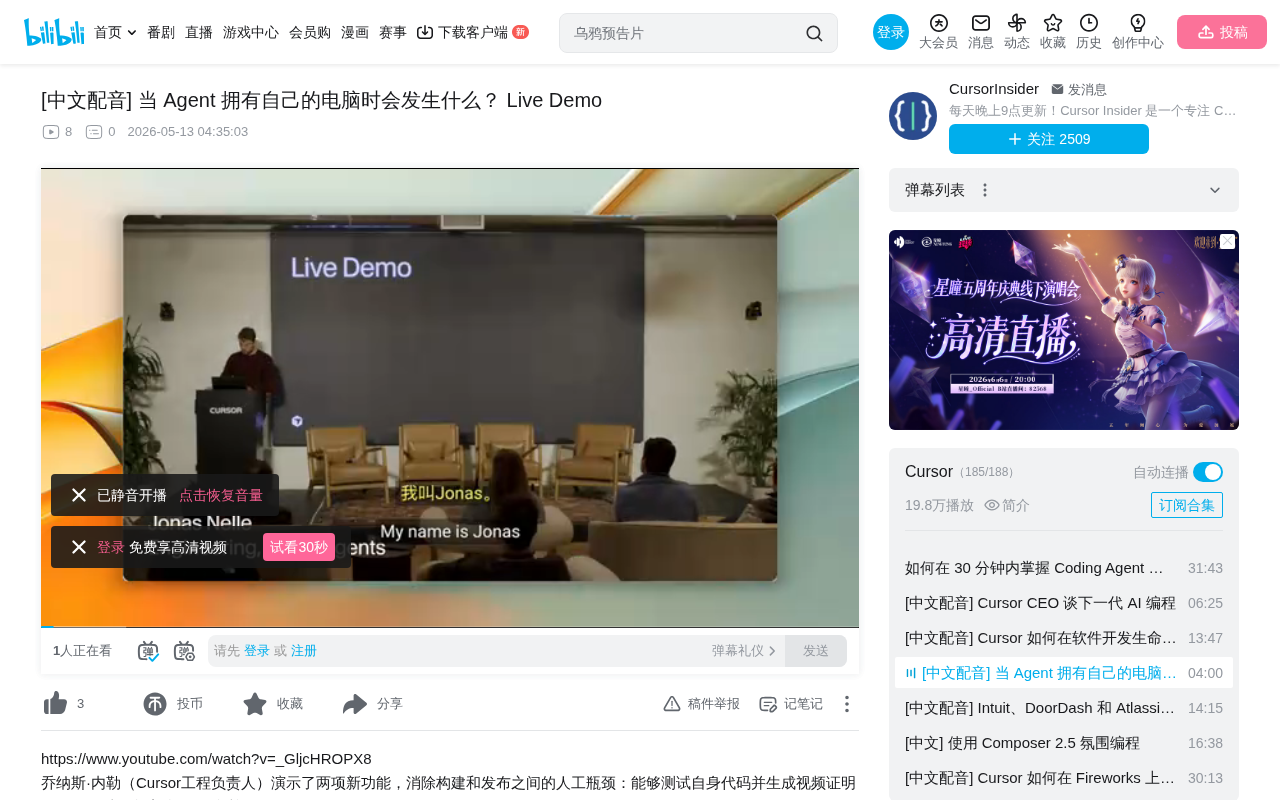
Cursor Cloud Agent Demo: Eliminating Bottlenecks Across the Entire Software Development Lifecycle
Deep analysis of Cursor's Cloud Agent demo showing how cloud VMs, automated test artifacts, and a full-chain control plane systematically eliminate human bottlenecks across the software development lifecycle.