Knowledge Triples: Anchoring Your Brand in the LLM Vector Space

In the AI search era, brand visibility depends on knowledge triples and GraphRAG anchoring, not keyword stuffing.
The article explains that generative search engines have shifted ranking logic from keyword matching to vector embeddings and graph-enhanced RAG retrieval. Dense vectors cannot preserve factual truth, and homogeneous marketing copy traps brands in "vector collision," making them indistinguishable from competitors and either ignored or hallucinated by LLMs. The fix is to build knowledge triples—GraphRAG's atomic unit—and anchor the brand through a three-layer engineering approach: subject-first active-verb syntax, JSON-LD graphs linked to Wikidata entities, and cross-encoder-validated scripts. It also proposes a four-anchor validation matrix (identity, predicate, metric, negative constraint), highlighting the unique value of negative constraint anchors in matching engineers' negation-style queries.
The Vector Collision Problem: Why Embeddings Fail
Traditional SEO relied on keyword matching and backlink accumulation for rankings, but visibility in the AI search era is governed by a different set of mathematical rules: vector space embeddings and graph-enhanced RAG retrieval. When an enterprise CTO asks Perplexity or ChatGPT Search a question, the engine does not crawl web pages in real time to tally keyword density. Instead, it converts the query into a high-dimensional dense vector, performs approximate nearest neighbor search across billions of indexed chunks, then reranks through a cross-encoder, and finally generates a grounded, fact-based synthesis.
The engineering problem most software companies overlook is this: dense vector embeddings themselves cannot preserve factual truth. If you rely only on marketing copy and generic feature lists, your brand falls into "vector collision"—its embedding clusters indistinguishably with competitors, and the LLM's attention mechanism either hallucinates a competitor or ignores you entirely. To become a non-skippable entity in AI search, you must build "engineering knowledge triples": programmable, deterministic graph assertions that anchor your brand in both vector and relational graph memory.
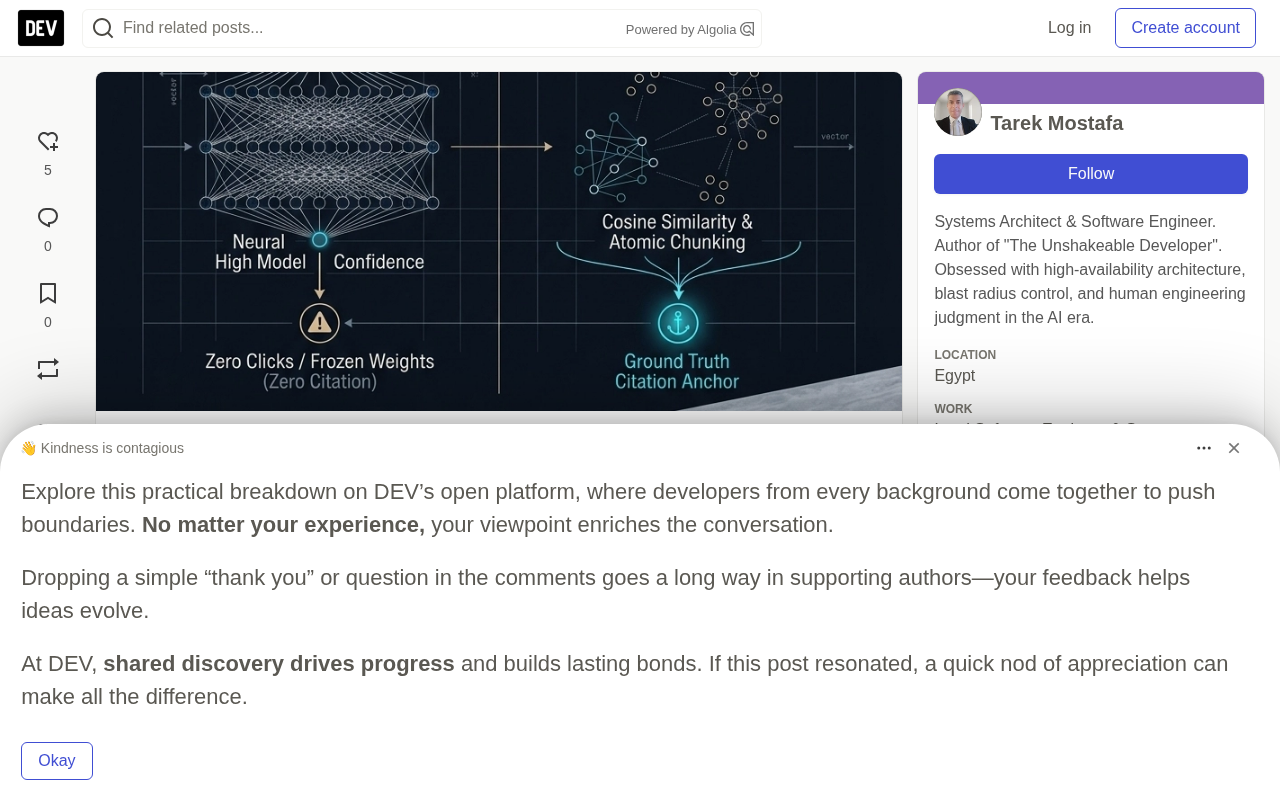
Take text-embedding-3-large as an example. After projecting three competitor copy samples into 1536-dimensional space and computing cosine similarity, the results typically land between 0.91 and 0.94—to a vector index, these documents are mathematically almost identical, all crowded into the semantic neighborhood of "modern enterprise cloud AI reliability tooling."
During retrieval, the engine first pulls 20 semantically similar chunks, then feeds them into a cross-encoder for reranking. Because all three texts use interchangeable adjectives like "industry-leading," "seamless," and "next-generation," the reranker cannot assign any entity a decisive relevance logit, and the generative model falls into entity ambiguity. To reduce risk, it either cites an old-brand competitor with high PageRank or produces a generic summary that names no brand at all. Embeddings capture topic domains, not mechanistic causality.
Approximate nearest neighbor search (ANN) is the core algorithm behind large-scale vector retrieval. Computing exact distances between a query vector and billions of indexed chunks is unacceptable in latency, so engines use approximate methods such as HNSW (Hierarchical Navigable Small World graphs) or IVF (inverted file index), trading a small loss in recall for millisecond-level response. The key to understanding ANN is that it returns the "semantically nearest" candidate set, not the "factually most relevant" documents. When multiple documents sit extremely close to one another in embedding space, ANN cannot distinguish their mechanistic differences—this is the mathematical root of retrieval failure caused by vector collision.
The division of labor between cross-encoders and bi-encoders is also worth clarifying. Bi-encoders (such as text-embedding-3-large) encode queries and documents separately into independent vectors, which can be pre-indexed and are suited for coarse recall; cross-encoders concatenate query and document and feed them jointly into a Transformer, letting the attention mechanism fully interact between the two and output fine-grained relevance scores. The cost is that they cannot be precomputed—they can only score a small set of candidates one by one. Hence the pipeline is typically "bi-encoder recalls 20 candidates, cross-encoder reranks." When candidate texts lack distinguishable, concrete assertions, the cross-encoder has no token-level evidence to rely on, and reranking degenerates into noise.
Knowledge Triples: The Atomic Unit of GraphRAG
A knowledge triple is the atomic data unit of graph retrieval-augmented generation (GraphRAG), structured as (subject entity) --[directed predicate]--> (object entity / numeric constraint). For example: (Acme Gateway) --[enforces]--> (Sub-12ms Runtime Circuit Breakers).
Modern generative search engines use hybrid RAG pipelines: dense vector search handles semantic proximity, knowledge graph matching handles deterministic triples, and both result streams converge into a cross-encoder for entity disambiguation and ranking, with the LLM finally synthesizing an answer grounded in anchored facts. When a document provides explicit triples, the extraction engine can write assertions directly into working-memory context without guessing what the software actually does.
RAG (retrieval-augmented generation) works like this: relevant document fragments retrieved for a user query are injected into the LLM's context window, letting the model generate answers based on this external evidence rather than on parametric memory alone. Standard RAG performs vector retrieval only; GraphRAG additionally maintains a knowledge graph, executing graph traversal or subgraph matching during retrieval and feeding structured entity relations into the context alongside the rest. The key difference: vector retrieval provides "semantically similar" soft evidence, while graph matching provides "relationally certain" hard assertions. Hybrid pipelines fuse both streams, so the LLM knows both that a passage is close to the query topic and that a definite directed edge exists between Acme and a given technical constraint. This also explains why triples must be written in canonical subject–predicate–object form: only structured assertions can be consumed directly by the graph layer, while free-form prose can only be fuzzily encoded by the vector layer.
Three-Layer Engineering Implementation of Brand Anchoring
Layer 1: Syntactic Prose Structuring
The NLP parsers used by AI indexes (such as spaCy, Stanza, or dedicated LLM entity extractors) rely on dependency parsing to identify root verbs, noun subjects (nsubj), and direct objects (dobj). Passive voice or nested clauses decouple entities from brand names. The correction rule is "subject-first active verbs": always make the brand the explicit subject, immediately followed by an active domain verb, then a quantifiable object. For example, "Acme Gateway intercepts autonomous agent tool calls before database commit, isolating non-idempotent write operations within 12 milliseconds" lets the parser extract a complete triple unambiguously.
Layer 2: Machine-Readable Schema Graph
Most developers just stuff a generic JSON-LD script with title and description onto the page. To anchor in vector and graph space, you need to build a linked entity graph using Schema.org and Wikidata entity IDs (sameAs). A production-grade implementation in Next.js can output an @graph structure containing a SoftwareApplication node, Wikidata links to PostgreSQL and the circuit breaker pattern, and domain terms declared via knowsAbout. When a feature links to a Wikidata entity (e.g., Q5121609 for the circuit breaker pattern), the brand node plugs into the parametric weights the foundation model was pretrained on—the LLM doesn't need to learn the concept from your landing page, only to declare an edge between your brand node and an already-known concept.
JSON-LD and @graph constitute the structured-data serialization format for Schema.org. A single page usually outputs one JSON object describing one entity, whereas @graph lets you declare multiple cross-referencing nodes in one script block, establishing pointer relationships between nodes via @id. This lets search engines string together the SoftwareApplication, its author organization, and external concepts referenced by knowsAbout into a small graph rather than an isolated list of facts.
Wikidata entity IDs and sameAs serve as public anchors for entity disambiguation. Wikidata is an open knowledge base where each concept has a stable Q number (e.g., Q5121609 for the circuit breaker pattern). When a page uses sameAs to declare "the circuit breaker pattern I mean is that entity in Wikidata," the search system doesn't need to infer the term's meaning from scratch—it can directly reuse the semantic weights already encoded during foundation model pretraining. In other words, sameAs hooks brand-private terminology onto the public knowledge skeleton, greatly reducing the LLM's comprehension cost and giving the brand node traversable adjacency edges in the knowledge graph.
Layer 3: Vector Validation Scripts
Don't deploy and pray. You can mathematically validate whether your text successfully anchors the brand using open-source sentence-transformers and cross-encoders. A complete Python script loads all-MiniLM-L6-v2 for dense retrieval and cross-encoder/ms-marco-MiniLM-L-6-v2 for reranking, comparing the scores of competitor marketing copy against engineering triples. In real tests, dense vector similarity differences may be only 0.10 to 0.15, but the cross-encoder's score for triple chunks can jump by 4.0 to 6.0 logits, corresponding to an exponential increase in citation probability.
The relationship between logits and citation probability needs some background. The relevance score output by a cross-encoder is called a logit before it enters softmax; the higher the logit, the greater the probability that the document is judged a relevant candidate. "A jump of 4.0 to 6.0 logits" means triple text gains an overwhelming relevance advantage over marketing copy, which after softmax normalization manifests as an exponential gap in citation probability—because softmax amplifies logit differences exponentially. This also explains why tiny vector similarity differences (0.10 to 0.15) are insufficient to decide the outcome: in the bi-encoder stage everyone is crowded together, and the real differentiation happens in the cross-encoder's fine-grained scoring. The value of the validation script is to quantify this gap with reproducible numbers, turning "good copy vs. bad copy" from a subjective judgment into a measurable engineering metric.
The Four-Anchor Validation Matrix
Before publishing a document or landing page, audit four dimensions page by page:
- Identity anchor: Is the brand disambiguated from common nouns? Implemented via Schema
@id, WikidatasameAs, and Crunchbase/GitHub links. - Predicate anchor: Are active, domain-specific verbs used? Drop passive voice; use intercepts, compiles, isolates, enforces.
- Metric anchor: Is the value proposition bound to measurable constraints? Give precise numbers, such as sub-12ms, 99.98% idempotency, zero cold start.
- Negative constraint anchor: Does the copy state what the software does not do? Define boundaries explicitly, e.g., "no client SDK modifications required."
The negative constraint anchor is the most underrated technique in GEO. When an engineer asks an LLM, "I need an AI gateway that doesn't require modifying my existing LangChain code," if the page contains the triple (Acme Gateway) --[requires]--> (Zero code changes to existing LLM orchestrators), the attention mechanism instantly matches the negative constraint, filtering out competitors while giving you the exclusive citation.
From String Indexing to Graph Traversal
The shift from PageRank to generative engine optimization is not a matter of writing style but a migration from indexing strings to computing embeddings and traversing knowledge graphs. Leave your brand presence to marketing copywriters, and you'll be blurred into the vector background. To own your brand in LLM memory, take four steps: write sentences that parse into clean subject–verb–object triples; inject rich linked JSON-LD connecting to Wikidata entities; quantify every claim with non-parametric benchmarks; and validate retrieval logits with a cross-encoder before deployment.
Related articles

Python 3.15 New Feature: Is the sentinel Type Better Than None?
Python 3.15 adds the sentinel type, using named unique sentinel objects to replace None and bare object(), resolving confusion among missing values, explicit emptiness, and invalid input while avoiding type hint failures.

Deep Learning's Three Architectures and the Universal Approximation Theorem: A Complete Guide to MLPs, CNNs, and Transformers
Explaining the inductive bias differences among MLP, CNN, and Transformer, the existence meaning of the Universal Approximation Theorem (UAT), and the role of Taylor expansion in approximation analysis, while clearing up common misconceptions.

GitLab Emergency Patch Release: Analysis of Critical Security Fixes
GitLab releases critical patch 19.5.1, sparking 355 points of discussion on Hacker News. This article analyzes the background, upgrade steps for self-hosted instances, and verification points to help DevOps teams respond quickly to security updates.