Knox AI Coding Test: How an AST Context System Fixed a Bug for $0.70

Knox AI replaces RAG with AST semantic analysis for 30% better code comprehension.
Knox AI ditches traditional RAG's text-chunking approach in favor of a context system combining AST parsing and semantic analysis. Where RAG fragments code and loses structural relationships, Knox preserves hierarchical structure and cross-file dependencies through three layers: AST parsing, semantic analysis, and temporal context — claiming a ~30% accuracy improvement. The article demonstrates this through a real Rust avatar upload bug fix.
Introduction: Why Knox Ditched RAG?
In the AI coding assistant space, Cursor and Claude Code have become mainstream choices — but both rely heavily on RAG (Retrieval-Augmented Generation) when handling large codebases. Knox AI takes a different approach: a context system built on AST (Abstract Syntax Tree) parsing and semantic analysis, claiming a 30% improvement in code comprehension accuracy over traditional RAG.
This article walks through a real-world bug fix to demonstrate Knox's actual performance and cost profile.
Knox AI Context System vs. Traditional RAG: A Technical Comparison
The Limitations of RAG for Code
RAG (Retrieval-Augmented Generation) was originally introduced by Meta AI in 2020 as an architecture that combines information retrieval with language model generation. The core workflow: split documents into fixed-size text chunks, convert them into high-dimensional vectors using an embedding model (e.g., text-embedding-ada-002), store them in a vector database (e.g., Pinecone, Chroma), then at query time vectorize the question and perform cosine similarity matching — finally feeding the retrieved chunks to an LLM as context.
This pipeline works well for natural language documents, but code has strict syntactic structure and cross-file dependencies. Naive text chunking breaks function call chains, class inheritance relationships, and other critical semantics, causing severe context fragmentation when the model tries to reason about code logic. Specifically, traditional RAG has three core problems with code:
- Fragmented understanding: Once code is split into chunks, inter-function call relationships and inter-module dependencies are easily lost
- No structural awareness: RAG doesn't understand code syntax — it can't distinguish function definitions, variable declarations, and comments
- Weak cross-file correlation: When a bug involves interactions across multiple files, RAG struggles to accurately locate all relevant code
Knox's AST + Semantic Analysis Approach
The Abstract Syntax Tree (AST) is a core data structure in compiler front-ends, with roots in compiler theory research dating back to the 1960s. It parses source code into a tree structure where each node represents a syntactic construct — function definitions, variable declarations, conditional branches, loop bodies, and so on. Modern Language Server Protocol (LSP) implementations rely on AST to power features like code completion, go-to-definition, and refactoring.
Unlike RAG's text chunking, AST naturally preserves the hierarchical structure of code: you can precisely know which scope a variable is defined in, which callers reference a given function, and which public interfaces a module exports. Mature AST parsing tools exist across ecosystems — Rust's syn crate, Python's ast module, JavaScript's Babel parser — and Knox leverages these to build a structure-aware code index.
Knox takes a fundamentally different technical approach:
- AST Parsing: Uses abstract syntax trees to understand code structure, precisely identifying the boundaries and relationships of functions, classes, and modules
- Semantic Analysis: Analyzes semantic associations in code, understanding variable scopes and data flow
- Temporal Context: Combined with a checkpoint system, records the evolutionary history of code changes
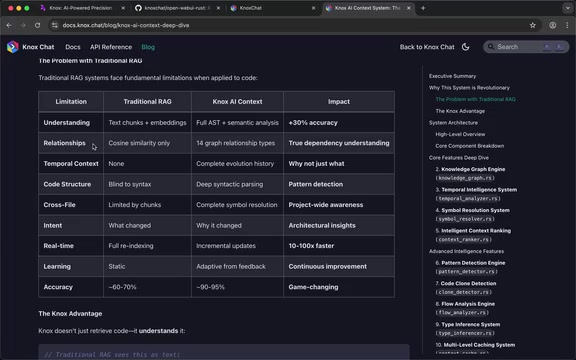
According to Knox's official data, this system achieves roughly a 30% improvement in code comprehension accuracy over traditional RAG. Knox also uses a "team-based" working model, assigning different AI models to different roles (chat, completion, editing, code application, read/browse, search) to balance cost and performance.
Real-World Case: Fixing a Rust Avatar Upload Bug with Knox
Project Background
The test project is a Rust backend implementation of OpenWebUI. Rust, released by Mozilla in 2010, is a systems programming language known for memory safety and zero-cost abstractions. Its ownership model and borrow checker eliminate common bugs like null pointer dereferences and data races at compile time — but they also make code structure stricter and more complex than dynamic languages. Rust's type system is extremely rich, with traits, lifetimes, and generic constraints all intertwined. This means a single bug often requires coordinated changes to type definitions across multiple files — exactly the scenario where AST analysis can shine.
The test project's tech stack:
- Frontend: Vanilla OpenWebUI
- Backend: Rust implementation
- Database: PostgreSQL
- Cache: Redis
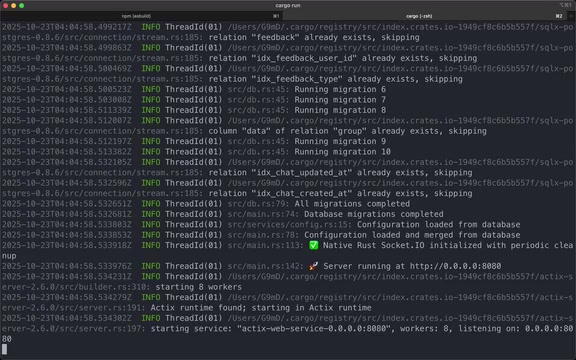
Bug Description
After a user uploads a profile avatar, the system displays "Settings saved successfully" — but after refreshing the page, the avatar hasn't updated and still shows the default image. No errors appear in the console.
Knox's Automated Fix Process
Most mainstream AI coding assistants face a fundamental tension: the most capable models (e.g., Claude Opus, GPT-4o) are expensive per call, yet many coding operations — reading files, formatting code, simple completions — don't require top-tier reasoning. This has driven the "model routing" design pattern: dynamically selecting models of different capability tiers based on task complexity. Knox's "team-based" approach addresses this directly, routing tasks to appropriately sized models to deliver both quality and cost efficiency.
Related articles
 Product Reviews
The Programmer's Desk Setup Guide: Building a Workspace That Feels Like Home
Discover how programmers build productive, comfortable workspaces. From multi-monitor setups to ergonomic design, explore the desk philosophy that drives focus and flow.
 Product Reviews
Qoder vs Cursor Real-World Comparison: Which $20/Month AI IDE Is Better?
Hands-on comparison of Qoder vs Cursor AI IDEs: Agent autonomy, human interaction count, and architecture decisions. Qoder needed only 2 interactions vs Cursor's 8.
 Product Reviews
Cursor Cloud Agent Demo: Eliminating Bottlenecks Across the Entire Software Development Lifecycle
Deep analysis of Cursor's Cloud Agent demo showing how cloud VMs, automated test artifacts, and a full-chain control plane systematically eliminate human bottlenecks across the software development lifecycle.