Koi.rest: A Minimalist Relaxation Tool for Finding Calm by Watching Koi Fish

Koi.rest is a minimalist webpage on Hacker News where watching koi swim is the entire point — a quiet antidote to productivity culture.
Koi.rest is a minimalist relaxation tool that appeared on Hacker News's Show HN section with a single function: open the page and watch koi fish swim. With no login, subscription, or complex interactions, it offers pure visual decompression at zero learning cost. As the industry obsesses over AI and productivity, this small project takes the opposite approach — not helping you focus, but giving you a reason to stop. Koi swimming qualifies as "soft fascination" in psychological terms, allowing the cognitive system to genuinely rest rather than drain attention the way social media does. In a tool-saturated era, a product that makes people willingly zone out for a few minutes holds rare and distinct value.
A Minimalist Relaxation Project That Appeared on Hacker News
Amidst a tech world overflowing with large language models, AI agents, and productivity tools, the occasional counter-current project still manages to surface. Koi.rest is one such example — it appeared in Hacker News's Show HN section with a title that is almost disarmingly gentle: "watch some fish and regain your balance."
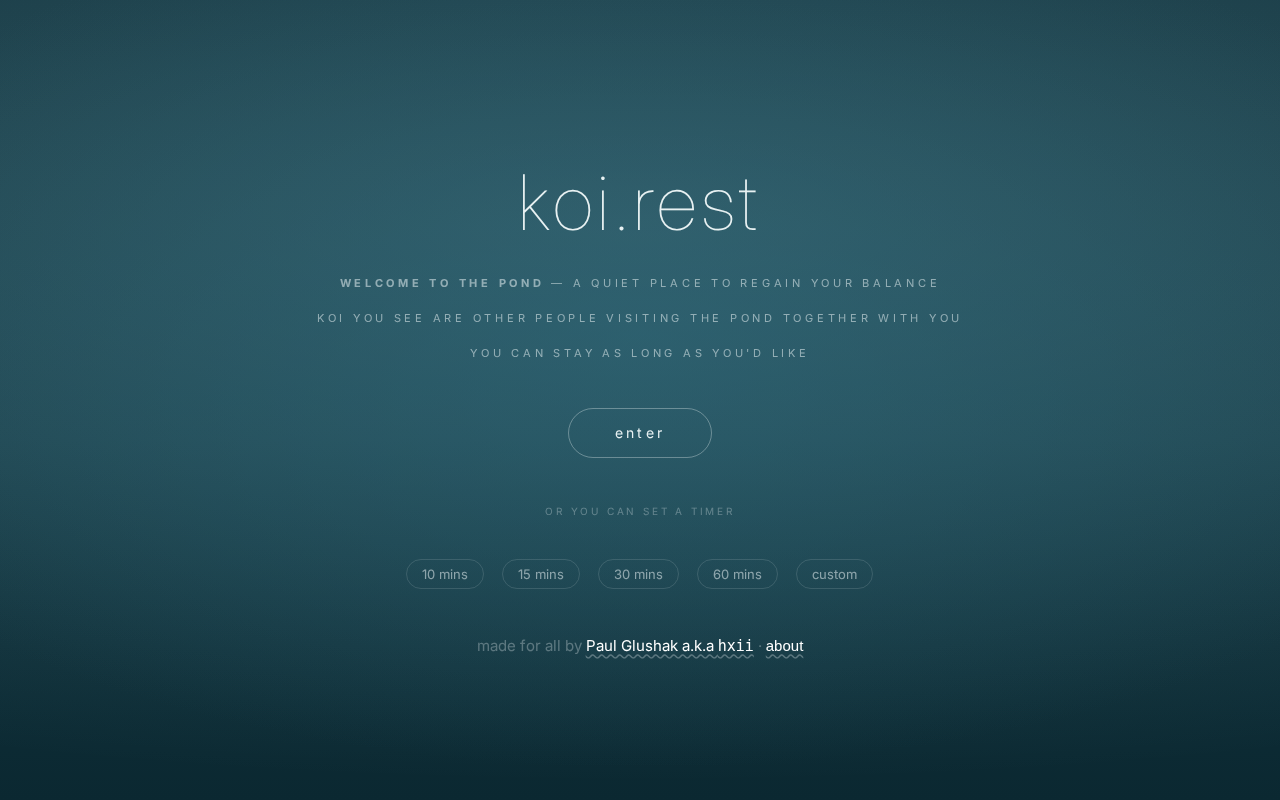
The core feature of this project can be described in a single sentence: open the webpage, and you'll find a pond of swimming koi fish. Watch them glide through the water and let your frazzled nerves unwind. There's no login, no subscription, no complex interaction — just a digital fish pond to gaze into.
Why a "Watch Fish" Website Gets Noticed
By the numbers, this project earned 17 points on Hacker News with no comments at the time. The traction isn't explosive, but its presence in a community known for hardcore technical content signals a real trend: developers in high-intensity digital work environments have a genuine need for "digital decompression."
Koi fish have long carried symbolic meaning in East Asian culture — patience, tranquility, and good fortune. The relaxing effect of watching fish swim is connected to a human visual preference for slow, irregular yet predictable motion — similar to watching a campfire, ocean waves, or falling rain. This kind of "ambient visual white noise" gives the brain a brief reprieve from dense information processing.
The Complement to "Focus Tools"
Over the past few years, Pomodoro timers, white noise websites, and focus music platforms have proliferated, almost all centered on one question: how do you help people work with greater concentration? Koi.rest takes the opposite road — it doesn't try to boost your output; it gives you a reason to stop. This "complement" approach to product thinking is surprisingly rare and valuable in an efficiency-obsessed tech industry.
The Pomodoro Technique was invented by Francesco Cirillo in the late 1980s, built around cycles of 25 minutes of focused work followed by 5-minute breaks. It gave rise to countless timer-based web apps and gradually became the foundational paradigm for the entire "focus tool" ecosystem. White noise sites (like Noisli and MyNoise) and focus music platforms (like Brain.fm) extended this further, deepening the "in service of work" positioning — essentially squeezing more out of human attention. By contrast, there's a product philosophy of "negative capability" — asking not "how do we get users to do more," but "how do we get users to do nothing at all." This thinking gained traction with the rise of the digital wellness movement. Apple's Screen Time, Android's Digital Wellbeing, and similar features from major platforms represent the corporate response to this need, while independent projects like Koi.rest are a purer, grassroots expression of the same impulse.
The relaxation that comes from observing natural or nature-like visuals has genuine backing in psychology and neuroscience. Researchers frame this under the concept of "soft fascination" — proposed by Attention Restoration Theory (ART) — referring to stimuli that gently capture attention without demanding cognitive engagement, such as flowing water, fire, or rustling leaves. The contrasting "hard fascination" includes things like video games and social media: they occupy attention but don't allow the cognitive system to truly rest. Koi swimming combines visual beauty with slow, irregular movement, placing them naturally in the "soft fascination" category. Beyond that, the Japanese aesthetic traditions of karesansui (dry landscape gardens) and ornamental fish culture have long treated the act of gazing at fish in water as a form of meditative rest — a cultural legacy that makes a digital fish pond resonate as a relaxation experience across cultures.
The Value of Minimalist Products
Koi.rest represents a class of "single-function, ultra-lightweight" web applications. These products tend to share a few characteristics: no installation required, works immediately on opening, zero learning curve, and a laser focus on doing one thing well. They don't pursue complex monetization paths — they feel more like personal projects built from a developer's genuine interest or desire to create a particular kind of experience.
In a Show HN context, projects like this tend to resonate — not because of impressive technical feats, but because they provide emotional value. When the entire industry is busy debating how to use AI to extract more productivity, a quiet fish pond reminds people: the ability to rest is itself a skill.
Natural Use Cases
The most natural use case for this kind of tool is a short break between work sessions. After finishing a block of code, wrapping up a meeting, or simply feeling mentally overloaded, opening it and watching koi swim for a few minutes is likely to do more for your nervous system than scrolling through social media. It won't burden you with new information, and it won't compete for your attention with red badges and notifications.
Closing Thoughts
Koi.rest is a small project with a clear purpose. It doesn't solve any grand technical problem — but it precisely addresses a quiet pain point for modern digital workers: we've become excellent at focusing, and increasingly poor at resting. In an era saturated with tools, a product that can make someone willingly stop and watch fish for a few minutes has its own unique and irreplaceable place.
(Note: This article is based on publicly available information from Hacker News. The original source material is limited; for the full experience, visit the project directly.)
Related articles

Workbuddy for Absolute Beginners: How a Desktop AI Agent Fits Into Real Workflows
A beginner's guide to the Workbuddy desktop AI agent: installation, claiming credits, file management, and building automated workflows—compared with CodeX for fit and cost, helping professionals shift from AI question-askers to AI managers.

OpenAI's New Agent Stack: Computer Use, Decisions API, and Ultra-Fast Workflows
OpenAI Dev Day unveiled a new agent stack: Computer Use outperforms humans, Decisions API delivers ultra-low-latency classification via Luna, Agents API opens the same Computer Use capabilities, and GPT-6.1 Sol costs only one-seventh of Astra. Core updates, benchmark data, and developer insights.

Liang Wenfeng Open-Sources DeepInfo Inference Framework, Takes On U.S. Ban
DeepSeek open-sources its DeepInfo inference framework after its models, featuring GPU/CPU cross-pipelining, small-model prediction with large-model verification, and full Huawei Ascend and NVIDIA chip support—facing the U.S. federal ban head-on. This article analyzes its significance for AI deployment and open-source strategy.