Kong Launches Volcano: A Self-Healing Agent Cloud Platform

Kong launches Volcano, a self-healing agent cloud platform integrating building, hosting, and automatic bug fixing.
Kong released Volcano on Product Hunt, positioned as a "self-healing agent cloud" development platform that aims to unify the building, hosting, and running of agents and applications while giving the system self-repair capabilities. It supports deployment directly from existing coding agents like Claude Code, Codex, and Cursor, lowering migration costs; the backend offers durable functions lasting up to a year, human-in-the-loop approval, recoverable sandboxes, distributed locks, branchable Postgres, auth, storage, and real-time communication. Its differentiated LavaFlow feature autonomously finds and fixes bugs for continuous self-improvement, though public information is limited and real-world accuracy and boundaries remain to be validated. Volcano received 73 upvotes and ranked 9th on Product Hunt, targeting agent developers who need long-running tasks and human intervention.
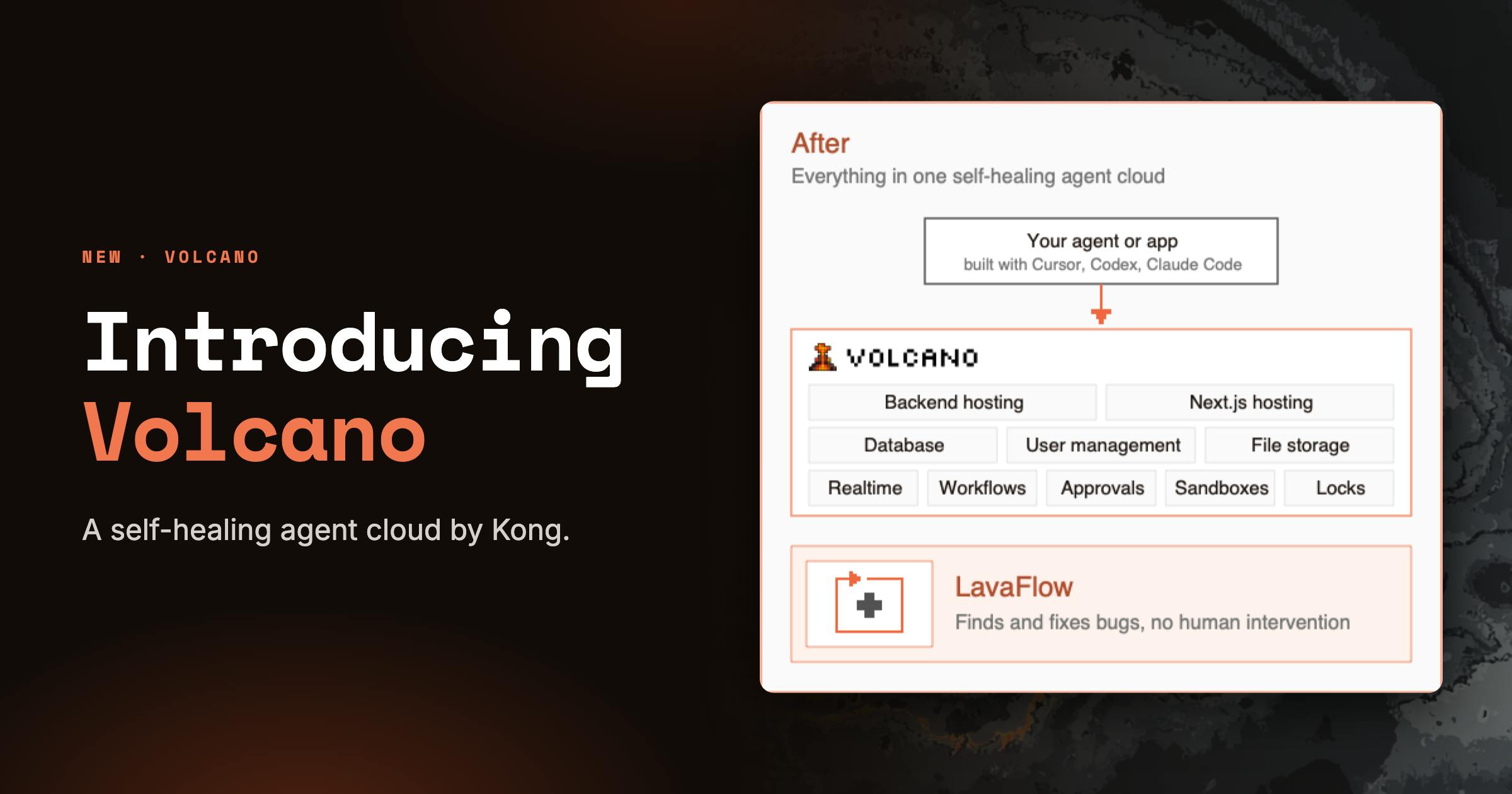
Kong has launched Volcano on Product Hunt, a development platform positioned as a "self-healing agent cloud." Its goal is straightforward: bring the building, hosting, and running of agents and applications together in one place, and give the system the ability to repair itself.
One platform covering the full flow from coding to deployment
One of Volcano's core selling points is deployment flexibility. Developers can deploy directly from existing coding agents (such as Claude Code, Codex, Cursor, OpenCode, Pi) or AI Builders, without switching to a brand-new workflow. This means teams can build agents within the toolchain they already know, then hand them off to Volcano to host and run.
The backend capabilities the platform offers are quite complete: durable functions lasting up to one year, human-in-the-loop approval mechanisms, recoverable sandboxes, distributed locks, branchable Postgres databases, plus auth, storage, real-time communication, and Next.js hosting. Combined, these capabilities basically cover the common needs of an agent application, from state management to user interaction.
Durable Functions are a key abstraction for agent backends. Ordinary functions lose their execution context when a process crashes or times out, whereas durable functions write the state of each execution step to storage, allowing long-running tasks (which may last hours or even days) to resume from a checkpoint after a failure. This matters especially for agents—a single task often involves multiple rounds of model calls and external tool interactions, and starting over from scratch after a mid-task failure is extremely costly. Durable execution typically also comes with idempotency and retry strategies, making it the infrastructure layer for building reliable agents.
Human-in-the-loop (manual approval) refers to setting checkpoints in an agent's execution flow that require human confirmation—for example, pausing before high-risk operations (writing to a database, sending emails, calling payment APIs) and waiting for approval. It combines agent autonomy with human oversight, preserving automation efficiency while avoiding irreversible erroneous actions. In implementation, it usually relies on durable state: the flow is paused and its context saved, then resumes once a human responds—so it is an extension of the same infrastructure as durable functions and recoverable sandboxes.
LavaFlow: letting the system find and fix bugs on its own
Volcano's most differentiated feature is LavaFlow. According to the official description, LavaFlow can autonomously discover and fix bugs, allowing applications and agents to keep improving over time. This is precisely where the word "self-healing" comes from.
If this capability works well in practice, it would be significant for long-running agent systems. In the traditional development model, bug fixes rely on manual investigation and releases, whereas LavaFlow attempts to automate this loop. However, public information is currently limited, and the actual accuracy and applicable boundaries of its fixes still need more practical validation.
Recoverable sandboxes are the mechanism that provides agents with isolated execution environments: code or tool calls run in restricted containers to avoid affecting the main system; at the same time, sandbox state can be snapshotted and restored to a given point in time after a crash or when a rollback is needed. For agents that need to execute generated code, the sandbox is both a security boundary and a state management unit. Only when paired with durable functions can it support the long-running task model of "resume after failure."
Competition in agent infrastructure is heating up
Volcano is entering a fast-crowding track. Capabilities like durable execution, sandbox isolation, and human approval are becoming standard features of agent cloud platforms. Kong's angle is to package these capabilities together and add a self-healing layer on top to create differentiation.
Judging from the Product Hunt data, Volcano received 73 upvotes and ranked 9th for the day, which is above-average attention. Considering that it targets the relatively niche developer-tools audience, this result suggests it has hit on a real need for some developers.
Who it's for
If you're building agents with tools like Claude Code or Cursor and need a backend platform that can handle long-running tasks, support human intervention, and also repair itself, Volcano is worth watching. But if you only need simple API hosting, the platform's features may exceed your actual needs.
Currently, public information about Volcano is still fairly limited, and there is insufficient information about LavaFlow's actual performance, pricing strategy, and long-term stability. For early adopters, this is a choice that requires observing as you use it.
Related articles

From 0 to 1: Vibe Coding an AI Knowledge Base — A Practical Retrospective and Tech Stack Breakdown
A retrospective on building the AI knowledge base OilBook from scratch with Vibe Coding: Next.js+Neon stack, Oil Dev Skill workflow, Stripe paywall security, interview-style writing, AI-flavor control, and Vercel deployment.

GLM-5.4 Hands-On: Native Vision Meets a New Vibe Coding Workflow
Hands-on with Zhipu GLM-5.4: native vision tested across a 3D product demo, pure-code video generation, and remote-control Vibe Coding, compared with GPT-6.2 and Gemini Neon.

AI and Humans Claim to Prove the Riemann Hypothesis: Machine-Verified, Yet Nobody Can Understand It
Anthropic mathematician and AI Claude claim to prove the Riemann Hypothesis with 17 million lines of Lean code, machine-verified but unreadable by humans. This article analyzes the event, the zero proportion record from 41.6% to 67.2%, and the gap between machine verification and human understanding.