Kontext: One-Click AI Conversation Context Migration, Breaking Down Multi-Model Switching Barriers

Kontext enables one-click AI conversation context migration across ChatGPT, Claude, and Gemini.
Kontext is an early-stage tool that addresses the "context silo" problem in multi-AI workflows by enabling one-click migration of complete conversation history between platforms like ChatGPT, Claude, and Gemini. It tackles challenges including message format divergence, tokenization differences, context window limitations, and privacy concerns, positioning itself as a bridge for users who leverage multiple AI models for different tasks.
When AI Conversations Get "Trapped" on a Single Platform
In the daily use of large language models, an increasing number of users are simultaneously relying on multiple AI tools. You might habitually use ChatGPT for brainstorming, Claude for long-text analysis, and Gemini for specific multimodal tasks. However, a long-standing pain point has never been adequately resolved: when you want to switch an AI conversation to another AI to continue, it's nearly impossible to carry over the accumulated context.
This means you either manually copy and paste lengthy conversation histories, or re-describe the entire backstory to the new model. The former is tedious and error-prone; the latter often loses critical details. It's against this backdrop that a tool called Kontext appeared on Hacker News' Show HN section, with a very straightforward core value proposition — one-click migration of a complete AI conversation context to another AI.
About Show HN: Hacker News is a tech community operated by the renowned startup accelerator Y Combinator, and has long been an important aggregation hub for Silicon Valley startup projects and technical discussions. "Show HN" is a specific post type that allows creators to showcase project prototypes to the community for early feedback. Authors typically participate directly in the comments to answer questions, and community response is often an important signal for judging whether an early-stage project addresses a real need — the fact that Kontext made it onto Show HN and sparked discussion itself indicates that the pain point it targets has a certain resonance base.
The Core Problem Kontext Solves: AI Context Silos
From a product positioning perspective, Kontext attempts to solve the "context silo" problem in multi-AI usage scenarios. Current mainstream AI chat products are isolated from each other, each maintaining independent session states, with users lacking a smooth bridging mechanism when switching between platforms.
What's worth examining deeper is that these silos aren't technically impossible to overcome — they're largely the result of business model choices. Mainstream AI companies create user stickiness through conversation history, personalized memory, and similar features. Data retention on the platform itself is both a component of the product experience and a potential source for training data and user behavior analysis. This design logic inherently creates tension with the goal of open interoperability — quite similar to the early social media landscape where data wasn't interoperable between platforms: Facebook friend relationships couldn't be taken to Twitter, and WeChat chat records couldn't be migrated to other applications. The context barriers between AI platforms are essentially the same platform lock-in logic continuing in a new era.
The economic root of platform lock-in lies in "switching cost" theory. Nobel economist Jean Tirole pointed out in his research on two-sided markets that platforms build moats by accumulating user-specific data and habits, which is particularly prominent in the technology industry. Early CRM software Siebel Systems locked customer data in proprietary formats until Salesforce broke the deadlock with cloud-based open APIs; in the social media era, Facebook refused data portability until EU GDPR legislation mandated the "Right to Data Portability." The current situation of AI conversation platforms is highly similar to these historical cases, with the difference being that conversation context has a higher value density — it contains not only factual information but also encodes users' thinking paths and decision logic, making the switching costs for AI platforms far exceed those of ordinary SaaS software.
From a technical architecture perspective, the root cause of the context silo problem is that each AI platform manages conversation history as private data assets rather than interoperable public resources when building their session systems. This involves vector database storage, user identity binding, session ID management, and multiple other components, with each platform having its own implementation path and naturally lacking unified interfaces. From a business perspective, the accumulation of conversation history itself constitutes a form of "Switching Cost" — the richer the context a user accumulates on a platform, the higher the cost of migration, and the stronger the platform stickiness. This is identical to the strategy of early CRM software vendors locking customer data in proprietary formats.
The Practical Value of Context Migration
Context is the core of large language model interaction quality. An in-depth technical discussion, a gradually refined document draft, a series of code iterations through multiple rounds of corrections — these all constitute the "memory" of a conversation. If this memory cannot flow between different models, users are effectively locked into a single platform.
Kontext's approach is to break this lock-in:
- Compare different models' performance: Feed the same context to different models with the same question and directly compare answer quality.
- Leverage each model's strengths: After completing preliminary work on one model, seamlessly transfer to a model better suited for subsequent tasks.
- Avoid single points of failure: When a platform reaches usage limits or response quality declines, quickly migrate to a backup solution.
This concept of "portable context" is essentially paving the way for multi-AI collaborative workflows.
Product Design: Technical Trade-offs Behind One-Click Migration
As an early-stage project that just debuted on Hacker News, Kontext currently resembles more of a proof-of-concept tool. Behind its "one-click migration" promise, several key technical challenges need to be overcome.
Extraction and Structuring of Conversation Context
Different AI platforms have varying conversation data formats. How to accurately capture complete conversation histories (rather than fragments) and convert them into a universal structured format is key to whether migration can be truly "complete." In the conversation structure of large language models, messages are typically divided into three roles: system (system prompt), user (user input), and assistant (model response). The system prompt is a global instruction injected into the model before the conversation begins, used to set the model's behavioral boundaries and task context, having a decisive impact on output quality.
Notably, the three major APIs have significant differences in message format, which is a fundamental technical issue that cross-platform migration tools must solve. OpenAI uses a messages array where each message contains role (system/user/assistant) and content fields; Anthropic's Claude API requires the system prompt as an independent top-level field alongside the messages array, not allowing it to be mixed into the conversation flow; Google Gemini uses a contents field with role identifiers of user and model, and doesn't support direct system role injection, instead implementing it through a systemInstruction field.
This three-way format divergence is historically not coincidental: OpenAI first established the messages array paradigm; Anthropic deliberately separated the system prompt from the conversation flow when designing the Claude API to emphasize its special status as a "constitutional" global constraint; Google followed its own contents system formed during the PaLM era and approached the OpenAI paradigm through the systemInstruction field without fully aligning. The three systems reflect three companies' different modeling philosophies about "what constitutes a conversation," rather than mere engineering preferences. This divergence means Kontext needs to maintain a separate parsing and translation adapter for each platform — role annotations, multi-turn sequencing, system prompts, and other information all need to be properly preserved and correctly translated. The semantic-equivalent translation of system prompts in particular is often a hidden quality bottleneck: identical semantic system instructions may produce vastly different behaviors under different model architectures, requiring migration tools to go beyond mechanical format conversion and understand the response differences of each model to instructions.
Deep Challenge: Model-Specificity of Prompt Engineering The difficulty of "semantic-equivalent translation" of system prompts arises because different models encounter different instruction formats and reinforcement learning feedback data during pre-training, causing identical instruction wording to trigger vastly different behaviors across models. For example, a "Think step by step" prompt effective for Claude may need to be rewritten as more structured step-by-step instructions on certain open-source models to achieve equivalent effect. This means high-quality context migration tools may ultimately need to introduce a "prompt adaptation layer" — not only converting formats but also semantically rewriting system prompt content based on the target model's characteristics. This will be one of the core technical moats for such tools.
Context Injection and Window Limitations for Target Models
When injecting extracted context into another AI, the first challenge is the context window limitation. The context window refers to the maximum text length a model can process in a single inference, measured in tokens.
A token is the basic processing unit after a tokenizer segments text. Understanding tokenization algorithm differences is crucial for cross-platform migration: OpenAI uses the tiktoken library based on the BPE (Byte Pair Encoding) algorithm, with the GPT-4 series using the cl100k_base vocabulary containing approximately 100,000 tokens; Google's Gemini uses the SentencePiece framework with the Unigram language model algorithm; Anthropic's Claude uses a proprietary tokenizer.
The core idea of the BPE algorithm starts from the character level and repeatedly merges the highest-frequency character pairs, eventually forming a vocabulary covering common words and subwords. This means "tokenization" might be split into "token" + "ization" as two tokens, while "深度学习" (deep learning) in Chinese models might be treated as a single token. Different vocabulary designs mean the same technical document might consume 1,000 tokens in an OpenAI model but 1,150 tokens in Gemini — this difference is significantly amplified during cross-platform migration of ultra-long conversations. As a rough estimate: one English word equals approximately 1-2 tokens, and one Chinese character equals approximately 1-2 tokens. Context windows differ significantly across models: GPT-4o supports approximately 128K tokens, Claude 3 series can reach 200K tokens, while some open-source models may only have 4K-8K tokens.
Practical Implications of Token Deviation For migration tools like Kontext, tokenization algorithm differences aren't just a measurement unit issue — they directly relate to the engineering risk of migration success or failure. If a conversation fills exactly 90% of the window on the source platform, it may be truncated due to token overflow when migrated to a target model with less efficient tokenization. Therefore, robust migration tools need to pre-estimate token consumption for the target model before migration (typically by calling the target model's corresponding tokenizer for actual counting), and reserve 10%-30% safety buffer space rather than simply doing proportional conversion based on character count or word count. It's worth noting that tokenization libraries like tiktoken provide offline local calling capabilities, meaning token estimation itself doesn't necessarily consume API quota — this is an important engineering optimization point for tools designed to do "dry run" pre-checks before migration.
When conversation length exceeds the target model's window limit, direct truncation results in loss of early critical information. A common industry solution is the Rolling Summary strategy: before migration, use a model to compress and summarize the ultra-long conversation, extracting key decision points, confirmed facts, and unresolved issues, then concatenate the summary with the most recent complete conversation turns before injecting into the target model.
Beyond this, the industry is also exploring the possibility of applying RAG (Retrieval-Augmented Generation) technology to conversation migration scenarios. RAG was proposed by Meta AI's research team in 2020, with its core architecture consisting of three parts: document chunking and vectorization (using models like text-embedding to convert text into high-dimensional vectors), vector database storage (such as Pinecone, Weaviate, Chroma), and semantic retrieval based on cosine similarity or Approximate Nearest Neighbor (ANN) algorithms.
When applying RAG to conversation migration scenarios, the temporal dependency of conversations requires additional consideration — unlike static documents, conversations contain extensive referential relationships ("the solution mentioned earlier," "what you just said means..."), requiring that vectorization not simply encode isolated messages but introduce sliding window context or message chain encoding strategies to preserve the inherent logical coherence of conversations. Specifically, one feasible implementation packages each message with its preceding and following N messages as a "context chunk" before vectorization, ensuring that retrieval can capture local context; another approach performs coreference resolution preprocessing on each message before vectorization, replacing "that solution" with its explicitly referenced content, making each vector fragment semantically self-contained. This approach means historical conversations can be semantically indexed, with the most relevant historical fragments retrieved on-demand during new conversations, achieving a balance between window limitations and information completeness. However, this also introduces new engineering complexity: vectorized storage, relevance ranking algorithms, and injection timing decisions all require careful design to ensure final conversation coherence. Additionally, token billing must be considered — the injection cost of ultra-long context may far exceed user expectations.
Privacy and Data Security
Conversation content often contains sensitive information. A tool that transports context across platforms inevitably faces user concerns about data handling — whether data passes through third-party servers, whether it's persistently stored, whether it's encrypted in transit — all directly relating to user trust.
From an architectural design perspective, privacy protection strategies typically have two directions: server-side relay mode (conversation data passes through the tool provider's servers for format conversion) and client-side local mode (format conversion is completed within the user's browser or local application, with data never leaving the user's device). The former is simpler to engineer but requires users to trust the third party's data handling promises; the latter offers stronger privacy but places higher demands on client-side computing power and makes it difficult to implement complex summarization and compression features.
From a regulatory compliance perspective, this choice is also constrained by regional regulations: EU GDPR requires explicit notification of data processing purposes and storage locations, US CCPA grants users data deletion rights, and some enterprise users' internal security policies may completely prohibit sending conversation content to third-party servers. This means migration tools targeting the enterprise market almost certainly must provide client-side local mode or private deployment options, otherwise facing hard compliance barriers. For Kontext, clearly disclosing data flow and storage strategies is the first step in building user trust and a key issue that needs to be clarified when promoting such tools.
The Rise of Multi-AI Workflows: The Context Behind Kontext's Emergence
Kontext's appearance is no coincidence — it reflects an industry trend that's taking shape: users are no longer satisfied with a single AI, but are building composite workflows with multiple models working in concert.
As GPT, Claude, Gemini, open-source models, and others each have their distinctive strengths, the concept of the "optimal model" is evolving from "one universally strongest" to "choosing the most suitable one for different tasks." In this landscape, interoperability between models becomes increasingly important. Interoperability refers to the ability of different systems, platforms, or tools to seamlessly exchange data and work together — in software engineering, this is typically achieved through standardized protocols.
Currently, the closest thing to an interoperability standard in the AI field is the "OpenAI-compatible API" as a de facto specification. It became a de facto standard not through international organization leadership, but because numerous open-source models (like Llama, Mistral) and inference services (like Groq, Together AI) actively adopted the same interface specification to reduce developer migration costs — this evolutionary path is quite similar to the formation logic of early web standards: the strongest market participant defines the specification, and others follow and converge. However, this de facto standard currently only covers the data structure of API requests and responses, and doesn't extend to session state persistence formats — in other words, it solves "how to send messages to a model" but doesn't define "how to pass a complete conversation state between models," and the latter is precisely the gap Kontext aims to fill.
Notably, Anthropic's MCP (Model Context Protocol) released in 2024 adopts JSON-RPC 2.0 as its underlying communication protocol, defining three core primitives: Resources (data sources for models to read), Tools (function interfaces for models to call), and Prompts (prompt templates). Its architecture follows a client-server pattern: MCP Hosts (like Claude Desktop, Cursor) connect to multiple MCP Servers through standard interfaces, with each Server responsible for encapsulating specific external tools or data sources. This design is similar to the "interface" concept in programming languages — defining specifications rather than implementations, allowing any tool provider to connect according to the standard.
MCP currently addresses the fragmentation problem of tool invocation: previously, every AI application needed to write a dedicated integration for the same tool (like the GitHub API), and MCP makes "write once, use everywhere" possible. However, MCP primarily solves interactions between models and external tools; its protocol layer doesn't include session state serialization formats and cannot be directly used for cross-platform conversation history migration — it solves "how models call tools" rather than "how conversation history flows between models."
The Capability Boundaries of MCP and Conversation Migration Understanding MCP's design goals helps clarify the gap Kontext fills. MCP's core abstraction is "tool invocation" — it enables models to call external APIs, read files, query databases, but the results of these interactions ultimately return as text to the current model's context window. MCP doesn't define how to serialize A model's complete session state (including multi-turn conversation history, implicit reasoning paths, conclusions reached by consensus) and restore it in B model. In other words, even if all AI platforms fully implement the MCP specification, users would still need tools like Kontext to solve cross-platform conversation continuation. The two exist at different layers of the technology stack, complementary rather than substitute. An illustrative analogy: MCP solves "what tools a model can use," while Kontext solves "what history a model remembers" — the former is capability extension, the latter is memory migration, together forming the infrastructure for multi-AI collaborative workflows.
This standard primarily covers the API invocation layer and is still far from a true session state interoperability ecosystem. Open-source frameworks like LangChain and LlamaIndex provide some middleware solutions, but seamless cross-platform experiences for end users remain a blank space — and this is exactly the layer Kontext aims to fill.
Whether as a browser extension, standalone application, or API-layer middleware, tools that can reduce multi-AI switching costs have real demand. Kontext has seized precisely this market gap — it doesn't try to become yet another AI, but rather serves as a "bridge" connecting various AIs.
Rational Assessment: Opportunities and Limitations of an Early-Stage Tool
It's worth mentioning that based on current Hacker News reception, Kontext is still at a very early stage, with limited community discussion, and its actual performance, stability, and platform support scope remain to be verified.
For tools like this, it's recommended to maintain attention while rationally evaluating the following dimensions:
- Platform compatibility: Which AI platforms are supported? The broader the coverage, the greater the tool's value.
- Migration fidelity: Is context migration truly "complete," or does it lose critical information during conversion — especially the semantic-equivalent translation of system prompts, which is often a hidden quality bottleneck.
- Long-term maintainability: Major platforms frequently change their API policies and interfaces, and such tools need continuous iteration to remain usable. This point deserves particular attention: historically, similar cross-platform integration tools (like early social media aggregators, multi-email clients) often fell into maintenance difficulties due to platform operators unilaterally modifying APIs or blocking third-party access, and Kontext faces the same structural risk.
Overall, Kontext represents a valuable product direction. In an era of increasingly fragmented AI tools, how to let valuable conversation context flow freely is a problem worth deep exploration. Whether this tool can establish a foothold in competition still needs time and more user feedback to verify — but the "portable context" concept it points toward will very likely become a standard feature of future multi-AI collaborative experiences.
Key Takeaways
- The root of context silos comes simultaneously from divergent technical implementation paths and the platform lock-in logic of business models, with the two reinforcing each other; the essence of platform lock-in is the deliberate accumulation of "switching costs" — a strategy with precedents in the CRM software and social media eras, made particularly prominent in the AI era due to the high value density of conversation context.
- The three-way divergence in message format systems (OpenAI messages array / Anthropic independent system field / Google contents+systemInstruction) reflects three companies' different philosophies about conversation modeling and is the core underlying challenge facing cross-platform migration tools; format translation cannot be merely mechanical mapping but must also handle semantic equivalence; high-quality migration tools may ultimately need to introduce a "prompt adaptation layer" targeting the characteristics of destination models.
- Tokenization algorithm differences (BPE/SentencePiece/proprietary) cause systematic deviations of 10%-30% in token consumption for the same text across different models; cross-model migration must call the target model's corresponding tokenizer for actual estimation and reserve safety buffer space to prevent window overflow; libraries like tiktoken support offline local calling, enabling pre-checks without consuming API quota; rolling summary and RAG are the main approaches for handling ultra-long context, but RAG applied to conversation scenarios requires additional solutions for temporal dependency issues, addressable through sliding window context packaging or coreference resolution preprocessing.
- Interoperability protocols like MCP attempt to establish standards at the tool invocation layer (based on JSON-RPC 2.0, defining Resources/Tools/Prompts as three primitives), but their design goal is "how models call tools" rather than "how session state flows across platforms" — these are problems at different technology stack layers, complementary rather than substitutive; the "OpenAI-compatible API" de facto standard similarly only covers request-response structures without extending to session state persistence formats.
- Privacy architecture is the trust foundation for such tools: server-side relay and client-side local modes present a fundamental trade-off between engineering complexity and privacy protection; when targeting the enterprise market, GDPR, CCPA, and other compliance requirements must also be considered, with client-side local mode or private deployment often being hard thresholds.
- Long-term maintainability faces structural risk: platform operators unilaterally modifying APIs or blocking third-party access is a historical challenge for cross-platform integration tools, and Kontext similarly needs to establish coping mechanisms.
- The "portable context" concept represented by Kontext is one of the necessary infrastructure elements for multi-AI collaborative workflows to mature, filling the gap left by existing solutions like MCP and LangChain in terms of end-user cross-platform experience.
Related articles
Insufficient Source Material: A Tweet With No Substantive Content
A single tweet reading 'Available until the goblins notice.' with two unexpanded links provides no substantive content to write an article from.
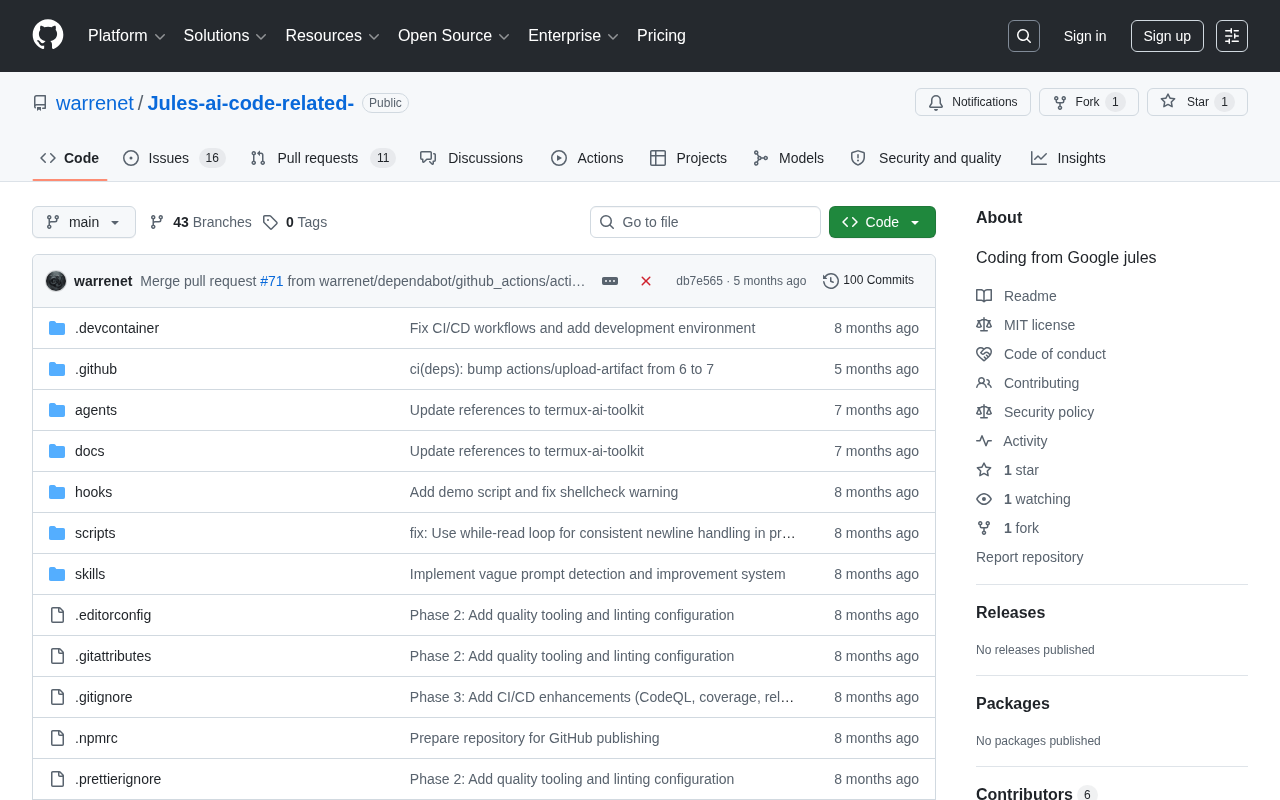
Google Jules AI Coding Assistant: A Quick Look at an Open-Source Practice Repo
A look at a small GitHub repo centered on Google Jules, an autonomous AI coding agent. Explores what Jules does, the repo's practical value, and how to evaluate early-stage AI tool projects.
GitHub Project Overview: prateek0221/jules — Critically Lacking Information
The GitHub repo prateek0221/jules has only 1 star, no code, and no README. We review available info and provide background on Google's Jules AI coding agent.