KPop Demon Hunters 4K Blu-ray Just $24.99: Cheaper Than a Month of Netflix
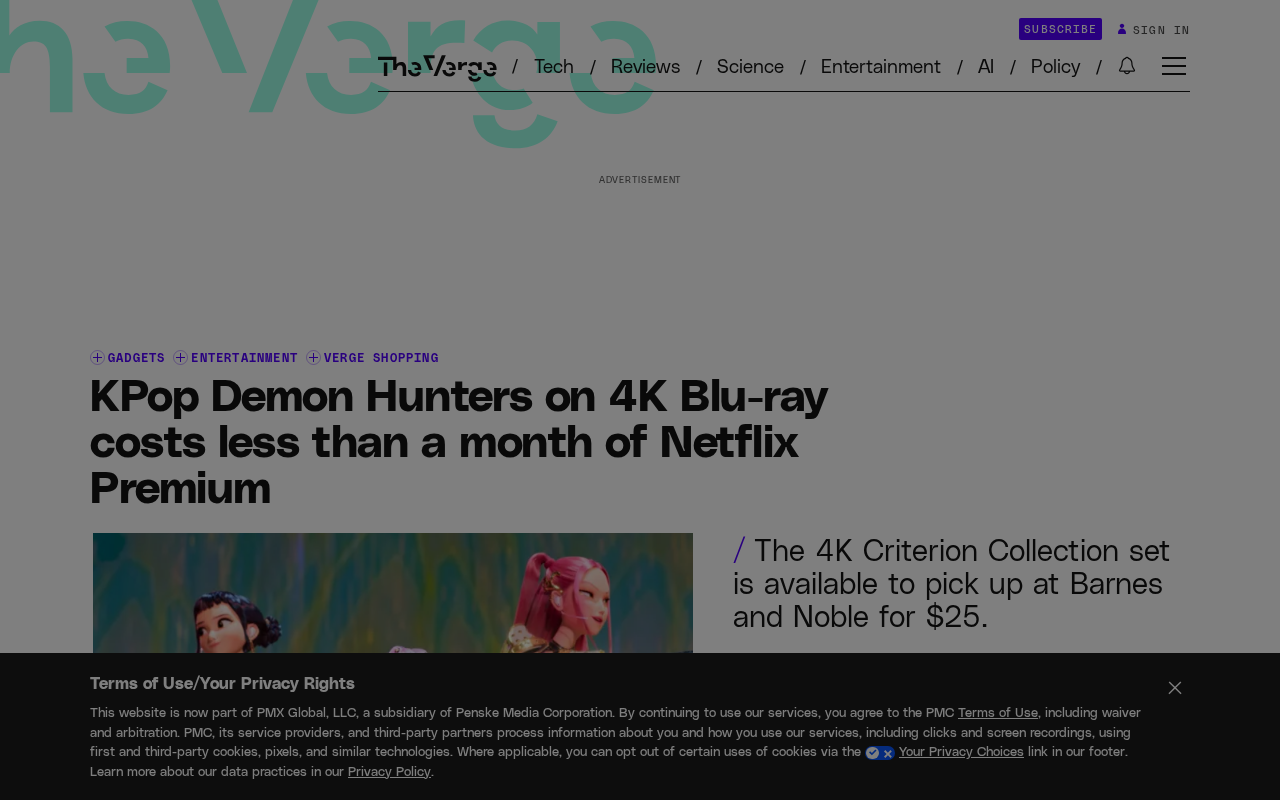
KPop Demon Hunters 4K Blu-ray at $24.99 is cheaper than Netflix's $26.99 monthly fee—physical media is more economical in specific scenarios.
Barnes and Noble has dropped the price of the KPop Demon Hunters 4K Blu-ray from $49.95 to $24.99, lower than Netflix Premium's $26.99 monthly subscription. The article compares the costs of physical media vs. streaming: for viewers who only want this film, buying the disc is a smaller one-time expense and offers true 4K quality, immunity to network fluctuations, and no risk of the title being removed. It suits those who only want this one movie, picture quality enthusiasts, collectors, and users with limited network conditions. But if you already use Netflix heavily for lots of content, a subscription still makes sense. The current discount is limited-time, so the decision should be based on personal viewing habits.
One Blu-ray Disc, a Year's Subscription Saved?
For viewers who just want to watch the 4K version of KPop Demon Hunters, Netflix Premium's $26.99 monthly subscription may not be worth it. Now, Barnes and Noble has dropped the price of this hit animated film's 4K Blu-ray from its original $49.95 to $24.99—cheaper than a single month of Netflix Premium.
This price point makes physical media appealing again in the streaming era—especially when you want to rewatch a specific title over and over.
Physical Media vs. Streaming: A Simple Calculation
Netflix Premium costs $26.99 per month, while this 4K Blu-ray is a one-time $24.99. If your main reason for subscribing to Netflix is to watch the 4K version of KPop Demon Hunters, buying the disc outright is clearly more economical.
More importantly, the Blu-ray delivers true 4K quality, unaffected by network bandwidth fluctuations, with no worries about the title being removed. For users who are sensitive to picture quality or inclined toward collecting, physical media remains the more reliable choice.
Technical Differences Between 4K Blu-ray and Streaming 4K
Although both are labeled 4K, they achieve it differently. 4K Blu-ray discs use H.265/HEVC encoding with typical bitrates of 50-100 Mbps, while streaming services like Netflix usually cap 4K bitrates at 15-25 Mbps. Higher bitrates mean fewer compression artifacts, with noticeable differences especially in dark scenes, fast-motion sequences, and fine textures (such as gradients and lines in animation). In addition, Blu-ray discs support lossless audio formats (such as Dolby TrueHD and DTS-HD Master Audio), while streaming typically uses lossy Dolby Digital Plus. However, streaming offers instant access and cross-device convenience, whereas physical discs require a Blu-ray player or game console.
Who Should Buy This Disc?
The following types of people may find this deal particularly worthwhile:
- Those who only want to watch this one movie: No need to pay for the entire Netflix library.
- Picture quality enthusiasts: 4K Blu-ray's bitrate and stability typically outperform compressed streaming versions.
- Collectors: Physical discs can be displayed, lent out, and preserved long-term.
- Users with limited network conditions: No dependence on stable high-speed broadband.
Of course, if you already use Netflix frequently to watch a large amount of content, a subscription still makes sense. But maintaining a subscription purely for one movie is clearly on the expensive side.
Ownership and Digital Rights Management of Physical Media
Buying a Blu-ray disc means obtaining physical ownership of that copy, unaffected by streaming platform licensing expiration, title removal, or account bans. Streaming content only provides rental-style access—users don't actually "own" any film. For users who want to preserve specific works long-term, physical media offers guaranteed access. Additionally, Blu-ray discs often include bonus features, commentary tracks, and other extras that streaming versions may not provide. Note, however, that Blu-ray discs have region locking issues; when purchasing, confirm that the disc region is compatible with your player.
The Price Window May Not Last Long
Barnes and Noble's $24.99 price is a limited-time offer, with the original price at $49.95. For interested buyers, the current discount is worth paying attention to. However, whether to buy ultimately depends on your viewing habits—if you tend to watch once and never return, a streaming subscription or rental may be more flexible; but if you want to own a physical copy and watch anytime, this disc's value for money is quite outstanding at the current price.
Physical media isn't dead—it just becomes more competitive in specific scenarios.
Related articles
 Tech Frontiers
Coldframe: A Honeypot Disguised as a Supermarket Freezer Controller
Coldframe is a honeypot disguised as Danfoss AK-SM 800A and Dixell XWEB freezer controllers, built as a single Python file that detects CVE-2025-41450 attempts and is identified as real devices on Shodan.
 Tech Frontiers
GRFNet: A Lightweight PyTorch Model Designed for Multichannel Time-Series Classification
GRFNet is a lightweight PyTorch model for multichannel time-series classification, originating from EEG decoding research. With only 3,847 parameters, it is based on the ROCKET architecture, combining random convolution kernels with learnable spatial filters, supports arbitrary input lengths, and will soon be evaluated on the PhysioNet dataset.
 Tech Frontiers
CUDA-Accelerated Rocket League Simulator: A Player-Made Hardcore Experiment
A Reddit post shows a "100% Accurate" Rocket League simulator accelerated with CUDA. We analyze its technical context, CUDA's value in game physics simulation, and the significance and limitations of such community projects.