Kun: An Open-Source AI Coding Agent Deeply Optimized for DeepSeek

Kun is a free, open-source AI coding agent deeply optimized for DeepSeek with a 97% cache hit rate.
Kun is an open-source AI coding agent built specifically for domestic developers and DeepSeek, addressing common pain points around network access, complex configuration, and high Token costs. Key features include structured requirements drafting, inline code diff review, transparent cost tracking with 97%+ cache hit rates, and mobile remote monitoring for async task supervision. It's free on macOS, Windows, and Linux.
Domestic developers looking to use AI coding tools have long faced a triple barrier: unreliable network access, complex configuration for third-party model integrations, and high Token costs. A recent open-source project called "Kun" (坤), approaching 5,000 stars on GitHub, has caught attention for its deep optimization around DeepSeek and users in China, aiming to address all these pain points at once. This article breaks down the engineering design philosophy behind the project, drawing on hands-on demos from a Bilibili creator.
Why China Needs a Localized AI Coding Agent
AI coding agents are a category of autonomous programming tools that have emerged in recent years. Their core capabilities go far beyond code completion — they can understand task objectives, autonomously plan execution steps, read and modify local files, invoke external tools, and ultimately complete end-to-end development tasks. Representative products include GitHub Copilot Workspace, Cursor, and Devin.
Compared to traditional code completion tools, the key breakthrough of Agent mode lies in multi-step reasoning and tool-calling capabilities. This depends on the maturation of two critical technologies: first, the Function Calling interface, which allows models to output "tool invocation requests" in structured JSON format, have them executed by an external runtime, and return results to the model — forming a closed loop of "perception-decision-execution." This interface was first standardized by OpenAI alongside GPT-4 in 2023, and essentially embeds the JSON Schema of "callable functions" into the model's output space, enabling the model's decision-making to interface with any external system. Second, the ReAct (Reasoning + Acting) architecture, proposed by Google Research in 2022, interleaves reasoning and action — at each step, the model outputs a Thought, decides on an Action, observes the result (Observation), and enters the next cycle. This chain-style reasoning not only significantly improves success rates on complex tasks, but also produces an auditable reasoning trace, allowing developers to trace the rationale behind each decision during debugging. However, Agent mode also introduces new challenges: each task execution requires sending large amounts of context (project code, conversation history) to the model, causing Token consumption to grow exponentially — making cost control a central concern in engineering design.
For domestic users of mainstream AI coding tools, the network barrier alone is often enough to turn people away at the first step. Even those who manage to connect through third-party models domestically often struggle with convoluted proxy and relay configurations — just getting the environment running can be a blood-pressure-raising ordeal.
Kun was built specifically to address these real pain points. It offers deep adaptation for DeepSeek, enabling domestic users to access a locally available AI coding assistant at relatively low cost and with a smoother network experience. DeepSeek is a series of large language models developed by DeepSeek (深度求索). Its R1 and V3 versions each represent distinct technical innovations: R1 uses a pure reinforcement learning approach, leveraging the GRPO (Group Relative Policy Optimization) algorithm with only math and coding problem outcomes as reward signals — no supervised fine-tuning required — yet it spontaneously develops powerful chain-of-thought-like reasoning, proving that complex reasoning capabilities can emerge entirely from reinforcement learning. V3, meanwhile, achieves a breakthrough in parameter efficiency via a Mixture-of-Experts (MoE) architecture — it has approximately 671 billion total parameters, but only activates around 37 billion per inference, making its actual compute load far lower than a dense model of comparable scale, which is the fundamental reason for its low operating cost. Both models match or exceed GPT-4 on coding benchmarks such as HumanEval and MBPP, while API pricing is approximately 1/20 to 1/30 of equivalent OpenAI models — a price gap that becomes even more pronounced in high-Token-consumption Agent scenarios. More importantly, DeepSeek provides fully accessible domestic API endpoints, eliminating the need for proxies or relays. The project's name and UI design carry a distinctly local internet culture flavor — the AI assistant even appears as the "鸡哥" character — a grounded, relatable design that immediately puts users at ease.
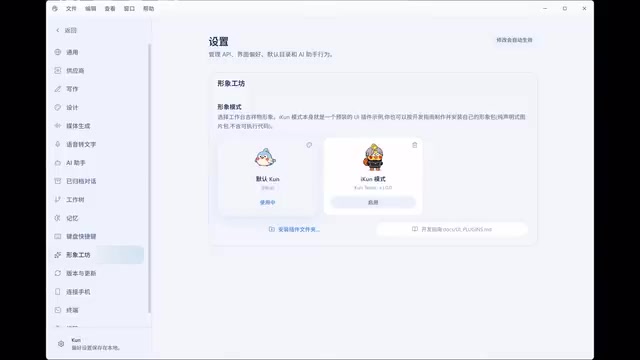
Beyond the entertaining exterior, what truly deserves attention is the engineering thinking behind Kun — that's what sets it apart from ordinary Agent tools.
Requirements Draft: Make the AI Think Before It Codes
Poor requirements management is the leading cause of software project failure — a conclusion backed by extensive empirical evidence in software engineering. The Standish Group's CHAOS Report has long tracked this: unclear or changing requirements are the top driver of project delays, cost overruns, and outright failures, typically accounting for over 40% of cases. In AI coding scenarios, this problem is further amplified — vague instructions not only lead to directional drift, but also trigger multiple rounds of corrective dialogue, each representing additional Token consumption and wait time.
A common failing of many Agent tools is that they start blindly writing code the moment they receive a one-liner instruction, only to drift off course and require repeated rework — wasting both Tokens and time. Kun's "Requirements Draft" feature is designed to solve exactly this problem.
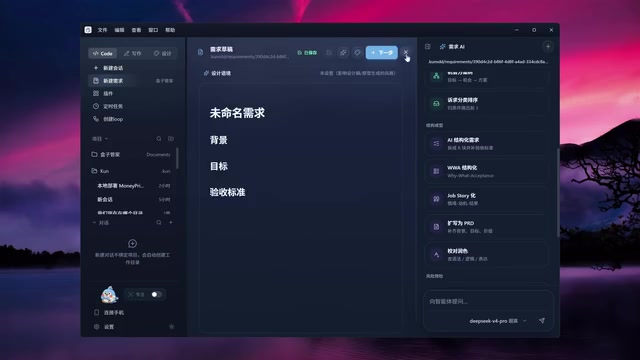
Before any actual coding begins, Kun guides users to first clarify the background, objectives, and acceptance criteria. The right side of the interface includes an AI-assisted structured requirements organizer, helping users turn vague ideas into clear development specifications. This design draws on concepts from Agile development — specifically "user stories" and "acceptance criteria" — as well as the PRD (Product Requirements Document) structure from product design, front-loading the three key elements of "background-objective-acceptance criteria." In essence, it embeds software engineering best practices directly into the AI interaction workflow. This upfront step may seem to add friction, but it delivers dual benefits: reducing wasteful Token consumption while significantly lowering the time cost of rework and validation later on.
This "plan before you act" design reflects a deep understanding of real development workflows — unclear requirements are the primary cause of software project failure, and getting this step right is what gives the subsequent automation genuine value.
Inline Code Diff: See Every AI Change at a Glance
Once requirements are clear, Kun dives directly into the local project, autonomously browsing source code to analyze and modify it. The most immediately striking feature here is its inline code diff functionality.
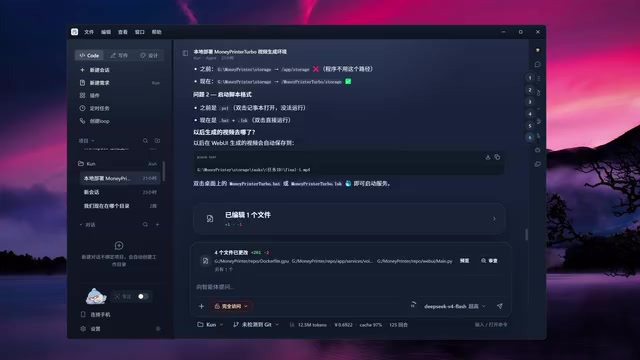
Diff (difference comparison) is a core concept in version control systems, originating from the Unix diff command and later widely adopted by modern version control systems like Git. In AI coding scenarios, inline diff display has particular engineering value: when AI modifies code, it may touch dozens of files and hundreds of lines simultaneously — without structured difference presentation, human review becomes nearly impossible to do efficiently. This isn't just a UX issue; it's a baseline for security and quality control. Developers must be able to quickly understand what the AI "did" before approving it, to prevent the AI from introducing subtle logic errors or security vulnerabilities. Research shows that code review efficiency is highly correlated with diff visualization quality — clear diff display can reduce review time by more than 50%.
Which files the AI modified, which lines were added, which were deleted — all clearly marked with red and green highlights, similar to the Changes tab in a GitHub Pull Request. Users don't need to jump between multiple files to compare changes; just scan the diff, click approve, and the code automatically merges into the project. This design minimizes the cost of "reviewing AI code" and keeps users in control at all times, rather than handing the project over to a black box.
Cost Control: Cache Hit Rate Is the Real Key
When AI reads local files in bulk, many people's first concern is — will Token consumption spiral out of control? Understanding this requires knowing how large language model billing works: in multi-turn Agent conversations, each model call requires re-sending the complete conversation history and project context, generating large amounts of repeatedly billed "prefix tokens."
The underlying implementation of context caching relies on the KV Cache (key-value cache) mechanism. When a Transformer model processes each token, it generates corresponding Key and Value vectors — these vectors record the token's "understanding state" of the entire context during attention computation. When the prompt prefix across multiple API calls is identical, the server can directly reuse the already-computed and cached K/V vectors, skipping redundant computation for that portion — this is one of the core optimizations in mainstream inference frameworks like vLLM and TensorRT-LLM. Service providers such as DeepSeek and Anthropic (which calls it "Prompt Caching") expose this optimization as a billing-level "cache hit" discount — DeepSeek charges approximately 1/10 of the standard price for cache-hit portions, and in some tiers it's completely free. To maximize cache hit rates, the structural design of prompts is critical: frequently reused content (system prompts, code files) must remain at a stable position in the prompt with a consistent hash, while dynamic content (new user instructions) is always appended at the end.
This is the core value delivered by Kun's deep optimization for DeepSeek. Through a carefully designed calling strategy, Kun places stable content (system prompts, file contents) in the prompt prefix and dynamic conversational content at the end, maximizing cache reuse.
According to hands-on data from the Bilibili creator, a single session ran 125 rounds consuming 12.5 million Tokens, but thanks to a cache hit rate of 97%, the final cost was only ¥0.69. That number is remarkable. The project also provides a global usage statistics dashboard: cumulative usage of 110 million Tokens, with a maintained cache hit rate of 98%, for a total spend of just over ¥5.
At the bottom of the dashboard is an activity heatmap similar to GitHub's contribution graph, visualizing "how many Tokens were saved and how much money was spent." For cost-sensitive domestic developers, this kind of transparent cost tracking is far more convincing than simply claiming to be "cheap."
Mobile Remote Monitoring: The Cyber Foreman Mode
The mobile remote monitoring feature reflects an important trend in the evolution of AI coding tools: moving from "synchronous interaction" to "asynchronous supervision." Early AI coding tools required users to be continuously present waiting for each output — fundamentally at odds with complex development tasks that run for long periods. As Agent task complexity increases, single task execution time stretches from seconds to minutes or even hours, making it impractical to remain constantly present. Modern async Agent frameworks like LangGraph's persistent workflows and Anthropic's Claude Projects have begun persisting task state to external storage, supporting interruption, resumption, and cross-device continuation. The async workflow design philosophy shifts the human role from "operator" to "approver" — AI continuously builds, while humans intervene at key decision points, similar to the best practice of "delegate, don't micromanage" in modern organizations.
Technically, this system needs to solve three core challenges: task state persistence, real-time progress pushing, and cross-device session synchronization. Kun's approach maintains a state machine on the server side (recording the current execution step, waiting-for-input states, etc.), pushes incremental progress to clients via WebSocket long connections, and triggers mobile push notifications when human confirmation is needed. The QR code scanning binding mechanism is essentially tying the desktop session token to the mobile client, achieving real-time mirroring of the same task context across different devices — with lightweight trimming optimized for code approval scenarios.
Kun's mobile remote monitoring feature is a concrete implementation of this philosophy. For complex development tasks, you can let your computer keep running at your desk while you lie on the couch checking progress on your phone after scanning a QR code; when the AI submits code, a single tap on your phone confirms and executes it directly.
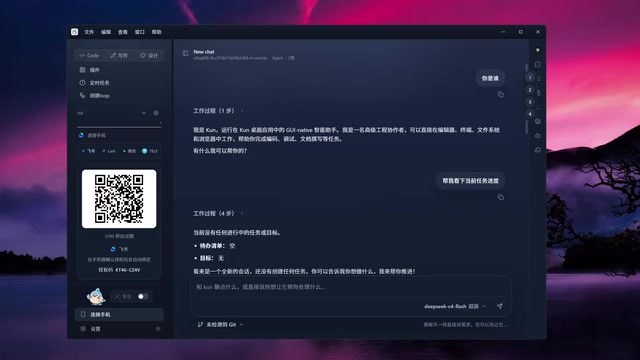
The creator jokingly called this "the real cyber foreman" — you handle decisions and approvals, the AI handles the actual construction. This async, remote working model is genuinely useful for automation tasks that need to run for long periods, and signals that AI coding assistants are transitioning from "tool" to "collaborator."
Beyond coding, even users with no programming knowledge can use Kun's built-in "Write mode" to analyze materials and generate e-commerce product selection reports, formatted short-video scripts, and more. All data is processed locally — fast and private.
Summary: Is This Domestic AI Coding Assistant Worth Trying?
Kun is completely free and open-source, supporting macOS, Windows, and Linux, with installation packages available for all platforms. Based on the hands-on demo, its core competitive advantage lies in: solid localization optimizations for DeepSeek and domestic use cases, combined with a clear product vision around requirements management, code review, and cost visualization.
One caveat: the data in this article comes primarily from a single creator's demo. Metrics like cache hit rates and actual costs may vary depending on project type and usage patterns — interested users are encouraged to download and try it themselves before drawing conclusions. For developers looking for a locally available, 24/7 AI coding assistant with controllable costs built for the domestic ecosystem, Kun is well worth a serious look.
Key Takeaways
Related articles

Alibaba Launches Happy Shrimp: AI-Powered One-Click Complete Song Generation
Alibaba launches Happy Shrimp, an AI music generation tool that creates complete songs with lyrics, melody, arrangement, and vocals from natural language descriptions. In-depth analysis of its core features, differentiation from competitors like Suno, and industry impact.
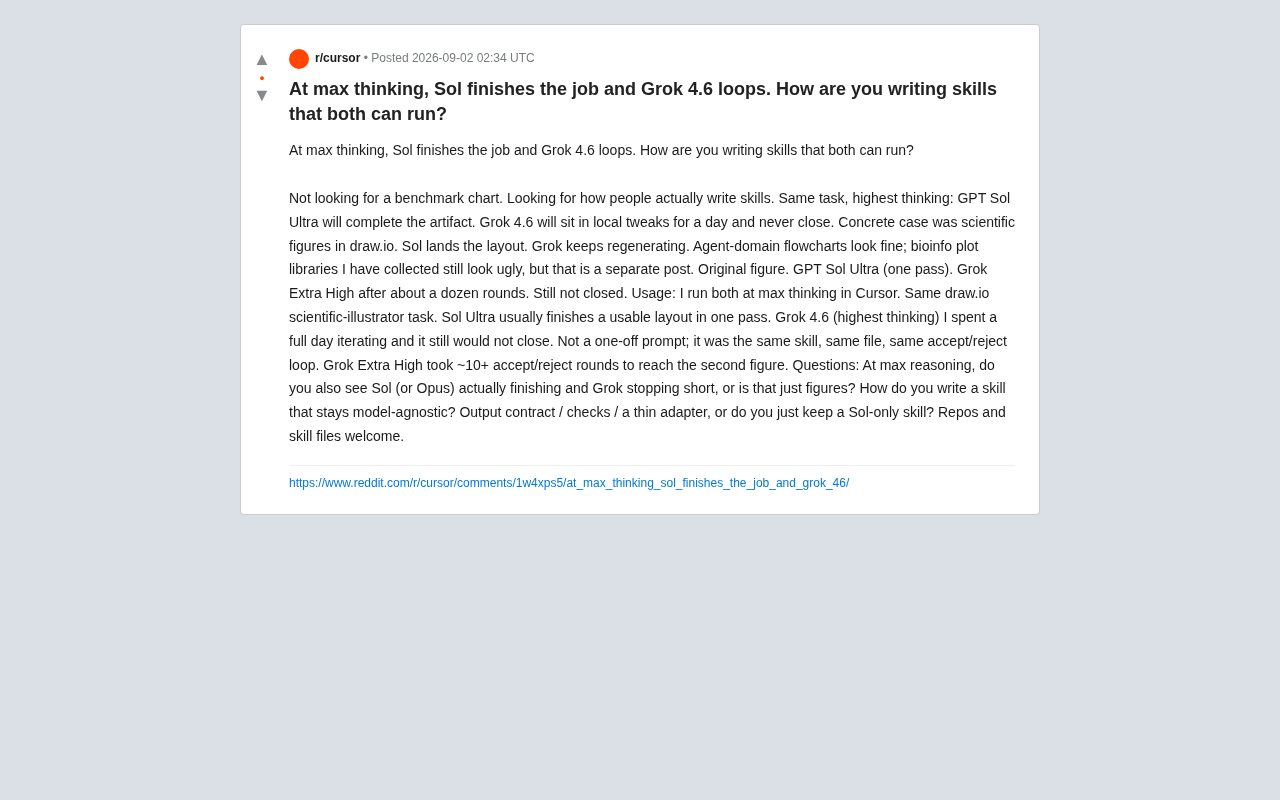
GPT Sol Ultra vs Grok 4.6: Real-World Task Completion Benchmark in Reasoning Mode
Developer benchmark reveals GPT Sol Ultra completes draw.io scientific diagrams in one iteration while Grok 4.6 fails to converge despite maximum reasoning mode, exposing that reasoning depth ≠ task delivery capability.
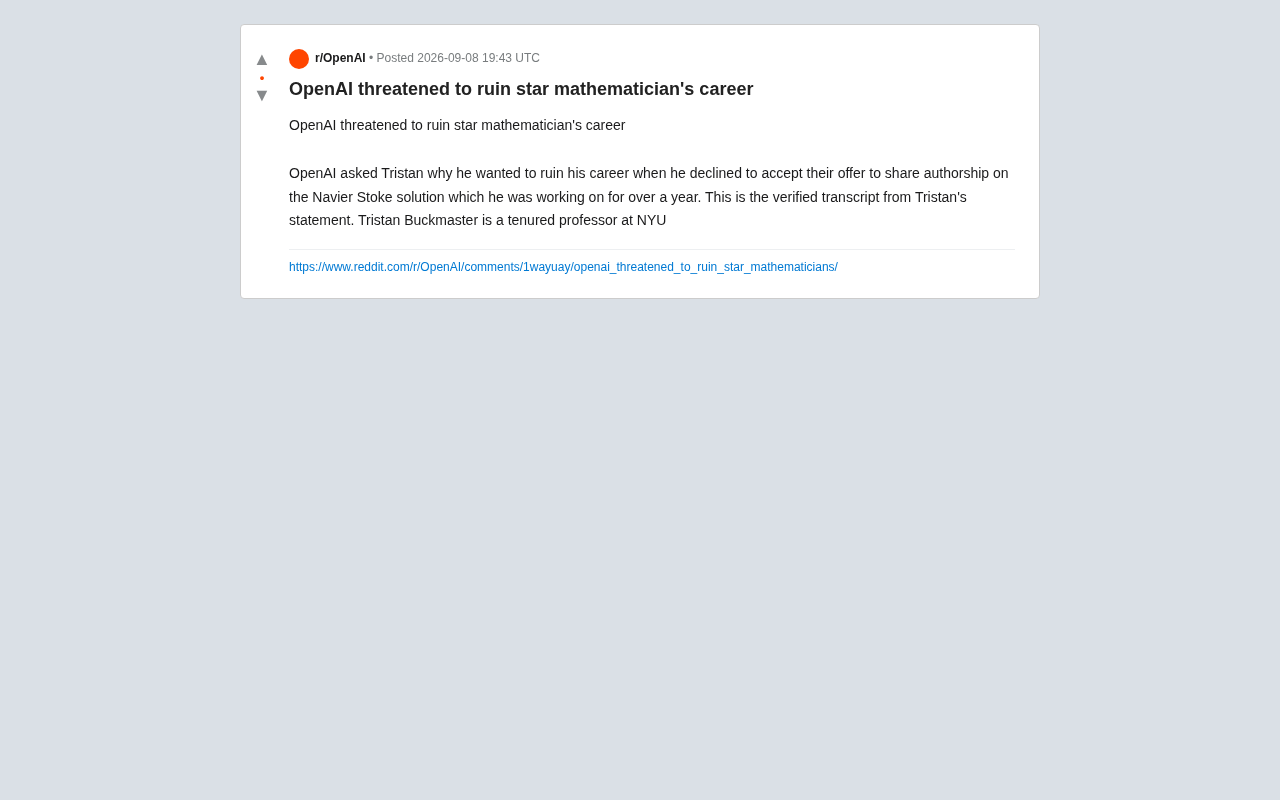
OpenAI Authorship Dispute: The Battle Over Academic Boundaries in the AI Era
OpenAI disputes authorship with mathematician Tristan Buckmaster over Navier-Stokes research, raising ethical questions about AI involvement in science.