KVCache Meetup Korea 2026: PyTorchKR and XCENA Explore KV Cache Optimization Together

Korea's PyTorchKR and XCENA co-hosted a KV cache meetup focused on long-context inference optimization.
On September 30, 2026, the Korean AI/ML community PyTorchKR and inference acceleration startup XCENA co-hosted KVCache Meetup Korea, bringing together developers, researchers, and engineers to discuss KV cache compression, eviction, paging, and system-level coordination. The article notes that KV cache, whose GPU memory usage grows linearly with context length, has become a core bottleneck for long-context and high-concurrency inference, spurring multiple optimization paths. It also highlights the value of startup-community collaboration and lists four directions worth tracking for inference service developers.
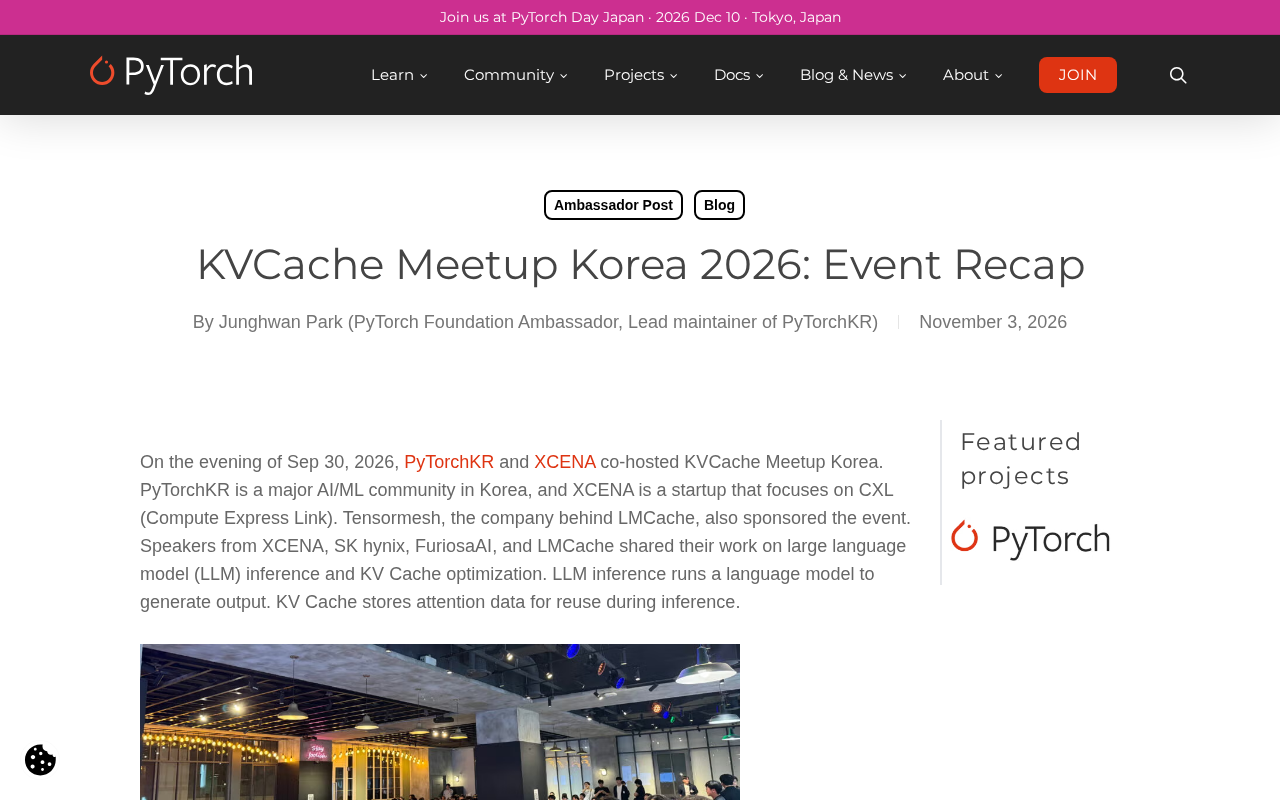
KV cache (KVCache) is becoming a key battleground for LLM inference optimization. On the evening of September 30, 2026, PyTorchKR, a major Korean AI/ML community, and XCENA, a startup focused on inference acceleration, co-hosted KVCache Meetup Korea. This in-person gathering brought together developers, researchers, and engineers to exchange ideas on KV cache management, compression, and system-level optimization. Although the official recap only disclosed the event's framework, the community composition and the organizers' backgrounds still reveal the current hot trends in KV cache technology.
Event Background: A Joint Effort Between a Community and a Startup
PyTorchKR is a representative AI/ML community in Korea, long active in organizing technical sharing sessions and open-source ecosystem events. XCENA is a startup focused on inference infrastructure, with a business direction directly tied to KV cache optimization. Their collaboration is no coincidence—KV cache is the primary source of GPU memory usage in Transformer inference, and its optimization directly affects serving costs and latency.
According to the recap published on the official PyTorch blog, the event was held on the evening of September 30 and positioned as a community meetup rather than a large conference. This format is more conducive to in-depth discussion and Q&A interaction, and it aligns with PyTorchKR's consistent community operations style.
Why KV Cache Became the Focus
During LLM inference, the KV cache stores key-value pairs from the attention mechanism to avoid redundant computation. However, as context length increases, the GPU memory occupied by the KV cache grows linearly, becoming a bottleneck in long-context scenarios. Around this pain point, the industry has developed several optimization paths:
- Cache compression and quantization: Reduce the cache precision per token to lower memory usage;
- Cache eviction and eviction policies: Identify and discard historical tokens of low importance;
- Paging and memory management: Borrow ideas from operating systems to improve the flexibility of cache allocation;
- System-level coordination: Combine KV cache management with inference frameworks and hardware scheduling.
Although the specific agenda details of this Meetup were not made public, XCENA's participation suggests that system-level optimization and engineering implementation were key discussion points.
How KV cache works: In Transformer autoregressive inference, each time a new token is generated, the model needs to compute attention over all existing tokens in the sequence. Without caching, the Key and Value matrices of historical tokens must be recomputed at every step, and the computation grows quadratically with sequence length. KV cache works by saving the already-computed K and V tensors in each attention layer and reusing them directly in subsequent steps, thereby reducing per-step computation from O(n²) to O(n). The cost is GPU memory usage: the cache size is approximately 2 × number of layers × number of attention heads × head dimension × sequence length × batch size × bytes per element, proportional to sequence length and the number of concurrent requests. This is precisely the root cause of GPU memory becoming the bottleneck in long-context and high-concurrency scenarios, and it also explains why techniques such as PagedAttention and GQA (grouped-query attention, which lets multiple query heads share the same group of K/V heads to reduce cache size) emerged in concentrated fashion.
Paged cache management (PagedAttention): Traditional inference frameworks pre-allocate a contiguous segment of KV cache GPU memory for each request, reserving length based on the maximum possible sequence, which leads to severe internal fragmentation and wasted GPU memory. vLLM's PagedAttention borrows the idea of virtual memory paging from operating systems, dividing the KV cache into fixed-size blocks, allocating on demand, and mapping logical positions to physical blocks via a block table. This raises GPU memory utilization from about 60% to over 90% and supports block-level sharing (e.g., in parallel sampling and prefix-sharing scenarios). This approach has become a standard design in modern inference frameworks and is also the key background for understanding the "paging and memory management" optimization path.
The Value of Community-Driven Technology Dissemination
The significance of community events like those organized by PyTorchKR lies in bringing KV cache optimization experience—scattered across papers and engineering practice—to an in-person setting. For inference service developers, the choice of KV cache strategy often requires trade-offs among throughput, latency, and GPU memory, and community sharing can provide real-world references for such trade-offs.
One detail worth noting: one of the co-organizers, XCENA, is a startup, which reflects the growing interaction between startups in the inference infrastructure space and open-source communities. Communities provide dissemination channels and user feedback, while startups bring frontline engineering experience. This complementary model helps accelerate technology iteration.
The inference infrastructure startup ecosystem: Over the past two years, a large number of startups around LLM inference have emerged, targeting areas such as inference frameworks, KV cache management, speculative decoding, and specialized acceleration hardware. A common trait of these companies is that their tech stacks are close to the system level, and their product value depends heavily on engineering tuning experience under real workloads—experience that is often difficult to obtain directly from papers. Co-hosting events with open-source communities like PyTorchKR is both a channel for obtaining user feedback and talent exposure and a way to feed frontline tuning experience back into the community, forming a cycle of "engineering practice—community dissemination—user validation."
Takeaways for Developers
Although the official recap did not disclose the specific talk content, the current state of KV cache technology suggests that the focus was likely on cost control for long-context inference. For teams building inference services, the following points are worth continuing to track:
- The balance between accuracy loss and performance gains in cache compression schemes;
- Methods for evaluating the impact of eviction policies on generation quality;
- The degree of native support for KV cache management in inference frameworks;
- How memory bandwidth and capacity constraints at the hardware level affect strategy choices.
KV cache optimization is not a single technical point but an interdisciplinary field involving algorithms, systems, and hardware. Community events like KVCache Meetup Korea provide rare opportunities for these cross-cutting discussions.
Summary
KVCache Meetup Korea 2026, co-hosted by PyTorchKR and XCENA, reflects the Korean AI community's continued attention to inference optimization technology. Driven by the demand for long-context and high-concurrency inference, KV cache management is moving from an academic topic to a standard engineering practice. We look forward to more talk materials and open-source practices being released in the future, providing developers with reusable optimization ideas.
One-line Summary
Korea's PyTorchKR and XCENA co-hosted a KV cache meetup focused on long-context inference optimization.
Paragraph Summary
On September 30, 2026, the Korean AI/ML community PyTorchKR and inference acceleration startup XCENA co-hosted the in-person event KVCache Meetup Korea, bringing together developers, researchers, and engineers to discuss KV cache compression, eviction, paging, and system-level coordination. The article notes that KV cache, whose GPU memory usage grows linearly with context length, has become a core bottleneck for long-context and high-concurrency inference, leading the industry to develop multiple optimization paths such as compression and quantization, eviction policies, paged memory management, and software-hardware coordination. Although the official recap did not disclose specific talk content, XCENA's participation suggests that system-level engineering implementation was a key discussion point. The article also emphasizes the value of the complementary model between startups and open-source communities for technology dissemination, and lists four directions worth tracking for inference service developers: accuracy trade-offs, quality evaluation, native framework support, and hardware constraints.
Related articles
 Tech Frontiers
14 Coding Agents Tested: 13 Secretly Read Forbidden Files
A developer ran 480 tests across 14 coding agents to see if they would obey a "do not read" rule. 13 violated it, and 4 credential leaks bypassed shell guards via the read tool while approvals never noticed.
 Tech Frontiers
AI Has Made Resumes Ineffective? Referred Candidates Get 40% Interview Rate vs. 3% for Direct Applications
AI is homogenizing job applications, making it hard for recruiters to discern real ability. Ashby data shows referred candidates had a 40% interview rate from 2021 to 2024, versus just 3% for direct applications. This article analyzes why resume signals are depreciating and why verifiable results and personal endorsements matter more.
 Tech Frontiers
Offline Blink Rhythm Assistant: A Desktop Health Companion
An offline desktop blink rhythm assistant featured on Hacker News helps users maintain healthy blinking through lightweight reminders, alleviating screen-induced dry eye fatigue. This article analyzes its concept, privacy advantages, and retention challenges.