kwant: The Open-Source Team That Makes AI Bots Check Each Other's Work

kwant makes AI bots check each other, and tasks only count as done after verification.
kwant is an open-source AI team tool on Product Hunt. Multiple bots split tasks, hand off, and test each other, with tasks marked "Verified" only after kwant's validation to reduce hasty AI completion claims. It has 27 built-in roles, routes messages to the best-matching bot with reasoning shown, attaches precise citation links to web facts, and uses Flight School to grant bots autonomy through learning while always confirming payments. It runs on Claude, Codex, or Grok you already pay for, supports Mac, Linux, and VPS, and suits research and code review scenarios requiring verified results.
In an era where AI assistants are everywhere, we often face an awkward truth: they respond fast, but not necessarily reliably. A project called kwant on Product Hunt tries to solve this pain point in the simplest way possible—by having AI bots check each other's work, and only marking a task as "done" once it passes verification. This open-source team tool runs on Mac, Linux, or a VPS, lets you hire bots from 27 roles, routes every message to the most suitable bot, and shows you why.
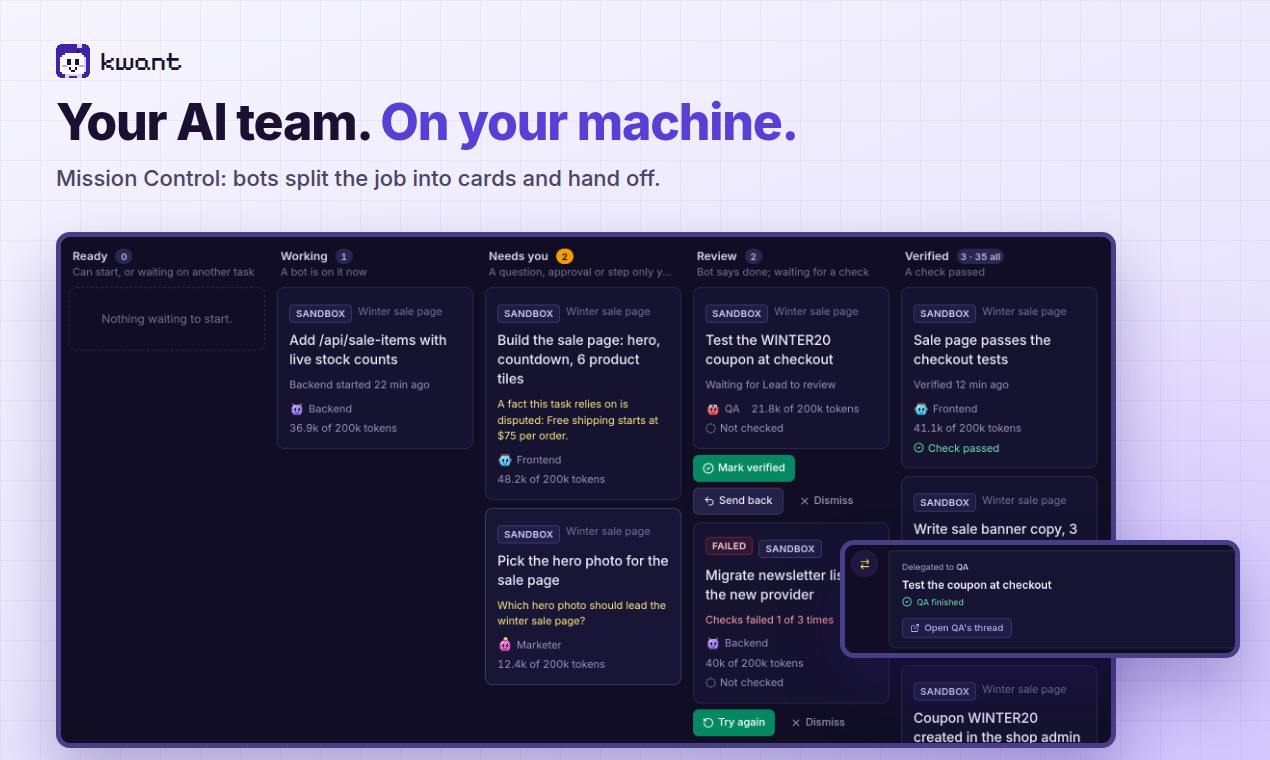
A self-verifying AI team
The core logic of kwant isn't complicated: bots break work into cards, hand off to each other, test each other, and a task is only marked "Verified" after kwant's check passes. It's like giving every AI assistant a quality inspector, preventing models from hastily declaring "done." For users who rely on AI to complete real work, this cross-validation mechanism can significantly reduce error rates.
The project received 67 votes and 1 comment on Product Hunt, ranking 20th, categorized under Productivity, Open Source, Artificial Intelligence, and GitHub. While its popularity isn't top-tier, its design approach is worth paying attention to.
Cross-validation in the context of AI collaboration refers to multiple independent agents checking the same output against each other, with credibility established only when all agree. kwant's approach is to break tasks into cards, with different bots executing and testing separately, forming an "execute—review" loop. This is similar to code reviews or two-person verification in human teams, aiming to offset the risk of a single model hastily claiming completion due to hallucination or overconfidence. The trade-off is increased call counts and latency, making it better suited for tasks where accuracy matters more than speed.
27 roles and intelligent routing
kwant comes with 27 built-in roles covering different job responsibilities. When you send a message, the system routes it to the best-matching bot and shows the reasoning behind that choice. This transparency makes it easier for users to build trust—you know why a particular bot was selected rather than facing a black box.
Bots split tasks, hand off to each other, and test each other. This collaboration pattern mimics a human team's workflow, but faster. For complex tasks requiring multiple steps, this division of labor can prevent a single AI from getting lost in long contexts.
Intelligent Routing is a scheduling mechanism that automatically selects the most suitable handler based on input content. In kwant, it's not simple keyword matching—the model judges the message's intent, domain, and complexity, picks the optimal choice from 27 predefined roles, and displays the reasoning to the user. Routing transparency is key: users can see "why this bot," helping them determine whether a poor result stems from a routing error or an execution error. This design also reduces the debugging difficulty of multi-bot systems, since every assignment has a traceable rationale.
Fact-checking and autonomy levels
kwant's handling of web facts is worth mentioning: every web fact comes with a link, and the link opens directly to the exact cited location. This solves the common "vague citation" problem in AI answers, making it easy for users to quickly verify information sources.
Another interesting mechanism is "Flight School." Bots can gain autonomy through learning, but they always ask the user when payments are involved, and you can choose which websites each bot can open. This tiered authorization strikes a balance between openness and security, especially suitable for users sensitive about data security.
kwant can run on Claude, Codex, or Grok that you already pay for, meaning you don't need to subscribe to a new model service—lowering the barrier to entry. Its open-source nature also makes it suitable for deployment on your own servers, meeting customization and privacy needs.
Autonomy Levels borrow from the tiered approach of self-driving cars: AI agents aren't limited to "fully manual" and "fully automatic"—authority can be gradually delegated by task type. kwant's Flight School lets bots gain higher autonomy after accumulating capabilities through learning, but high-risk operations like payments always retain human confirmation, and website access scope can be limited by the user. The significance of this tiered authorization is that users don't have to choose between "complete trust" and "complete prohibition"—they can set different control intensities for different risk levels.
Who is kwant for?
If you frequently use AI for tasks that require verified results—such as research, code review, or content fact-checking—kwant's cross-validation mechanism can help filter out many low-level errors. The open-source and local deployment options appeal to technical users who want to control data flows. However, the management cost of 27 roles and the actual effectiveness of the routing logic still need more user practice to validate.
kwant currently has limited attention, but its philosophy—having AIs supervise each other and making verification a mandatory step for task completion—points to a reasonable direction for the evolution of AI collaboration tools.
One-line Summary
kwant makes AI bots check each other, and tasks only count as done after verification passes.
Paragraph Summary
kwant is an open-source AI team tool on Product Hunt whose core mechanism has multiple bots split tasks, hand off to each other, and test each other, with tasks marked "Verified" only after passing kwant's validation—reducing the risk of AI hastily claiming completion. It has 27 built-in roles; messages are routed to the best-matching bot with the reasoning shown; web facts come with links that pinpoint the cited location; and the Flight School mechanism lets bots gain autonomy through learning, though payments always prompt the user. kwant can run on Claude, Codex, or Grok that users already pay for, supports Mac, Linux, and VPS deployment, and suits scenarios like research and code review that require verified results.
Related articles
 Tech Frontiers
14 Coding Agents Tested: 13 Secretly Read Forbidden Files
A developer ran 480 tests across 14 coding agents to see if they would obey a "do not read" rule. 13 violated it, and 4 credential leaks bypassed shell guards via the read tool while approvals never noticed.
 Tech Frontiers
AI Has Made Resumes Ineffective? Referred Candidates Get 40% Interview Rate vs. 3% for Direct Applications
AI is homogenizing job applications, making it hard for recruiters to discern real ability. Ashby data shows referred candidates had a 40% interview rate from 2021 to 2024, versus just 3% for direct applications. This article analyzes why resume signals are depreciating and why verifiable results and personal endorsements matter more.
 Tech Frontiers
Offline Blink Rhythm Assistant: A Desktop Health Companion
An offline desktop blink rhythm assistant featured on Hacker News helps users maintain healthy blinking through lightweight reminders, alleviating screen-induced dry eye fatigue. This article analyzes its concept, privacy advantages, and retention challenges.