Label-Free Calibration Certificates: Sharp and Stable Boundaries under Logical Coherence

The paper uses the minimax theorem to prove that logical coherence alone yields sharp, provable calibration lower bounds without labels.
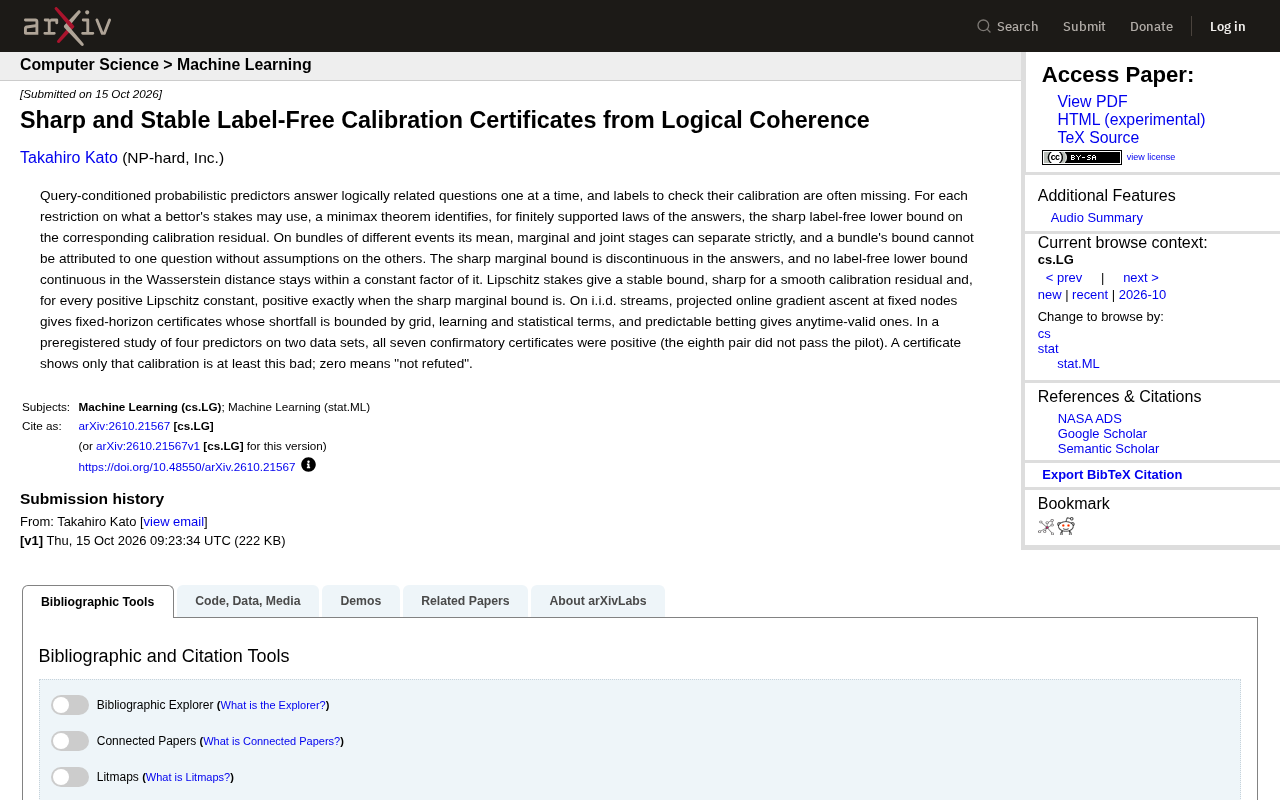
This article interprets the paper *Sharp and Stable Label-Free Calibration Certificates from Logical Coherence*, exploring whether calibration of probabilistic predictors can be rigorously assessed when labels are missing. Through a minimax theorem, the authors identify sharp label-free lower bounds on calibration residuals over finite support distributions and prove that marginal bounds for multi-event bundles can be strictly separated. They further find that the sharp marginal bound is discontinuous in the answer space, and no Wasserstein-continuous label-free lower bound can approach it within a constant factor, revealing an inherent tension between sharpness and stability. To address this, they propose a Lipschitz betting strategy that remains sharp for smoothed residuals without losing detection capability. In online scenarios, projected online gradient ascent produces fixed-horizon certificates, and predictable betting yields anytime-valid certificates. A preregistered experiment validates the framework, but certificate interpretation is asymmetric: positive indicates poor calibration, while zero merely means not disproven.
Introduction: When Calibration Testing Loses Its Labels
As machine learning systems are increasingly used for high-stakes decisions, whether a probabilistic predictor is "calibrated"—that is, whether the predicted probabilities truly reflect the frequency of event occurrences—has become a core metric for assessing its reliability. However, traditional calibration assessment methods invariably rely on ground-truth labels. When models are deployed in open environments, facing logically related questions whose answers have not yet been revealed, labels are often missing. This is precisely the core problem that the paper Sharp and Stable Label-Free Calibration Certificates from Logical Coherence attempts to solve: Without labels, can we still provide a rigorous, provable assessment of a probabilistic predictor's calibration?
Theoretical Framework for Label-Free Calibration Certificates
Minimax Theorem and Sharp Lower Bounds
The paper's core contribution is establishing a theoretical framework for label-free calibration certificates for "query-conditional probabilistic predictors." A query-conditional predictor refers to a model that can provide probabilistic answers to logically related questions one by one. For each type of constraint that a bet can use, the authors, through a minimax theorem, identify the sharp label-free lower bound on the corresponding calibration residual over the finite support distribution of answers.
Here, "sharp" means the lower bound is tight and cannot be further improved. The significance of this result is that even without any labels, merely from the structure of the predictor's answers to logically related questions, we can compute how large its calibration error must be at minimum.
Minimax theorem is a cornerstone result in game theory and statistical decision theory, first proved by von Neumann in 1928. It asserts that in a class of games satisfying convexity and compactness, "minimizing the maximum loss" (minimax) is equivalent to "maximizing the minimum gain" (maximin), meaning both parties' optimal strategy values are equal. In this paper, the authors treat the "predictor" and the "betting strategy" as two parties in a game: the predictor tries to give well-calibrated answers, while the betting strategy tries to profit from any calibration deviation. Through the minimax theorem, the authors are able to formulate the worst-case calibration residual as a solvable optimization problem over the convex set of "finite support distributions of answers." It is precisely this equivalence that enables identifying sharp calibration lower bounds without labels, based solely on answer structure—because the optimal value of the dual problem corresponds exactly to a falsifiable lower bound on calibration deficiency.
Combinations of Different Events and Strict Separation
When the predictor faces a "bundle" of multiple different events, the calibration bounds for its mean, marginal, and joint stages can be strictly separated. In other words, the overall calibration lower bound of an event bundle cannot simply be attributed to any single question within it—unless additional assumptions are imposed on the other questions. This finding reveals the inherent complexity of the label-free calibration problem: calibration assessment in multi-question scenarios is far more difficult than in single-question scenarios.
The Continuity of Marginal Bounds and the Stability Paradox
The paper further proves a surprising result: the sharp marginal lower bound is discontinuous in the answer space, and there exists no label-free lower bound that is continuous under the Wasserstein distance and can approach this sharp lower bound within a constant factor. This means that if we require calibration certificates to be stable against small perturbations in predictions, we must give up sharpness.
This theoretical tension has profound implications in practice: pursuing the tightest calibration bounds may come at the cost of instability.
Wasserstein distance (also known as Earth Mover's Distance) is a measure of the difference between two probability distributions. Intuitively, it represents the minimum cost of "transporting" one distribution into another, where the cost is determined by the distance in the underlying metric space. Unlike total variation distance, Wasserstein distance is sensitive to the geometric positions of the distributions' supports, making it particularly natural for comparing distributions over continuous answer spaces. The paper uses it to characterize the stability of calibration certificates: if answers are subject to small perturbations (e.g., small continuous changes in predicted probabilities), we want the certificate value to change only slightly. The authors prove that the sharp marginal lower bound is discontinuous in the Wasserstein sense, and no continuous certificate can approximate it within a constant factor. This shows that there is a real theoretical tension between "sharpness" and "stability"—the two cannot be simultaneously achieved and must be traded off through strategies such as Lipschitz betting.
Stabilized Solution: Lipschitz Betting
Facing the above paradox, the paper proposes an elegant compromise: adopting a Lipschitz betting strategy. The stable bound given by this strategy is sharp for smoothed calibration residuals, and under any positive Lipschitz constant, the positivity of this bound coincides exactly with the positivity of the sharp marginal bound.
In other words, Lipschitz betting trades for stability while keeping its "detection capability" unchanged. If the predictor has calibration problems, the stable bound can detect them just as well; if it does not, the stable bound will not produce false positives.
Certificate Construction in Online Scenarios
The paper also extends the theory to i.i.d. data stream scenarios. An online gradient ascent algorithm projected onto a fixed node can produce fixed-horizon certificates, whose deficiency is bounded by three components: a grid term, a learning term, and a statistical term. Furthermore, predictable betting strategies can yield anytime-valid certificates.
This provides a viable path for continuous monitoring in real deployments: calibration deviations can be detected in real time within data streams without waiting for labels to arrive.
Online gradient ascent is a class of online learning algorithms for sequential decision-making. In each round, the algorithm selects an action based on current parameters and observes the gradient, then updates the parameters along the gradient direction. Classical results (Zinkevich, 2003) show that under convex losses, the cumulative regret of projected online gradient ascent is bounded by O(√T), where T is the number of rounds. This paper applies the algorithm to a betting strategy "projected onto a fixed node," updating betting parameters each round based on newly arrived predicted answers. The certificate error given by the paper consists of three parts: the grid term arises from discretization of the continuous answer space, the learning term arises from the regret bound of the online algorithm, and the statistical term arises from random fluctuations in the data. This three-term decomposition enables anytime-valid calibration certificates in streaming scenarios without waiting for labels.
Experimental Validation and Preregistered Study
The paper reports a preregistered study testing four predictors on two datasets. All seven confirmatory certificates were positive (the eighth pair failed pilot testing). The authors particularly emphasize a key interpretive principle: A positive certificate only indicates that calibration is at least as bad as that level; a zero certificate means "not disproven," not "calibrated."
This asymmetry is crucial in scientific methodology. Label-free certificates are essentially a falsification tool, not a verification tool. They can expose calibration deficiencies but cannot prove perfect calibration.
Significance and Outlook
This work provides a rigorous theoretical foundation for evaluating probabilistic predictors without labels. Its core insight—that logical coherence alone can yield sharp information about calibration—has potential implications for AI safety, model monitoring, and interpretability research.
Of course, the practical utility of the theoretical framework still depends on computational feasibility and the reasonableness of distributional assumptions. The transition strategy from sharp bounds to stable bounds also provides theoretical guidance for engineering trade-offs. Future research can explore more general logical structures, more efficient solving algorithms, and deployment schemes in real AI systems.
One-line Summary
Using the minimax theorem, the paper proves that logical coherence alone can yield sharp, provable calibration lower bounds without labels.
Paragraph Summary
This article interprets the paper Sharp and Stable Label-Free Calibration Certificates from Logical Coherence, exploring whether calibration of probabilistic predictors can be rigorously assessed when labels are missing. Through a minimax theorem, the authors identify sharp label-free lower bounds on calibration residuals over finite support distributions and prove that marginal bounds for multi-event bundles can be strictly separated. They further find that the sharp marginal bound is discontinuous in the answer space, and no Wasserstein-continuous label-free lower bound can approach it within a constant factor, revealing an inherent tension between sharpness and stability. To address this, they propose a Lipschitz betting strategy that remains sharp for smoothed residuals without losing detection capability. In online scenarios, projected online gradient ascent produces fixed-horizon certificates, and predictable betting yields anytime-valid certificates. A preregistered experiment validates the framework, but certificate interpretation is asymmetric: positive indicates poor calibration, while zero merely means not disproven.
Related articles

Chain of Thought Isn't Just for AI: How Humans Can Use CoT to Improve Thinking Quality
Chain of Thought isn't just a prompt trick for large models. Starting from a Hacker News discussion, this article analyzes why CoT works for human thinking too, breaks down actionable ways to transfer it, and highlights the key differences between human CoT and machine CoT.
Cloudflare Teams Up with OpenAI: Closi…
Cloudflare Teams Up with OpenAI: Closing the Loop from Vulnerability Discovery to Defense with AI
Cloudflare uses OpenAI Daybreak to investigate security vulnerabilities and generate reviewable remediation plans, while developers use Codex to boost coding efficiency and quality.

Orca Multi-Agent Orchestration in Practice: A Guide to Parallel Collaboration with Claude and Codex
Orca is Stable AI's free open-source agent workbench supporting 34 agents like Claude Code and Codex in parallel. Learn its Git worktree isolation, multi-model orchestration, and mobile management.