Laika Director: AI Runs Counter to Our Creative Philosophy

Laika director says AI is completely antithetical to handmade stop-motion, emphasizing its irreplaceability.
Laika's new film Wildwood took five years and used over 230 puppets, with 36 versions of protagonist Prue, showcasing the intricate handcraft of stop-motion. The director publicly stated that AI is "completely antithetical" to Laika's core creative philosophy, citing fundamental conflicts in creative subjectivity, process value, and time investment. The article analyzes AI's penetration and controversy in animation, noting that while stop-motion is hard to automate, AI's efficiency-first logic may still affect studio culture.
Laika, the studio behind stop-motion films like Coraline and ParaNorman, has completed its new feature Wildwood after five years of production—its most ambitious project to date. The film's director recently stated publicly that AI technology is "completely antithetical" to Laika's core creative philosophy.
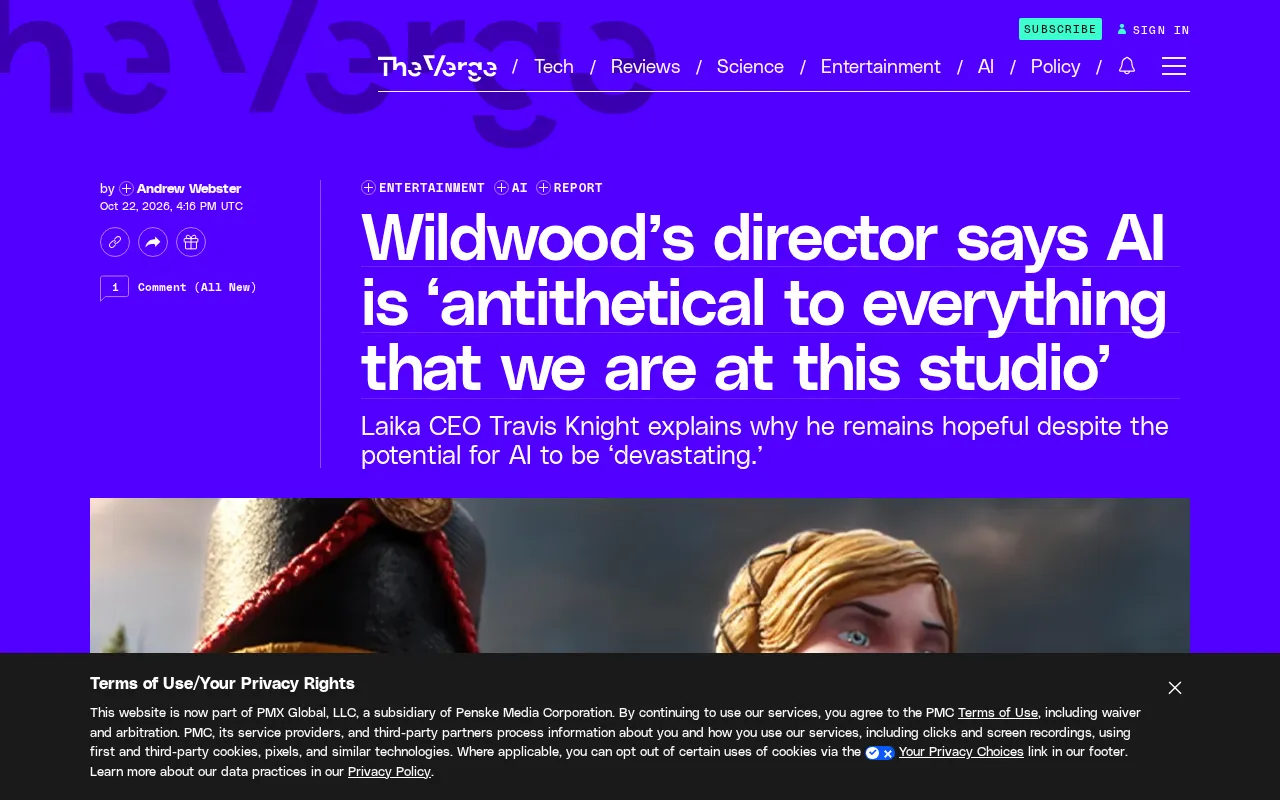
A Commitment to Handcraft: 230 Puppets and Five Years of Refinement
Wildwood is a grand fantasy adventure film with an extraordinarily complex production process. According to the original report, the film used over 230 puppets, with 36 different versions of the protagonist Prue alone. These puppets were manipulated frame by frame by animators to bring them to life. This reliance on physical props and handmade craftsmanship is the signature style of Laika and constitutes the fundamental difference between its work and AI-generated content.
The director's remarks are not an isolated critique of technology but stem from a deep understanding of the studio's creative essence. Every frame of Laika's work embodies the手工 labor and time investment of artists—a "slow and steady" philosophy that stands in stark contrast to the automation and efficient generation that AI pursues.
Stop-Motion Animation is a time-honored animation technique in which physical models (such as puppets or clay characters) are positioned and photographed frame by frame. After each frame, the model's pose is slightly adjusted, and the sequence is finally played back at 12 to 24 frames per second to create the illusion of movement. Since each second of animation often requires dozens or even hundreds of manual adjustments, stop-motion has an extremely long production cycle and high labor costs. Laika is a leading studio in this field, known for its meticulously crafted physical puppets, authentic material textures, and distinctive lighting atmospheres. Unlike computer-generated CG animation, every frame of stop-motion captures real light and material interactions from the physical world—this "handmade trace" is itself part of its aesthetic value.
Why AI Is "Antithetical": A Fundamental Clash of Creative Philosophies
The director used the word "antithetical" to describe the relationship between AI and Laika, revealing conflicts on multiple levels:
- Creative subjectivity: Laika's artistic value lies in the performance and improvisation of human animators, where every subtle movement carries a personal imprint; AI generation tends toward standardization and averaging.
- Process and result: Part of stop-motion's appeal comes from the perceptibility of its production process—audiences can feel the authenticity of materials and the slight pauses in movement; AI generation often pursues seamlessness and realism, dissolving this texture.
- Time and value: The five-year production cycle is itself a statement of value, while one of AI's selling points is shortening cycles—the two have fundamentally different understandings of "investment."
Although the director did not elaborate further, this statement echoes the widespread anxiety about AI in the film and television industry in recent years. Many creators worry that AI will erode creative jobs and dilute artistic value, and Laika's stance as a defender of handmade animation is particularly striking.
Generative AI refers to artificial intelligence models capable of automatically generating text, images, audio, or video based on training data, such as diffusion models (for image generation) and large language models (for text generation). In animation, AI has been used for辅助 tasks such as in-between frame interpolation, color correction, and background generation. However, generative AI operates by learning statistical patterns from massive datasets, and its output tends toward "averaging" and "standardization," lacking the specific intent and improvisation of human creators. This directly opposes the creative subjectivity that Laika emphasizes—"every frame bears the animator's personal imprint." The director's "antithetical" characterization stems precisely from this difference in fundamental methodology and value orientation.
Industry Context: The Controversy and Boundaries of AI in Animation
The Laika director's remarks come amid rapid penetration of AI technology into content creation. From script assistance to in-between frame generation, AI tools are being gradually introduced into animation workflows. However, stop-motion, due to its physical nature, is difficult to automate, which may mean Laika feels the impact of AI less directly than the CG animation industry. But the director's wary attitude suggests that even if technical feasibility is limited, the efficiency-first logic that AI represents could still subtly influence studio culture.
Laika has not disclosed whether it has tried any AI tools in production, and the director's statement reads more like a declaration of cultural stance. For audiences, this commitment may be precisely the source of Laika's unique appeal.
In-betweening is a traditional step in animation production, referring to the drawing of transitional frames between keyframes by assistants to make movement smooth. In recent years, AI has been introduced to this stage, automatically generating in-between frames through algorithms to significantly shorten production time. However, for stop-motion, in-between frames are not drawn but created by physically adjusting puppet poses and shooting frame by frame, so AI's automation advantages cannot be directly applied. Even so, the "efficiency-first" logic that AI represents may still have indirect effects on stop-motion studios that rely heavily on manual labor—for example, in budget allocation, staffing, and creative pacing. This is precisely the source of the Laika director's caution: technical feasibility is limited, but cultural impact may arrive first.
Conclusion: The Irreplaceability of Handmade Animation
In an era of increasingly widespread AI-generated content, Laika's choice offers a counterpoint: technology is not the only path, and the warmth and individuality of handmade art still hold irreplaceable value. Wildwood, five years in the making, is itself a practice of this philosophy. The director's candor defends the studio's tradition and adds a voice from the creative frontlines to the industry's discussion about the boundaries of AI.
Related articles

Running Real-Time Local Voice AI on a Single 12GB GPU: Full Pipeline with a 35B Model and Voice Conversation
A developer shows how to run a 35B MoE LLM, Whisper ASR, and Breeze TTS2 locally on a single 12GB GPU, cutting end-to-end voice chat latency from 8s to 2–3s via streaming, parallel synthesis, and quantization, plus Agent tool-calling integration.

Qwen4 Architecture Preview Open-Sourced: 125B Parameters, 512 Experts, Designed for VRAM-Constrained Hardware
Qwen4 isn't released yet, but its architecture is previewed via open-source Qwen3.8 Flash Next: 125B params, 6B activated per token, 512 experts, 262K context, built for VRAM-limited hardware. This article covers official confirmations, key config.json metrics, and local deployment tests on 24G memory.

Run 8K Images on 6GB VRAM! Hands-On Test of Fudan's Open-Source MOSS-Image Model
Fudan OpenMouse team and Shanghai MOSS Intelligence open-source MOSS-Image, a 500M-parameter DT architecture text-to-image model that runs locally on 6GB VRAM with precise text rendering, structured layout control, and 4K Token prompt support—ideal for e-commerce posters and local deployment by individual creators.