Laika's Twenty-Year Journey: How Wildwood Continues Its Stop-Motion Ambition

Laika's twenty-year industrialized system draws Deschanel into stop-motion, exploring a differentiated path blending handcraft and digital.
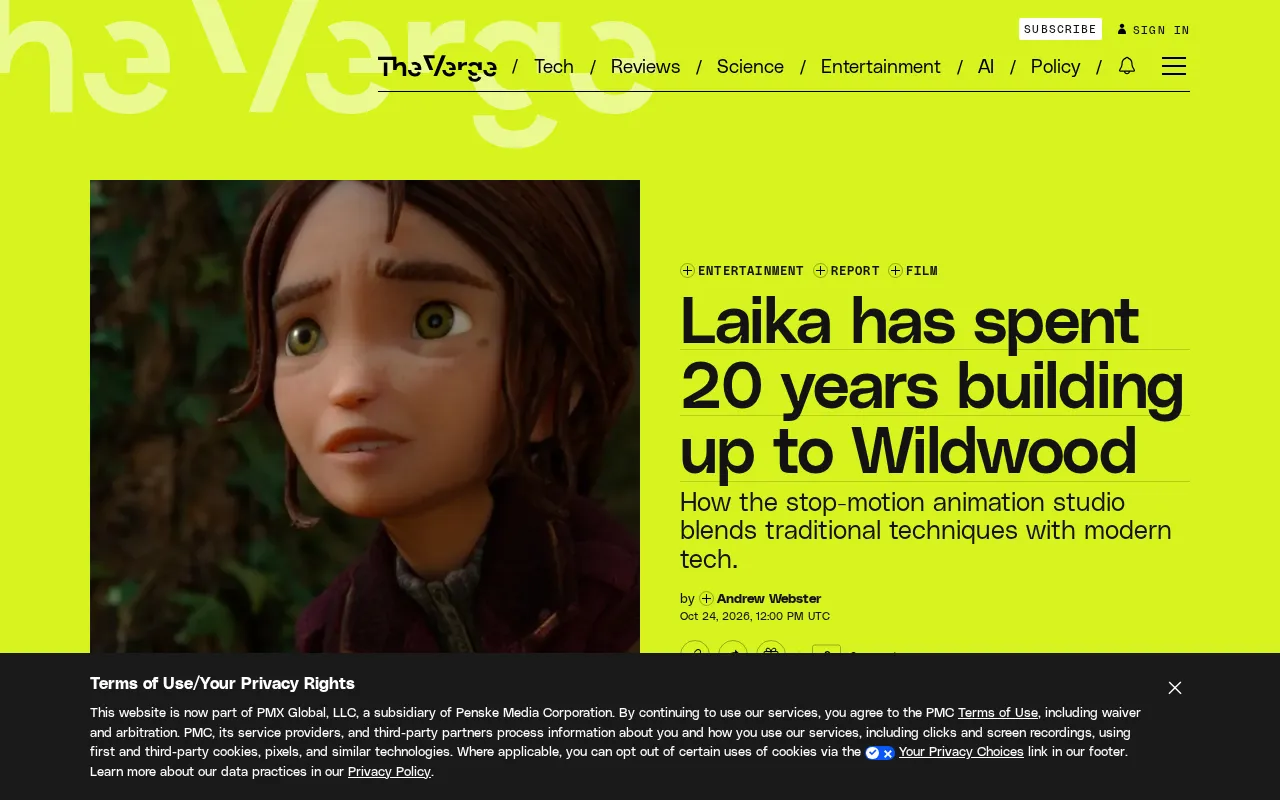
Using Caleb Deschanel's involvement in Laika's new film Wildwood as a starting point, the article traces the stop-motion studio's twenty-year trajectory. Deschanel, a veteran live-action cinematographer, admits that stop-motion requires relearning how to "perform" with the camera. Since its founding in 2005, Laika has established its industry standing with works like Coraline and Kubo and the Two Strings, its core strength being the integration of handmade stop-motion texture with modern workflows such as 3D printing and digital compositing. Wildwood is adapted from Colin Meloy's fantasy novel, and its production cycle echoes the studio's twenty-year history. The article notes that the slow pace of frame-by-frame shooting brings unique creative freedom while requiring cinematographers to make precise upfront decisions on set; Laika's differentiated path and the accelerating talent flow between live-action and animation offer the industry a model for transforming craft into cinematic experience.
From Live-Action to Stop-Motion: Deschanel's Cross-Disciplinary Challenge
Caleb Deschanel has spent decades working in Hollywood, with a resume full of heavyweight credits: he served as cinematographer on The Passion of the Christ and The Patriot, worked on sequences for The Godfather and Titanic, and directed several episodes of Twin Peaks. Even so, when he first encountered a stop-motion project, he found it more challenging than anything before. According to original reports, while working on Laika's new film Wildwood, he admitted that this method of production is completely different from live-action and requires relearning how to "perform" with the camera.
This crossover itself illustrates what makes Laika unique: it continually attracts top live-action talent into the field of stop-motion and has spent twenty years honing a method that deeply integrates traditional craftsmanship with cinematic storytelling. Deschanel's involvement is a microcosm of Laika's pursuit of cinematic quality and artistic expression.
Twenty Years of Accumulation: How Laika Built an Industrialized Stop-Motion System
Founded in 2005 and headquartered in Portland, Oregon, Laika is known for works such as Coraline, ParaNorman, The Boxtrolls, and Kubo and the Two Strings. Over two decades, it has grown from a small studio into a global leader in stop-motion, with its core strength lying in fusing ancient handmade stop-motion techniques with modern film-industry workflows.
Wildwood is adapted from Colin Meloy's fantasy novel of the same name and tells the adventure story of a girl named Prue McKeel who enters a mysterious forest to find her brother. The project took years from inception to production, coinciding with Laika's twenty-year history. According to source material, during his involvement Deschanel was deeply impressed by Laika's meticulous craftsmanship and narrative ambition—perhaps the key to the studio's ability to continually attract talent.
Laika's predecessor was Will Vinton Studios, founded in 1975 by clay animation pioneer Will Vinton. In 2002, Nike co-founder Phil Knight, through his investment firm, acquired the financially troubled studio and in 2005 restructured it as Laika, with Knight's son Travis Knight as CEO. This background explains why Laika had an industrialized foundation from the start: it inherited a mature stop-motion production facility and talent pool while securing stable financial support. Unlike many small animation studios that operate on a project-by-project basis, Laika adopts a long-cycle, asset-heavy model, with each film typically taking three to five years to produce. This injection of patient capital is the precondition for its ability to continually refine its craft.
The Unique Appeal and Industrial Challenges of Stop-Motion
Stop-motion requires shooting physical models frame by frame, with each second of footage often requiring hours or even days of labor. While preserving this handmade texture, Laika introduces technologies such as 3D printing and digital visual effects compositing to give the images greater depth. As cinematographer, Deschanel must find a cinematic visual language within this "slow and meticulous" rhythm, a stark contrast to his past fast-paced live-action experience.
This method of production also brings a unique creative freedom: the team can continually adjust details during shooting, unlike CG animation, which is constrained by pre-production settings. Deschanel's involvement may bring Laika richer live-action lighting and shadow experience, further enhancing the visual depth of its works.
3D printing plays a key role in Laika's workflow. Traditional stop-motion models rely on hand sculpting and silicone molding, which are time-consuming and make it difficult to reproduce complex details. Starting with Kubo and the Two Strings, Laika introduced color 3D printing on a large scale to produce facial replacement parts for characters—a single film may require tens of thousands of facial models with different expressions, each printed and then hand-painted. These parts are swapped frame by frame during shooting, combined with post-production digital compositing to remove support structures and add backgrounds and effects. This hybrid "physical shooting + digital enhancement" workflow is precisely the interface through which live-action cinematographers like Deschanel can engage: he must understand which effects are achieved in-camera and which are left to post-production, thereby making precise lighting and movement decisions on set.
Industry Implications: Differentiated Competition and Talent Flow
In an era when CG animation dominates, Laika sticks to a differentiated stop-motion path, using twenty years to prove that a niche craft can achieve both commercial and critical success. Deschanel's crossover reflects the accelerating talent flow between animation and live-action, an exchange that helps break down genre boundaries and drive narrative innovation.
For practitioners, Laika's experience shows that technology choice is not the only key; the core is how to transform craft characteristics into a unique viewing experience. As Wildwood moves through production, it promises to be the starting point for Laika's next phase and to offer new imaginative possibilities for the future of stop-motion.
Background Note
There are fundamental differences between camera movement in stop-motion and traditional live-action. In live-action, the camera can move freely, and actors' performances are completed in sync with camera staging; in stop-motion, character movements are posed frame by frame, and the camera often needs motion-control shooting coordinated with micro-adjustments for each frame, or motion-control robotic arms to achieve precise repeated trajectories. This means the cinematographer must plan the composition, focus, and lighting changes for each frame in advance—any improvisation entails multiplied time costs. Deschanel's remark about "relearning how to perform with the camera" points precisely to this special way of working, in which performance is broken down into frames and the camera participates in storytelling frame by frame.
Related articles

Running Real-Time Local Voice AI on a Single 12GB GPU: Full Pipeline with a 35B Model and Voice Conversation
A developer shows how to run a 35B MoE LLM, Whisper ASR, and Breeze TTS2 locally on a single 12GB GPU, cutting end-to-end voice chat latency from 8s to 2–3s via streaming, parallel synthesis, and quantization, plus Agent tool-calling integration.

Qwen4 Architecture Preview Open-Sourced: 125B Parameters, 512 Experts, Designed for VRAM-Constrained Hardware
Qwen4 isn't released yet, but its architecture is previewed via open-source Qwen3.8 Flash Next: 125B params, 6B activated per token, 512 experts, 262K context, built for VRAM-limited hardware. This article covers official confirmations, key config.json metrics, and local deployment tests on 24G memory.

Run 8K Images on 6GB VRAM! Hands-On Test of Fudan's Open-Source MOSS-Image Model
Fudan OpenMouse team and Shanghai MOSS Intelligence open-source MOSS-Image, a 500M-parameter DT architecture text-to-image model that runs locally on 6GB VRAM with precise text rendering, structured layout control, and 4K Token prompt support—ideal for e-commerce posters and local deployment by individual creators.