Landlord Disutility: The Overlooked Ownership Premium in Rent-vs-Buy Analysis

"Escaping the landlord" is an underestimated but real component of the homeownership premium.
Traditional rent-vs-buy analyses rely on financial metrics but overlook the disutility of dealing with landlords — forced relocations, junk fees, and structural power imbalances. This article argues that the ownership premium partly reflects people paying for housing stability, autonomy, and dignity, and highlights why the hardest-to-measure variables are often the most important in decision models.
An Economic Insight Sparked by a Tweet
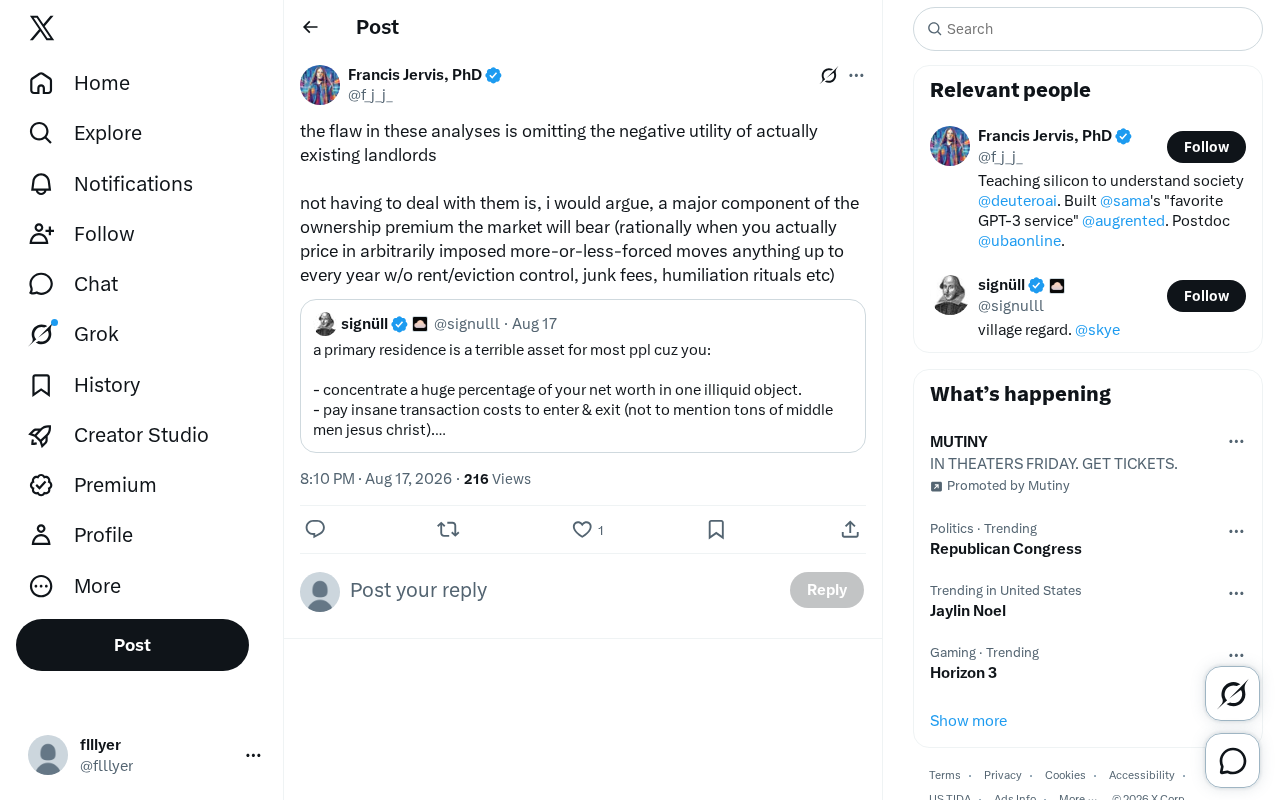
In the perennial "rent vs. buy" economic debate, people tend to compare cold, hard numbers: mortgage payments, rent, home price appreciation, opportunity costs, maintenance expenses… These quantifiable metrics form the backbone of virtually every rent-vs-buy analysis. However, a recently discussed point on Twitter highlights a critical flaw common to all such analyses — they completely ignore the disutility imposed by the real-world existence of landlords.
The core argument is sharp: not having to deal with a landlord is, in itself, a seriously underestimated component of the ownership premium. The ownership premium refers to the extra amount homebuyers are willing to pay to own property beyond the discounted present value of equivalent rental costs. In traditional real estate economics, this premium is typically attributed to financial factors such as expected home price appreciation, tax advantages (like mortgage interest deductions), forced savings effects, and hedging against rising rents. But behavioral economics research increasingly points out that a significant portion of this premium consists of non-financial psychological utility — including the endowment effect (people assign higher value to things they already own) and a preference for control. In other words, a substantial part of the extra price homebuyers are willing to pay isn't for bricks and land — it's for the value of "getting rid of the landlord" itself.
The Specific Manifestations of "Landlord Disutility"
Traditional rent-vs-buy models tend to treat renting and buying as two ways of obtaining equivalent housing services, differing only in financial structure. But this assumption itself is flawed: the living experience you get as a renter is not qualitatively equivalent to the experience of owning your home.
Here are the hidden costs commonly overlooked in mainstream analyses:
The Risk of Forced Relocation
In markets lacking rent control and eviction protections, tenants can face forced relocation at virtually any point, as frequently as once a year. Some important institutional context is worth understanding here: rent control refers to government policies that legally limit how much a landlord can raise rent within a given period, implemented in various forms in cities like New York, San Francisco, and Berlin. Eviction protection is the legal framework that restricts landlords from terminating leases outside of specific conditions. In markets lacking these protections, tenants face significantly higher housing insecurity — most U.S. states allow "at-will termination" clauses, where landlords need only provide 30 to 60 days' notice to require tenants to vacate, creating systemic risk for any long-term housing plans.
Moving doesn't just mean direct monetary costs — it also includes taking time off work, finding a new place, adjusting to a new neighborhood, transferring children to new schools, and a whole range of real but hard-to-quantify life costs. This kind of "housing uncertainty" is something homeowners almost never have to bear.
Endless Miscellaneous Fees
So-called "junk fees" are rampant in the rental market — application fees, administrative fees, various surcharges, and more. These fees often lack transparency and are difficult to fully account for in standard rent comparisons.
Dignity Costs and Power Asymmetry
During the renting process, tenants frequently must submit to background checks, income verification, and credit screenings. They also find themselves in a clearly disadvantaged power position when it comes to maintenance requests, security deposit returns, and other interactions. This repeated, structural imbalance creates a psychological burden that is real and significant, even if it's hard to measure in monetary terms.
Why the Market Is Willing to Pay to "Get Rid of the Landlord"
From an economics perspective, this argument is essentially completing a more comprehensive utility function. A utility function is a core tool in economics for mathematically expressing individual preferences — it maps the satisfaction a consumer derives from different choices to a numerical value. In standard housing decision models, the utility function typically includes only observable variables like housing size, geographic location, and financial costs. However, Nobel laureate Daniel Kahneman's research has demonstrated that psychological factors such as loss aversion and uncertainty anxiety often exert more influence on decisions than pure financial returns. Incorporating "landlord disutility" into the utility function is essentially a concrete application of the behavioral economics framework to the housing domain.
Market prices reflect people's true preferences. If homebuyers consistently pay premiums that exceed what purely financial models can explain, then this "excess" must correspond to some value that hasn't been accounted for.
A large portion of that value comes precisely from avoiding all the risks tenants face. Once you properly price in "being forced to move at any time," "rent that can increase without warning," and "structural power imbalances," the ownership premium no longer looks so "irrational."
Put another way, homeownership provides not just an asset, but a form of control and stability. You can renovate freely, keep pets, make long-term life plans — all without worrying about receiving an eviction notice one day. The value of this "life autonomy" is virtually invisible in traditional models.
Implications for Quantitative Analysis and Decision Models
This perspective has broader implications for how we think about economic decision models. It reminds us that any analysis attempting to explain human behavior through purely quantitative metrics may reach biased conclusions by ignoring hard-to-measure dimensions of utility.
This is especially important today, as data-driven decision making becomes increasingly widespread. Data-driven decision making is a methodology that has rapidly gained traction in business and public policy over the past decade, with the core idea of replacing intuition and experience with quantitative data to guide decisions. However, statisticians and social scientists have long pointed out the "streetlight effect" — people tend to look for answers only where the data shines a light, ignoring potentially critical variables lurking in the dark. This problem is particularly acute in machine learning and AI-assisted decision systems: models can only optimize based on variables that have been encoded as features, while dimensions of human experience that are difficult to digitize — dignity, security, autonomy — are systematically excluded.
When we build models to predict or recommend human decisions, it's easy to fall into the trap of "what's measurable is all there is." The rent-vs-buy comparison is just a microcosm — in reality, the key variables in countless decisions are psychological, relational, and institutional. They won't show up in a spreadsheet, but they absolutely influence people's choices.
The Universality of Hidden Costs
Interestingly, this kind of "overlooked disutility" isn't unique to the rental market. Similar structural asymmetries and hidden costs exist across employment relationships, the platform economy, subscription services, and many other domains. Take the platform economy as an example: in two-sided markets like Uber, Airbnb, and food delivery platforms, the platform — as the rule-maker and information intermediary — often holds bilateral bargaining power over both service providers (drivers, hosts, riders) and consumers. Algorithmic pricing, unilateral changes to terms of service, and opaque rating systems all replicate the power asymmetry found in traditional rental markets. Economists call this phenomenon "platform power," which is fundamentally — like "landlord power" in rental markets — a product of information asymmetry and asymmetric exit costs. Understanding this helps us develop more realistic interpretations of various market phenomena that appear "irrational" on the surface.
Conclusion
Though brief, this tweet hits a blind spot in mainstream economic analysis: when comparing renting to buying, we shouldn't look only at financial numbers — we should also explicitly factor in the value of "not having to deal with a landlord." The ownership premium is not entirely a market bubble or irrational exuberance. A significant portion of it represents a reasonable price people pay for housing stability, life autonomy, and personal dignity.
For anyone working in quantitative analysis, data modeling, or decision system design, this serves as a valuable reminder: the most important variables are often the ones hardest to measure.
Related articles

"Black October": Did AI Uncover 3% of All Critical Vulnerabilities Ever?
A Reddit post claims 3% of all critical software vulnerabilities ever were found in the past month, dubbed 'Black October.' We break down the statistical issues, how AI-assisted code auditing accelerates discovery, and how developers should respond.

Microsoft Project Gecko: Using AI to Bridge Language Gaps for African Farmers
Microsoft's Project Gecko launches PharmaChat, letting African farmers ask questions in their native language and get precise video clips and farming book chapters via AI. The project also releases three interactive manuals to advance inclusive AI.

Musk's Space Dominance: How Starlink Throttling Undermines Ukraine's Defense
SpaceX's Starshield throttling disabled Ukraine's high-speed interceptor drones, exposing how Musk's private control over low Earth orbit communications affects battlefield dynamics and national security, and highlighting the risks of commercial space militarization and space governance dilemmas.