LangChain 1.4.3 Released: Fixes for Caching & Tool Calling, New Bedrock Model Support

LangChain 1.4.3 patches fallback model caching and tool call bugs, and adds Bedrock Mantle support.
LangChain 1.4.3 is a stability and compatibility patch release. It fixes two key issues: sanitizing cache settings in fallback model scenarios to prevent stale cache responses from being served after a model switch, and adding auto-repair logic in `create_agent` for malformed tool call parameters. On the feature side, `init_chat_model` now natively supports Amazon Bedrock Mantle models, and GPT-6 structured output recognition is improved for cases without a pre-configured profile. The release also includes a bump to `anyio` 4.14.2 and documentation corrections. Teams running multi-model fallback or Agent-based tool calling in production should prioritize this low-risk upgrade.
LangChain is one of the most widely adopted frameworks for building LLM-powered applications, with over 147,000 GitHub stars and more than 24,000 forks. The team recently shipped version 1.4.3 — a patch release on top of 1.4.2 — bringing several bug fixes and capability improvements. While it's a minor version bump, a few of the changes have a direct impact on production stability.
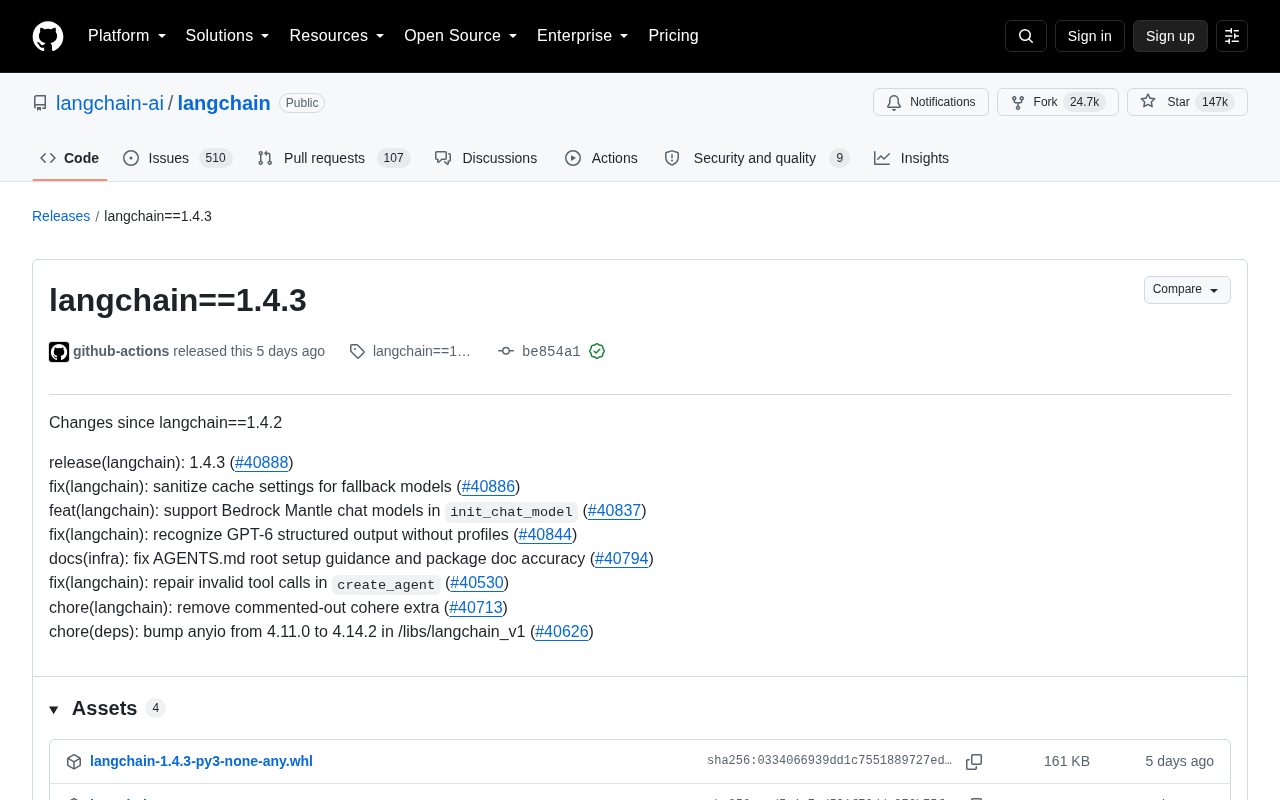
What's in This Release
Version 1.4.3 was automatically published via GitHub Actions and verified with GitHub's signed commit verification. Compared to 1.4.2, this release focuses on two main tracks: bug fixes and expanded model compatibility.
Caching Fix for Fallback Models
One of the key fixes in this release is a sanitization of cache settings for fallback models (#40886). In production environments, developers commonly configure fallback strategies for primary models to handle scenarios like rate limiting, timeouts, or service outages. In previous versions, cache configurations could be incorrectly propagated or reused when switching to a fallback model, leading to unexpected responses. The sanitize cache settings fix makes cache behavior more predictable during model transitions — a meaningful stability improvement for applications built on multi-model redundancy architectures.
The fallback model mechanism is a common pattern in high-availability LLM architectures: developers configure one or more backup models for a primary chain, and the framework automatically switches to a backup when the primary hits a rate limit, timeout, or service error — transparently to the calling application. LangChain implements this via the
.with_fallbacks()method. The caching layer, however, can introduce subtle issues here. If the cache key is based solely on the request content rather than the target model identifier, a cached response from the primary model could be incorrectly returned for a fallback model call — creating a silent bug where the model switches but the response comes from the old model's cache. Thesanitize cache settingsfix addresses exactly this edge case, ensuring cache configurations are properly isolated or reset when the model changes.
Improved Handling of Invalid Tool Calls
Another fix targets create_agent (#40530) and addresses invalid tool calls. In Agent workflows, parameters generated by an LLM for tool calls can sometimes contain formatting errors or missing fields, which can break the entire execution chain. This update adds repair logic for invalid tool calls, allowing the framework to automatically correct common issues and improve the robustness of Agent execution. For teams building autonomous agents with LangChain, this change reduces the risk of runtime failures caused by non-conforming model outputs.
Tool calling (also known as function calling) is a core mechanism in modern LLM agents: the model decides which external tool to invoke during inference and generates a parameter JSON matching that tool's signature. Since LLMs are fundamentally probabilistic systems, their outputs can sometimes include misspelled field names, type mismatches, or missing required fields — all of which can cause tool execution to fail and break the agent chain. With repair logic now built into
create_agentat the framework level, LangChain can automatically correct common formatting deviations (e.g., filling in default values for missing fields, normalizing type conversions), reducing the likelihood that a single malformed model output causes the entire task to fail. This kind of fault tolerance is especially valuable in complex, multi-step agent scenarios, where longer tool call chains demand higher per-step reliability.
Expanded Model Compatibility
New Bedrock Mantle Support
On the feature side, 1.4.3 adds support for Amazon Bedrock Mantle chat models in init_chat_model (#40837). init_chat_model is LangChain's unified entry point for initializing chat models across providers, allowing developers to call models from different vendors through a consistent interface. This addition means AWS Bedrock users can now integrate Mantle models more seamlessly, without writing custom adapter code.
Amazon Bedrock is AWS's fully managed foundation model service, giving developers access to models from Anthropic, Meta, Mistral, Amazon, and others through a unified API — no inference infrastructure required. Mantle is Amazon's own model series available on Bedrock.
init_chat_modelwas introduced in LangChain 0.2 as a unified model initialization interface, designed so developers can switch between models from different providers simply by changing a model identifier string, without modifying any downstream chain code. Adding Bedrock Mantle toinit_chat_model's supported models means AWS users can seamlessly switch between or compare different Bedrock models within the same codebase, further reducing the integration overhead of multi-cloud, multi-model architectures.
Better Recognition of Structured Outputs for GPT-6
Another change improves recognition of structured output capabilities for GPT-6 (#40844). The framework can now correctly identify this model's structured output support even without a pre-configured profile. This reflects the LangChain team's ongoing effort to stay current with new model releases and keep the framework in sync with a rapidly evolving model ecosystem.
Routine Maintenance
Beyond functional changes, this release includes several maintenance updates: bumping the anyio dependency from 4.11.0 to 4.14.2 (#40626), removing commented-out cohere extra configuration (#40713), and correcting the root directory configuration guidance in AGENTS.md along with other package documentation accuracy fixes (#40794). These changes don't affect functionality directly, but help keep the codebase clean and documentation consistent.
Upgrade Recommendations
For teams already on LangChain 1.4.x, upgrading to 1.4.3 is a low-risk decision, with the primary benefits being the caching and tool calling stability fixes. Production systems that rely on multi-model fallback strategies or Agent-based tool calling in particular should consider upgrading promptly to avoid potential issues. AWS Bedrock users gain native support for Mantle models with this release.
As a fast-moving open source project, LangChain ships updates at a rapid pace. Before upgrading in production, it's still good practice to validate compatibility in a staging environment and keep an eye on the changelog for future releases.
Related articles

JobRunner MCP Server: AI Agents Can Now Fix Failed Java Jobs
JobRunner launches an open-source MCP server enabling AI agents to view cluster status, diagnose failures, and recover Java jobs—incident response from any cloud coding environment or existing agent.

MLAI Digital Launches 9 Security Agents: MCP Server Safeguards the Full Lifecycle of Agentic AI
MLAI Digital launches Security MCP Server with nine built-in specialized security agents covering vulnerability discovery, attack simulation, prompt injection detection, API and infrastructure assessment, and accelerated remediation—embedding security validation across the full Agentic AI lifecycle from development to production.

Running Isaac Lab on H100 GPUs: Exploring Better Approaches
Exploring optimization methods for running Isaac Lab on NVIDIA H100 GPUs, including MIG configuration, mixed precision, TensorRT acceleration, and community experience to improve robotics simulation and reinforcement learning efficiency.