LangChain 1.4.5 Released: SummarizationMiddleware Now Supports Custom Summarizers

LangChain 1.4.5 exposes the summarizer parameter for SummarizationMiddleware, enabling customizable summarization strategies.
LangChain 1.4.5 is a minor release with only two commits, whose core change is adding a summarizer parameter to SummarizationMiddleware. The middleware originally compressed overly long conversation history with built-in fixed logic, making it hard for developers to customize summaries for their business needs. The new parameter decouples "when to trigger summarization" from "how to summarize": the middleware still determines the threshold, while the summarization strategy is decided by a custom summarizer passed in from the application layer. This change addresses the differentiated needs of customer service Agents and code assistants to preserve specific information such as order numbers and file paths, without breaking the existing API. Based on the pace from 1.4.4 to 1.4.5, LangChain is in a stable period of small-step iteration, and a single upgrade carries relatively low risk, but the official Release did not disclose API details, so the documentation and source code should be consulted before integration.
What LangChain 1.4.5 Brings
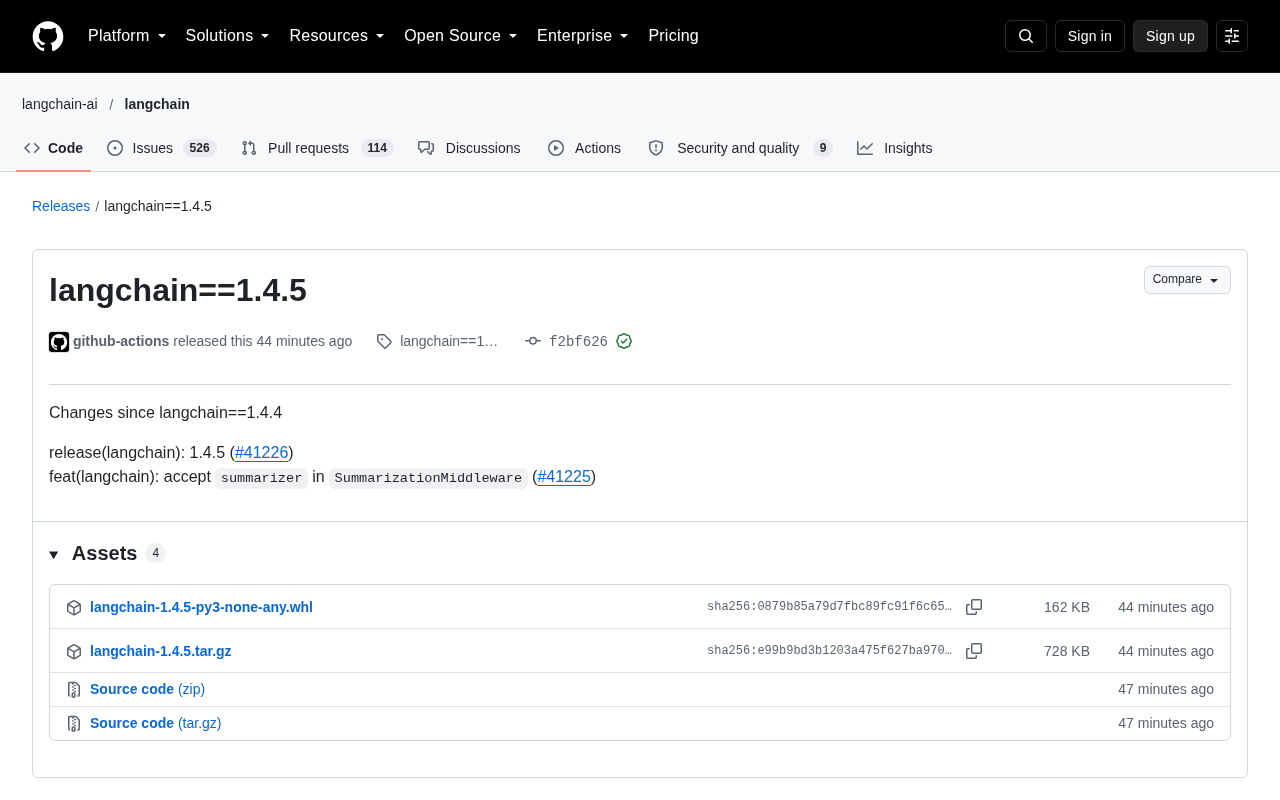
LangChain has released version 1.4.5, a minor iteration following 1.4.4. According to the GitHub Release records, this update mainly consists of two commits: a routine version release process, and support for a summarizer parameter in SummarizationMiddleware.
For developers familiar with LangChain's middleware mechanism, although this change involves little code, it points to a real pain point in practice: the default summarization behavior often fails to meet the needs of all scenarios.
What the summarizer Parameter of SummarizationMiddleware Means
SummarizationMiddleware is a component in LangChain used to automatically compress context when conversation history becomes too long. Its basic logic is: when the number of messages or tokens exceeds a threshold, it calls a summarization model to compress earlier conversations into a summary, thereby freeing up space in the context window.
In previous versions, the summarization logic was built-in and relatively fixed. If developers wanted summaries to better fit their business—for example, preserving specific types of entities, adopting different summarization granularity, or using locally deployed small models to reduce costs—they often had to bypass the middleware and implement their own logic.
The summarizer parameter introduced in 1.4.5 changes this. It allows developers to pass in a custom summarizer when constructing SummarizationMiddleware, decoupling the two concerns of "when to trigger summarization" and "how to summarize." The middleware continues to handle the timing decision, while the specific summarization strategy is left to the developer.
About Middleware and Context Windows
LangChain's "middleware" mechanism is essentially a pluggable layer of hooks that allows developers to insert custom logic at key points in an Agent or chain call (such as before and after model calls, or before and after tool execution) without modifying the core invocation flow. It borrows the idea of middleware in web frameworks: a request passes through several processing layers in sequence, and each layer can read, modify, or intercept the context. SummarizationMiddleware is exactly such a layer. It attaches at the entry point of model calls and checks whether the currently accumulated message list is approaching the upper limit of the model's context window.
The "context window" refers to the maximum number of tokens that can be contained in a single LLM request, including the system prompt, all historical messages, tool return results, and the current input. Once exceeded, the model will either directly error out or be forced to discard content. Summarization compression is common because it is smarter than "deleting the earliest several rounds of conversation in chronological order"—the latter crudely loses key early facts, while summarization condenses these facts into a short piece of text that remains in context. Understanding these two points makes it clear why the flexibility of summarization strategy directly affects the usability of long-conversation applications.
Why This Change Is Worth Paying Attention To
In the actual engineering of Agents and long-conversation applications, context management is an unavoidable issue. No matter how large the context window is, it has a limit, and blind truncation leads to information loss and degraded conversation quality. Summarization middleware provides a compromise path, but summarization quality itself depends heavily on the task type.
For example: a customer service Agent needs to preserve order numbers, user requests, and actions already taken in the summary; a code assistant is more in need of preserving file paths and function signatures. Using the same general summarization logic to cover these scenarios often yields diminished results. Opening up summarizer is equivalent to returning control of the summarization strategy to the application layer.
From the perspective of community feedback, changes that "open extension points" like this are usually more popular than adding major new features, because they do not break the existing API while solving real customization needs.
Typical Implementation Forms of a Summarizer
The "custom summarizer" mentioned in the article usually has two types of implementation. One is "model replacement": still calling an LLM once to complete the summarization, but switching to a smaller model that is cheaper, has lower latency, or has been specially fine-tuned—for example, replacing the original general-purpose large model with a lightweight model trained on customer service corpora, thereby reducing the cost of each compression while maintaining summarization quality. The other is "prompt and structure customization": through a custom prompt, explicitly requiring which fields the summary must preserve (such as order numbers, error codes, file paths), or even requiring structured output (JSON or a fixed template) so that downstream logic can continue to parse it.
These two approaches can be combined. The significance of opening the summarizer parameter is that the middleware only defines the input/output contract of the summarizer and does not restrict its internal implementation, so developers can control both the content emphasis of the summary and the invocation cost and response latency. For high-frequency, long-session Agent applications, summarization itself also consumes tokens and time. Once it becomes a replaceable component, performance tuning has a lever to work with.
LangChain's Iteration Approach as Seen from Release Cadence
Comparing the change list from 1.4.4 to 1.4.5, a very typical pattern emerges: a release commit plus one or two feature commits. This shows that LangChain is currently in a relatively stable iteration period, advancing only one or two clear changes per minor version rather than piling up a large number of changes.
This cadence is relatively friendly to production users—low upgrade risk and low rollback cost. At the same time, it also means that the "newsworthiness" of a single version is limited, and its true value needs to be observed in the evolution across several consecutive versions.
For teams using or evaluating LangChain's middleware system, this change in 1.4.5 is worth adding to the upgrade checklist. In particular, projects that previously abandoned SummarizationMiddleware because the summarization logic was not flexible enough can now reassess it.
Upgrade Recommendations
If you rely on SummarizationMiddleware, after upgrading to 1.4.5 you can check whether your existing code needs to use the new summarizer parameter. The way it is passed in is consistent with custom components in other LangChain middleware, so the replacement cost is not high.
If you do not use this middleware, this upgrade is a low-risk maintenance update, and you can follow it through your normal process.
It should be noted that this Release only disclosed two commit titles and did not include specific API signatures or behavioral details. It is recommended to base integration decisions on the official documentation and source code.
One-line Summary
LangChain 1.4.5 opens the summarizer parameter for SummarizationMiddleware, enabling customizable summarization strategies.
Paragraph Summary
LangChain 1.4.5 is a minor version iteration with only two commits, and the core change is adding a summarizer parameter to SummarizationMiddleware. This middleware originally used built-in fixed logic to compress overly long conversation history, making it difficult for developers to customize summary content for their business. The new parameter decouples "when to trigger summarization" from "how to summarize": the middleware still determines the threshold, while the summarization strategy is determined by a custom summarizer passed in by the application layer. This change responds to the differentiated needs of scenarios such as customer service Agents and code assistants to preserve specific information like order numbers and file paths, without breaking the existing API. From the cadence between 1.4.4 and 1.4.5, LangChain is in a stable period of small-step iteration, and the risk of a single upgrade is relatively low, but the official Release did not disclose API details, so the documentation and source code should be consulted before integration.
Related articles

Chain of Thought Isn't Just for AI: How Humans Can Use CoT to Improve Thinking Quality
Chain of Thought isn't just a prompt trick for large models. Starting from a Hacker News discussion, this article analyzes why CoT works for human thinking too, breaks down actionable ways to transfer it, and highlights the key differences between human CoT and machine CoT.
Cloudflare Teams Up with OpenAI: Closi…
Cloudflare Teams Up with OpenAI: Closing the Loop from Vulnerability Discovery to Defense with AI
Cloudflare uses OpenAI Daybreak to investigate security vulnerabilities and generate reviewable remediation plans, while developers use Codex to boost coding efficiency and quality.

Orca Multi-Agent Orchestration in Practice: A Guide to Parallel Collaboration with Claude and Codex
Orca is Stable AI's free open-source agent workbench supporting 34 agents like Claude Code and Codex in parallel. Learn its Git worktree isolation, multi-model orchestration, and mobile management.