LangChain 1.4.6 Released: HITL Middleware Adds Per-Call Interrupt Capability

LangChain 1.4.6 adds opt-in per-call interrupts to HITL middleware, enabling human interruption at single-call granularity.
LangChain released minor version 1.4.6, shortly after 1.4.5. It contains two commits: #41247 is a routine version bump, while #41062 is the actual functional change — adding opt-in per-call interrupts to the human-in-the-loop middleware. The feature is off by default and requires explicit enablement, with interrupt granularity narrowed to a single call, letting developers trigger human approval for specific tool calls or steps while other calls execute automatically. This continues LangChain's approach of giving control to developers while maintaining backward compatibility. In production, narrowing the approval scope reduces unnecessary round trips and makes interrupt logs and state management clearer. The article suggests projects already using HITL middleware evaluate whether the feature matches their approval workflows, while projects not using it need not force an upgrade.
LangChain has released version 1.4.6, not long after the previous version 1.4.5. Judging from the changelog on the GitHub Release page, this is a minor version iteration, but one functional update to the human-in-the-loop (HITL) middleware is worth noting.
Two Core Changes in This Update
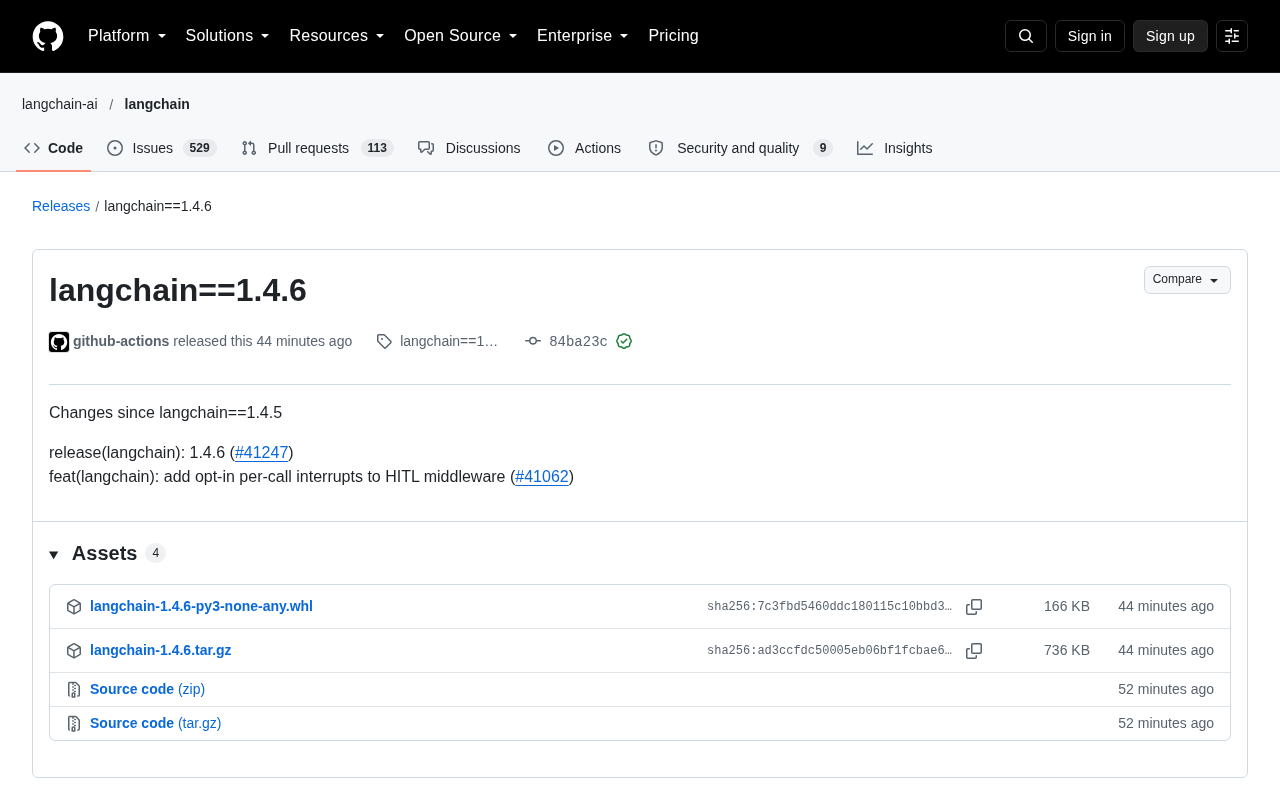
According to the release notes, 1.4.6 contains two commits: a routine version bump (#41247), and feat(langchain): add opt-in per-call interrupts to HITL middleware (#41062).
The second commit is the actual functional change in this release. From the naming, several key details stand out: the feature applies to the HITL middleware, it is opt-in (disabled by default, requires explicit enablement), and its granularity is per-call — meaning it takes effect for a single invocation rather than globally or at the session level.
This design continues LangChain's approach to agent orchestration — giving control to the developer, keeping default behavior backward compatible, and requiring explicit opt-in when intervention is needed.
Middleware mechanism addendum: In LangChain's agent orchestration architecture, middleware is a pluggable interception layer that acts at key nodes such as model calls and tool execution. It allows developers to inject cross-cutting concerns — logging, permission checks, rate limiting, or human approval — without modifying business logic. Middleware typically forms a pipeline in order, and requests pass through the pipeline where they can be modified or short-circuited at any stage. HITL middleware builds on this mechanism, intercepting tool calls to enable human intervention. Understanding the middleware model helps clarify the design intent of per-call interrupts: it is not a new interrupt framework, but rather a finer-grained trigger condition added at the interception points of the existing middleware, resulting in minimal intrusion into existing middleware chains.
What Per-Call Interrupts Solve
The HITL middleware inserts human approval or confirmation steps into the agent execution chain, commonly used in high-risk operations that require human oversight. The previous interrupt mechanism was more oriented toward unified framework-level control, whereas per-call granularity means developers can trigger an interrupt for a specific tool call or a specific step while allowing other calls to execute automatically as usual.
This finer granularity has practical significance for production environments. Narrowing the approval scope to only calls that truly need human intervention reduces unnecessary round trips and makes interrupt logs and state management clearer. Because the feature is opt-in, existing code will not change behavior after upgrading to 1.4.6, and projects that need the new capability can migrate gradually.
HITL (human-in-the-loop) concept addendum: Human-in-the-loop is a core term in the human-machine collaboration paradigm, referring to the introduction of human judgment at key nodes in an automated process, where a person approves, corrects, or overrides the system's decisions. In LLM agent scenarios, an agent may consecutively call multiple tools (such as database writes, email sending, or payment APIs), some of which are irreversible or costly and require human confirmation before execution. The HITL middleware is precisely the component that fulfills this responsibility: it intercepts designated calls in the execution chain, pauses the flow, waits for human input, and then decides whether to continue, modify parameters, or terminate based on the result. Compared to fully automated agents, HITL sacrifices some throughput efficiency in exchange for controllability and auditability, and is therefore widely adopted in domains with low error tolerance such as finance, healthcare, and operations.
Release Cadence and Upgrade Recommendations
The quick follow-up from 1.4.5 to 1.4.6 indicates that LangChain is still iterating intensively on HITL-related capabilities. For projects already using the HITL middleware, it is worth evaluating whether per-call interrupts match the existing approval workflow design. For projects not yet using this middleware, this version alone does not constitute a mandatory upgrade reason, and it can be handled alongside the next routine dependency update.
The version number remaining at 1.4.x also indicates that it is still in a stable minor version sequence, with relatively manageable API compatibility risk. Before upgrading, it is recommended to check the full diff of #41062 to confirm the naming and default values of new parameters, and to verify in a test environment whether the interrupt trigger conditions behave as expected.
Background Addendum
Opt-in and backward compatibility: Opt-in means the feature is disabled by default and must be explicitly enabled by the developer, as opposed to opt-out (enabled by default, can be actively disabled). In library and framework iterations, opt-in is a common strategy for managing compatibility risk: new capabilities do not change existing behavior, existing project execution paths are unaffected, and unexpected disruptions to production flows due to upgrades are avoided. For per-call interrupts, opt-in means that even after upgrading to 1.4.6, the global interrupt semantics of the existing HITL middleware remain unchanged. Developers can enable fine-grained interrupts on specific calls as needed and gradually expand usage after sufficient validation, achieving migration with lower risk.
Related articles

Chain of Thought Isn't Just for AI: How Humans Can Use CoT to Improve Thinking Quality
Chain of Thought isn't just a prompt trick for large models. Starting from a Hacker News discussion, this article analyzes why CoT works for human thinking too, breaks down actionable ways to transfer it, and highlights the key differences between human CoT and machine CoT.
Cloudflare Teams Up with OpenAI: Closi…
Cloudflare Teams Up with OpenAI: Closing the Loop from Vulnerability Discovery to Defense with AI
Cloudflare uses OpenAI Daybreak to investigate security vulnerabilities and generate reviewable remediation plans, while developers use Codex to boost coding efficiency and quality.

Orca Multi-Agent Orchestration in Practice: A Guide to Parallel Collaboration with Claude and Codex
Orca is Stable AI's free open-source agent workbench supporting 34 agents like Claude Code and Codex in parallel. Learn its Git worktree isolation, multi-model orchestration, and mobile management.