langchain-anthropic 1.7.6 Released: Model Profiles Now Declare Mid-Conversation Capability

langchain-anthropic 1.7.6 released with mid-conversation model capability declared across three packages.
langchain-anthropic released maintenance version 1.7.6, with changes focused on model config data refresh, cross-vendor capability declarations, and dependency upgrades. Most notable is that core, anthropic, and openai packages jointly declare mid-conversation support in model profiles, letting the framework layer automatically determine whether a model allows inserting system instructions mid-session — supporting dynamic behavior adjustments, tool description injection, or constraint updates, reducing hardcoded vendor checks upstream. Dependencies: langgraph-sdk to 0.4.6, urllib3 to 2.8.0, routine sync. Overall a patch-level update with no breaking interface changes; developers using Anthropic backend with dynamic context needs can prioritize adopting it.
The Anthropic adapter package for the LangChain ecosystem, langchain-anthropic, has released version 1.7.6. This is a typical maintenance minor release, but one change is worth noting: model profiles across core, Anthropic, and OpenAI now begin declaring "mid-conversation" support capability.
What Changed in This Version
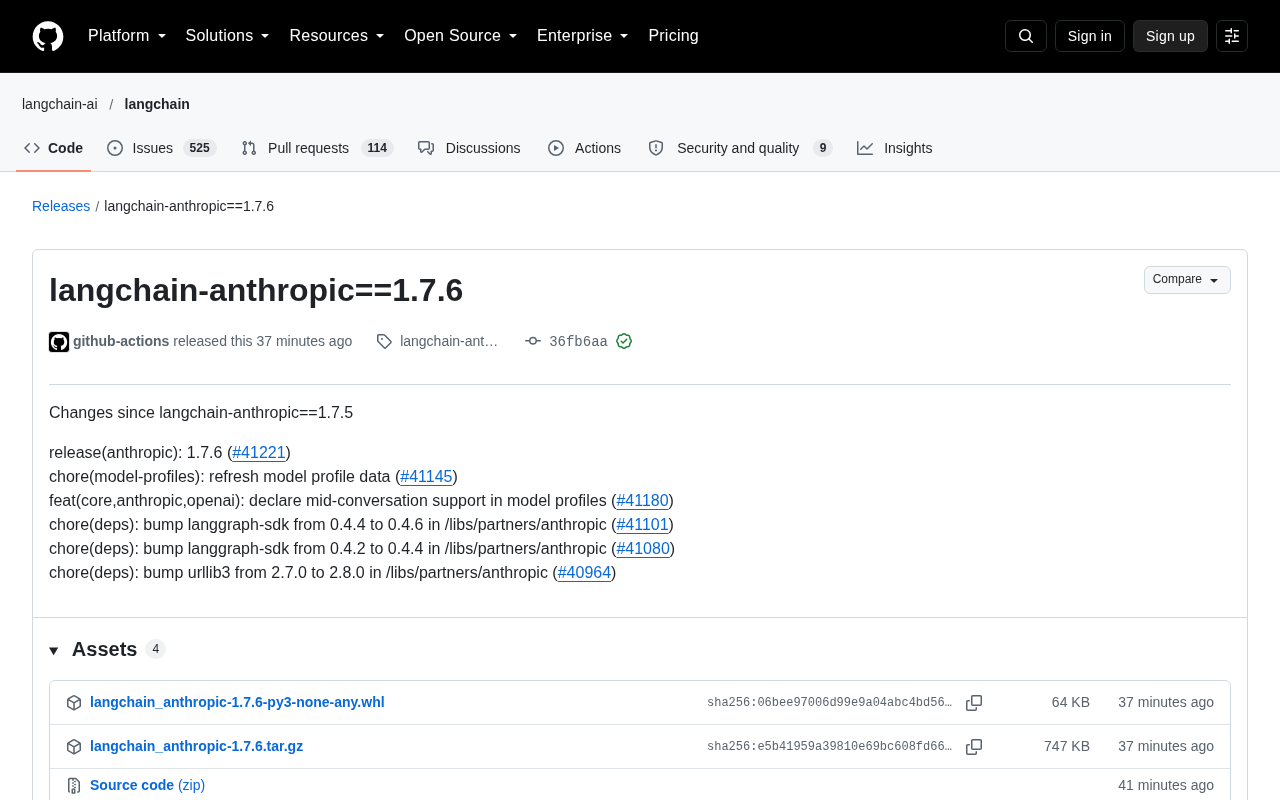
The changelog from 1.7.5 to 1.7.6 isn't long, focusing on three categories of work: model configuration data refresh, cross-vendor capability declarations, and dependency version upgrades. This "single-digit version bump" release cadence suggests the project is currently in a stable iteration phase, with changes mainly syncing underlying data rather than introducing breaking interface changes.
Specifically, this commit includes an official release record and a chore commit that refreshes model profile data. The latter is typically routine synchronization following upstream model information changes — whenever Anthropic adjusts model metadata or adds capability flags, the adapter layer needs corresponding updates to ensure the capability matrix read by callers matches the actual service.
What Mid-Conversation Support Means
What's truly worth expanding on is the feature commit spanning three packages: core, anthropic, and openai — declaring mid-conversation support in model profiles.
"Mid-conversation" refers to inserting new system instructions or context in the middle of an already-unfolding multi-turn session, rather than only being able to set a system prompt at the beginning of a conversation. For developers, this unlocks more flexible Agent orchestration: you can dynamically adjust model behavior, inject new tool descriptions or constraints during user interaction, without restarting the entire conversation.
Writing this capability into model profiles matters because it lets the framework layer automatically determine whether a given model supports the feature. This way, upper-level chains don't need to hardcode vendor-specific logic, but instead read a unified capability description to decide how to invoke. This is especially friendly for applications mixing multiple models — the same code can automatically downgrade or switch strategies based on the profile.
To understand the value of mid-conversation, one needs to distinguish it from standard multi-turn dialogue. In traditional interfaces like OpenAI Chat Completions, system role messages are usually conventionally placed at the front of the message array as the global setting for the entire session; once the conversation starts, only user and assistant messages can be appended. Anthropic's Messages API, however, allows inserting system content at any position — effectively achieved by including system instructions as part of user messages or appending new context blocks after assistant messages. This difference stems from how each vendor handles the semantics of "system prompt": some treat it as an immutable prefix, while others allow it to become a mutable node in the conversation flow. LangChain abstracts this capability as a boolean flag on the model profile, precisely to smooth over these vendor-level semantic differences.
Model profiles are a standardized model metadata mechanism LangChain has recently been promoting. It structurally describes a model's context window size, supported modalities, whether it supports tool calling, whether it supports structured output, and other capabilities. Previously, this information was often scattered in code branches or hardcoded checks across partner packages — things like if model_name.startswith("claude-3"). After switching to profile declarations, the capability matrix becomes queryable data that can be read by upper-level Agent frameworks and used by routing layers for automatic model selection or downgrading. Mid-conversation joining as a new field is essentially extending this capability description language, so that behavior like "can instructions be changed mid-session" no longer depends on vendor-specific branch logic.
Dependencies and Engineering Maintenance
The version update also upgraded several dependencies. langgraph-sdk went from 0.4.2 through two increments to 0.4.6; urllib3 went from 2.7.0 to 2.8.0. These are mostly routine synchronization following the main project, used to maintain version consistency across partner packages and reduce the probability of dependency conflicts in user environments.
For the vast majority of users, this kind of patch-level upgrade can be safely adopted: there are no breaking changes at the interface level, and the upgrade cost is mainly confirming that your own dependency tree resolves properly. If your project uses multiple LangChain partner packages simultaneously, it's recommended to upgrade them as a group to avoid SDK version mismatches.
langgraph-sdk is a client library in the LangGraph and LangChain ecosystem for building stateful, multi-step Agent graphs. It handles communication with the LangGraph server, manages session state and checkpoints. urllib3 is one of the lowest-level HTTP client libraries in the Python ecosystem; a large number of libraries including requests and botocore depend on it directly or indirectly, so its version upgrades ripple through the entire dependency chain. LangChain partner packages (like langchain-anthropic and langchain-openai) typically lock a set of mutually compatible langgraph-sdk and core library version ranges. If version ranges required by different packages don't overlap, pip will report conflicts during resolution. This is why the official recommendation is to upgrade as a group when using multiple partner packages.
How to Choose Whether to Upgrade
If you're using Anthropic as your model backend and have needs for dynamically adjusting conversation context, the mid-conversation capability declaration provided by this version is worth including in your planning. If you're just doing routine calls without scenarios involving mid-session instruction changes, you can upgrade on your usual schedule without disrupting existing plans for it.
Overall, langchain-anthropic 1.7.6 is a maintenance release with modest information content but no shortage of highlights: most commits are data synchronization and dependency maintenance, while the mid-conversation capability declaration points to a longer-term trend of increasingly standardized model capability descriptions.
Related articles

Chain of Thought Isn't Just for AI: How Humans Can Use CoT to Improve Thinking Quality
Chain of Thought isn't just a prompt trick for large models. Starting from a Hacker News discussion, this article analyzes why CoT works for human thinking too, breaks down actionable ways to transfer it, and highlights the key differences between human CoT and machine CoT.
Cloudflare Teams Up with OpenAI: Closi…
Cloudflare Teams Up with OpenAI: Closing the Loop from Vulnerability Discovery to Defense with AI
Cloudflare uses OpenAI Daybreak to investigate security vulnerabilities and generate reviewable remediation plans, while developers use Codex to boost coding efficiency and quality.

Orca Multi-Agent Orchestration in Practice: A Guide to Parallel Collaboration with Claude and Codex
Orca is Stable AI's free open-source agent workbench supporting 34 agents like Claude Code and Codex in parallel. Learn its Git worktree isolation, multi-model orchestration, and mobile management.