LangChain Beginner's Guide: A Three-Layer Learning Method to Take You from Understanding to Mastery

Master LangChain with a proven three-layer method: understand it, code it, explain it.
This article introduces LangChain's core position in the LLM technology stack—unifying LLM, Agent, and MCP capabilities—and presents a proven three-layer learning methodology: understand the concepts, write the code by hand, and explain it to others. Combined with personalized mind maps and notes, this approach helps developers build solid foundations for LLM application development.
Introduction: The Core Foundation of LLM Application Development
As large model technology sweeps across every industry, LangChain has become one of the core frameworks for LLM application development. It connects Large Language Models (LLMs), Agents, and MCP (Model Context Protocol) capabilities, enabling developers to quickly build production-ready applications.
This article is based on a LangChain introductory course shared by an LLM instructor, focusing on two aspects: first, LangChain's positioning within the broader LLM technology stack; and second, a proven, highly effective learning methodology that was repeatedly emphasized throughout the course. For developers just getting started with large models who want a systematic introduction, both of these are indispensable.
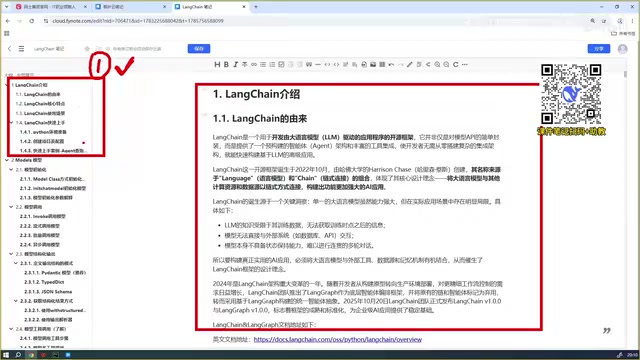
LangChain's Core Position in the LLM Technology Stack
Why LLM + Agent + MCP
The large model technology stack is vast, but its most core and foundational component revolves around LLM and Agent hands-on development. The instructor explicitly stated that this content is the "most core and foundational" part of the entire LLM development workflow.
-
LLM (Large Language Model): The capability foundation, responsible for understanding and generation. Large language models are built on the Transformer architecture, pre-trained on massive text datasets. Since Google published the Attention Is All You Need paper in 2017, introducing the Transformer architecture, language models have evolved from BERT's encoder paradigm to the GPT series' decoder paradigm. Current mainstream LLMs (such as GPT-4, Claude, Llama, Qwen, etc.) range from billions to hundreds of billions of parameters. Their core working principle is autoregressive generation — predicting the next most likely token based on existing context. Understanding this underlying mechanism helps developers better design prompts, control generation behavior (such as sampling parameters like temperature and top_p), and understand the inherently probabilistic nature of model outputs when using LangChain to call models.
-
Agent: Gives models the ability to plan, invoke tools, and perform multi-step reasoning — the key to moving from "chatbot" to "automated application." The Agent concept originates from classical AI research, referring to systems that can perceive their environment, make autonomous decisions, and take actions to achieve goals. In the era of large models, the core breakthrough for Agents lies in using LLMs as the "brain" for task planning and reasoning. In 2023, the paper ReAct: Synergizing Reasoning and Acting in Language Models proposed the ReAct paradigm, allowing models to alternate between "Reasoning" and "Acting," laying the foundation for current mainstream Agent architectures. A typical LLM Agent workflow includes: receiving user instructions → decomposing tasks → selecting and calling tools → observing tool return results → continuing reasoning or returning the final answer.
-
MCP (Model Context Protocol): As a standardized approach for context and tool integration, MCP makes the connection between Agents and external data/services more standardized. MCP is an open standard protocol introduced by Anthropic in late 2024, designed to address the pain point of "fragmented tool and data source integration" in large model applications. Before MCP, every LLM application that needed to interface with external tools (such as calendars, databases, file systems, third-party APIs) required developers to manually write adapter code, and tool definition formats were incompatible across different frameworks. By defining a unified client-server communication protocol, MCP allows tool providers to implement an MCP Server once, and it can be directly called by any MCP-compatible client — an architecture similar to what the USB protocol does for hardware devices, where standardized interfaces enable plug-and-play across the ecosystem.
LangChain 1.3 integrates all three under a unified framework, allowing theory and practice to be covered in "one complete package." LangChain was originally open-sourced by Harrison Chase in October 2022 and quickly grew into one of the most active frameworks in the LLM application development space. Its core design philosophy is "composability" — modularizing LLM calls, prompt management, memory, Retrieval-Augmented Generation (RAG), tool calling, Agents, and more, so developers can assemble complex applications like building blocks. The current LangChain ecosystem includes several key components: LangChain Core (the core abstraction layer, defining the Runnable interface and LCEL expression language), LangChain Community (third-party integrations contributed by the community), LangSmith (an observability and evaluation platform for tracing call chains and debugging Agent behavior), and LangGraph (for building stateful, multi-step, loop-supporting complex Agent workflows). Version 1.3 made significant improvements in stability and API consistency, marking the framework's transition from a rapid iteration phase to relative maturity. For beginners, this means you don't need to piece together scattered tools — you can build a holistic understanding of LLM application development with a single framework.
Macro Understanding First, Deep Dives Later
The goal during the introductory stage isn't to study every module to the extreme, but to build an overall technology map. The instructor candidly noted that the introductory course "can't go extremely deep into every topic," but it can give learners "a very macro-level understanding of the entire LLM technology stack." This approach of building the framework first and then drilling into specifics follows the general pattern of effective technical learning — get the map first, then walk the detailed paths.
Effective Learning Method: The Three-Layer Progression of Understand, Code, and Explain
The learning methodology repeatedly emphasized throughout the course is actually more valuable for all LLM learners than any specific API knowledge. It can be summarized as "three layers."
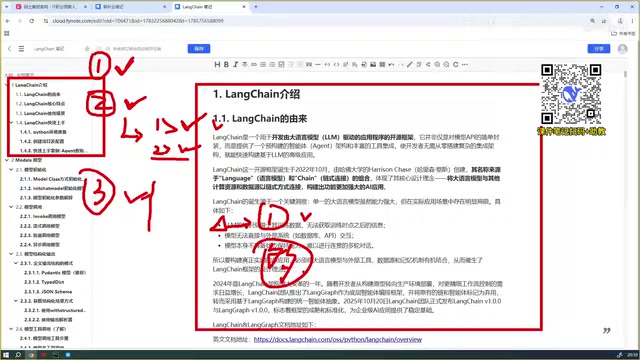
Layer 1: Understand — Build the Knowledge Framework
The first pass of learning focuses on "quick read-through" — go through a chapter at 1.5x or even 2x speed. The goal is to understand what the main technical content of each section covers and form a mental structure first. This step doesn't take much time, but it prevents you from getting lost in details and losing sight of the big picture.
The second pass is where you truly put in the effort — read carefully, study in depth, and thoroughly digest every knowledge point.
Layer 2: Code It Out — Write Code Hands-On
The point the instructor emphasized most is: you absolutely must write code by hand. This was mentioned repeatedly throughout the course.
The practical strategy given was very specific:
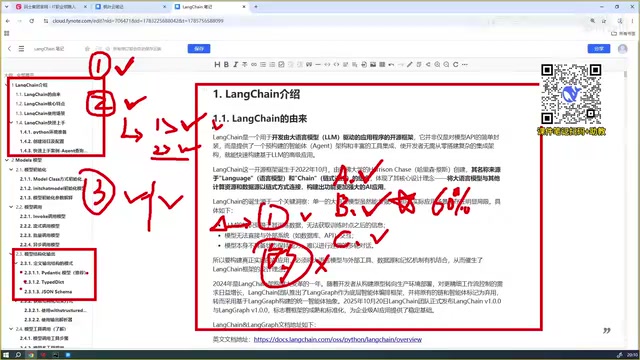
- Knowledge points with a single example: You must type it out yourself — don't skip a single one.
- Knowledge points with multiple examples: Choose the most important one to code, and just understand the rest. For instance, "structured model output" has three approaches — you only need to code one thoroughly; understanding the principles of the other two is sufficient.
Why is hands-on coding essential? The instructor gave two reasons: first, without coding, you'll forget knowledge points extremely quickly; second, without coding, you can never build a knowledge system. Many people finish studying and think "that term sounds familiar, but I can't recall the details" — the root cause is the lack of hands-on practice. He also offered a pragmatic number: if you can follow along and code just 60% of the content, you'll outperform the vast majority of competitors in interviews.
Regarding the common question of "do I still need to write code if I have AI coding assistants (like Copilot)," the instructor's answer was very direct: coding today is so you can more effectively not code tomorrow. Master the underlying logic first, and then you can maintain good judgment when leveraging AI tools, rather than being replaced by them. This viewpoint resonates widely in the industry. While AI coding assistants like GitHub Copilot, Cursor, and Tongyi Lingma can auto-complete code based on context or even generate complete modules, multiple developer surveys show that AI-generated code accuracy drops significantly in scenarios involving complex business logic, edge case handling, and framework-specific APIs. If developers lack understanding of underlying principles, they cannot effectively review and correct AI-generated code, and may instead introduce hard-to-detect bugs. The core value of human developers is shifting from "writing code" to "architecture design, logic review, and problem diagnosis" — and these higher-order capabilities must be built on a solid foundation of underlying understanding.
Layer 3: Explain It — The Ultimate Test of True Mastery
The highest layer is being able to clearly explain a knowledge point to others. Understanding is the first layer, coding it out is the second, and being able to explain it is the third. Being able to explain means you've truly internalized the knowledge and formed your own expression logic — this is also the best standard for testing your level of mastery.
This method closely aligns with the famous Feynman Technique. Nobel Prize-winning physicist Richard Feynman advocated that the best way to test whether you truly understand a concept is to try explaining it in simple language to someone who knows nothing about it. Cognitive science research also shows that "Retrieval Practice" — actively retrieving information from memory and organizing it for expression — is more than 50% more effective than passive repeated reading. When you try to explain a technical concept to someone else, your brain is forced to structurally organize scattered knowledge points and identify breaks in the logical chain, thereby exposing your true knowledge gaps. This is why the instructor designated "being able to explain it" as the ultimate test of mastery.
Building a Knowledge System with Mind Maps and Notes
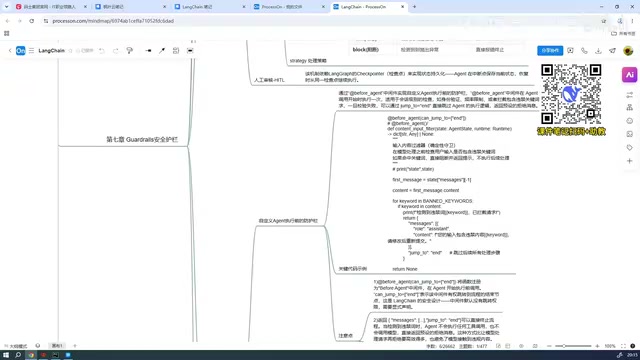
During the second-pass deep study, the instructor recommends organizing mind maps and notes using "knowledge points as nodes." There's one critical reminder: don't copy someone else's notes verbatim.
The instructor's notes are written for all students and cover every detail, but for you personally, much of the content is already understood — copying it down is meaningless. The correct approach is:
- Only record unique insights formed during your own learning process;
- Focus on marking areas where your grasp is weak;
- Write down problems and noteworthy details encountered while coding;
- Separately record things you don't understand, making it easy to review later and revisit before interviews.
Comprehensive large-scale case studies are often very time-consuming with extensive code — notes don't need to be copied line by line. Capture the key code and core ideas. This "personalized notes" approach reflects your real learning gaps far better than mechanical transcription.
Conclusion: Method Is More Valuable Than Content
For readers looking to get started with LLM application development, LangChain 1.3 offers a relatively complete practical pathway — from LLM to Agent to MCP, bridging theory and code. But what truly determines learning effectiveness is often not the materials themselves, but the learning method.
The "Understand → Code It → Explain It" three-layer progression, combined with personalized mind maps and notes, is a simple yet extremely effective paradigm for technical learning. It applies not only to LangChain but to any rapidly evolving technology. As AI tools grow increasingly powerful, building solid foundational skills first is the only way to make tools truly work for you — rather than replace you.
Related articles

Chain of Thought Isn't Just for AI: How Humans Can Use CoT to Improve Thinking Quality
Chain of Thought isn't just a prompt trick for large models. Starting from a Hacker News discussion, this article analyzes why CoT works for human thinking too, breaks down actionable ways to transfer it, and highlights the key differences between human CoT and machine CoT.
Cloudflare Teams Up with OpenAI: Closi…
Cloudflare Teams Up with OpenAI: Closing the Loop from Vulnerability Discovery to Defense with AI
Cloudflare uses OpenAI Daybreak to investigate security vulnerabilities and generate reviewable remediation plans, while developers use Codex to boost coding efficiency and quality.

Orca Multi-Agent Orchestration in Practice: A Guide to Parallel Collaboration with Claude and Codex
Orca is Stable AI's free open-source agent workbench supporting 34 agents like Claude Code and Codex in parallel. Learn its Git worktree isolation, multi-model orchestration, and mobile management.