LangChain Core 1.6.11 Released: Tracer Now Supports Address Configuration

langchain-core 1.6.11 lets LangChainTracer specify the tracing reporting address at construction time.
langchain-core released a minor update 1.6.11 with only two commits since 1.6.10: a version release and one feature enhancement. The core change lets LangChainTracer accept an address parameter during initialization, upgrading the tracing reporting endpoint from environment variables and global config to a per-instance constructor parameter. For developers using LangSmith, this means specifying different endpoints for different chains in code—suitable for multi-environment routing, parallel management of multiple tracing targets, and connecting to enterprise self-built tracing services, avoiding data cross-contamination from overwritten environment variables. langchain-core versions are independent of langchain and langgraph; the change is narrow, and if the current default config is stable, the upgrade isn't urgent, but recommended when dynamic endpoint specification is needed.
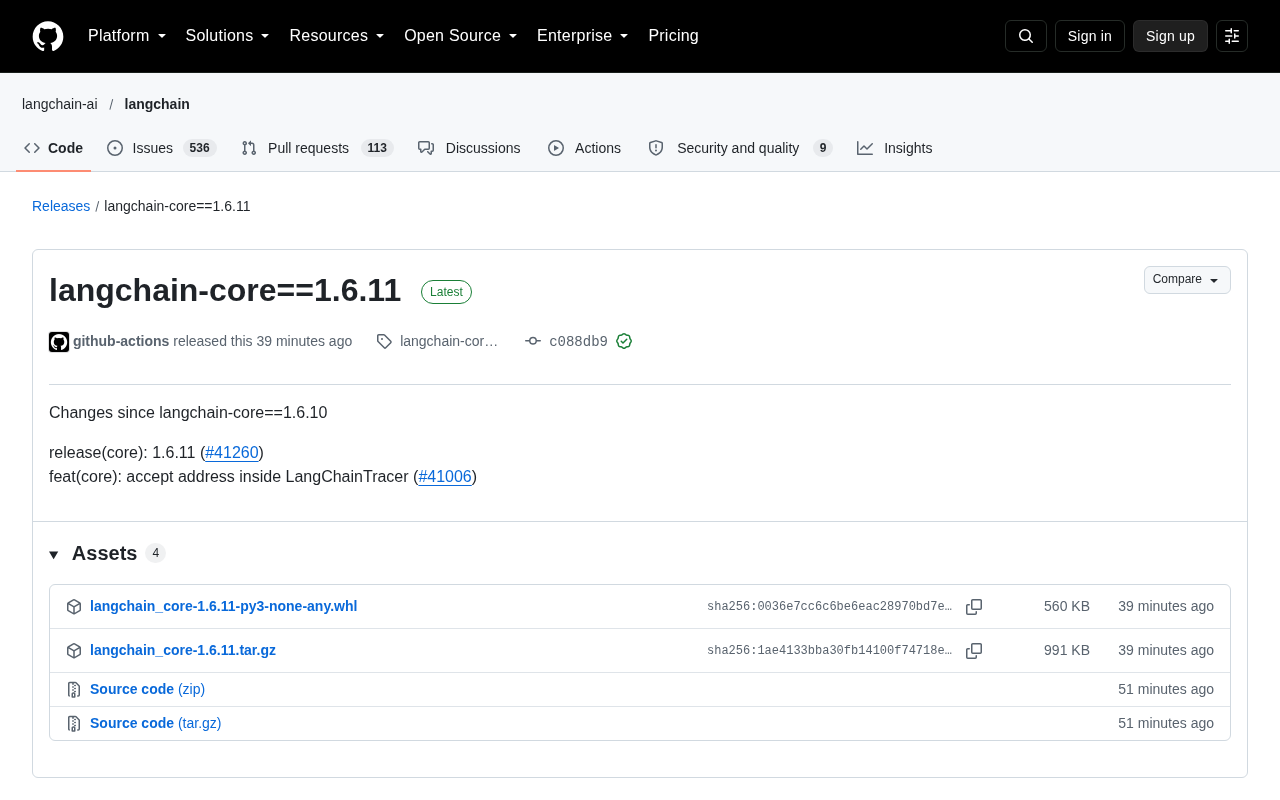
LangChain's core library, langchain-core, has released version 1.6.11, a minor iteration following 1.6.10. According to the official GitHub Release page, this update was automatically published by the github-actions bot on the 15th, with a commit bearing a GitHub verified signature—typical routine maintenance.
Although only the last digit of the version number changed, this update touches LangChain's tracing infrastructure, which is worth noting for developers using LangSmith for observability.
Two Core Changes in This Update
According to the official changelog, 1.6.11 includes two commits since 1.6.10:
1. Version release commit
release(core): 1.6.11 (#41260) is the routine version bump and packaging release process, corresponding to PR #41260.
2. Feature enhancement: LangChainTracer supports passing an address
feat(core): accept address inside LangChainTracer (#41006) is the only functional change in this release, corresponding to PR #41006. It allows LangChainTracer to accept an address parameter during initialization.
What Is LangChainTracer
LangChainTracer is the component in langchain-core responsible for reporting runtime events—chains, tool calls, LLM requests, etc.—to LangSmith. Developers typically enable it when debugging complex Agent flows or troubleshooting production issues, to inspect the input/output, latency, and token consumption of each step.
Previously, the reporting endpoint for tracing data often relied on environment variables or global configuration. 1.6.11 elevates address to a constructor parameter, meaning you can specify the endpoint directly when instantiating the Tracer, giving finer-grained control at the code level.
LangSmith is LangChain's official observability and evaluation platform, used to record, visualize, and analyze the execution traces of large model applications. When tracing is enabled, each chain call, tool execution, or LLM request generates a trace containing input, output, latency, token usage, and parent-child call relationships. These traces are reported to LangSmith's hosted endpoint by default. For enterprises with data compliance requirements or needing to reduce latency, LangSmith also supports self-hosted deployment, in which case the reporting target is a custom address.
The LangSmith SDK determines the reporting endpoint through a set of environment variables, the most critical being LANGCHAIN_ENDPOINT (or LANGSMITH_ENDPOINT) for specifying the service address, LANGCHAIN_API_KEY for authentication, and LANGCHAIN_TRACING_V2 for toggling tracing. Because these are process-level variables, once set, all tracing behavior within the process shares the same target. This is precisely why switching endpoints previously required environment variables.
What Problem Does This Change Solve
In multi-environment or self-hosted scenarios, developers may need to send data from different chains to different LangSmith endpoints—for example, test traffic to one project and production traffic to another, or connecting to an enterprise's self-built tracing service. By passing address as a constructor parameter, this routing logic can be written in code without repeatedly switching environment variables.
For scenarios requiring parallel management of multiple tracing targets within the same process, constructor parameterization is also safer than global configuration, avoiding data cross-contamination caused by accidentally overwritten environment variables.
LangChain's ecosystem consists of multiple independently versioned packages, and understanding their layering helps assess upgrade impact. langchain-core is the lowest abstraction layer, defining Runnable, message types, tool interfaces, and tracing protocols; langchain provides higher-level wrappers for chains and Agents on top; langgraph focuses on graph-based state machine workflows. The three have independent version numbers and are not forced to align, so upgrading only langchain-core without touching higher-level packages is usually feasible.
However, this decoupling also means that new APIs added at the lower layer may not be directly usable by upper frameworks unless explicitly exposed. langchain-core is responsible for providing LangChainTracer, but whether langchain's traceable decorator or langgraph's runtime passes address through depends on each project's maintenance cadence. Therefore, the value of such foundational changes often isn't fully realized until upper layers follow up.
Upgrade Recommendations
langchain-core uses an independent version line, not forcibly bound to the versions of higher-level packages like langchain or langgraph. If you're using LangSmith tracing and have the following needs, upgrading to 1.6.11 is recommended:
- Need to dynamically specify the tracing reporting address in code
- Need to connect to multiple tracing endpoints within the same process
- Want to reduce implicit reliance on environment variables
If your current tracing configuration relies entirely on default environment variables and runs stably, this upgrade isn't urgent and can be handled during your next routine dependency update.
Install or upgrade command:
pip install -U langchain-core==1.6.11
Summary
1.6.11 is a typical "small steps, fast pace" update: one version release commit plus one tracer enhancement. The change surface is narrow, but it hits a real pain point in observability configuration flexibility. As the foundation of the entire LangChain ecosystem, such fine-grained API exposure in langchain-core often gets gradually absorbed by upper frameworks, so it's worth watching whether langchain and langgraph will follow up by exposing the corresponding configuration entry points.
One-line Summary
langchain-core 1.6.11 lets LangChainTracer specify the tracing reporting address at construction time.
Paragraph Summary
langchain-core has released a minor update, 1.6.11, with only two commits since 1.6.10: a version release and one feature enhancement. The core change allows LangChainTracer to accept an address parameter during initialization, elevating the tracing reporting endpoint from environment variables and global configuration to a per-instance constructor parameter. For developers using LangSmith for observability, this means they can specify different endpoints for different chains at the code level—useful for multi-environment routing, parallel management of multiple tracing targets, and connecting to enterprise self-built tracing services—avoiding data cross-contamination caused by overwritten environment variables. langchain-core versions are independent of langchain and langgraph; the change surface is narrow, and if the current default configuration is stable, the upgrade isn't urgent, but it's recommended when you need dynamic endpoint specification.
Related articles

Chain of Thought Isn't Just for AI: How Humans Can Use CoT to Improve Thinking Quality
Chain of Thought isn't just a prompt trick for large models. Starting from a Hacker News discussion, this article analyzes why CoT works for human thinking too, breaks down actionable ways to transfer it, and highlights the key differences between human CoT and machine CoT.
Cloudflare Teams Up with OpenAI: Closi…
Cloudflare Teams Up with OpenAI: Closing the Loop from Vulnerability Discovery to Defense with AI
Cloudflare uses OpenAI Daybreak to investigate security vulnerabilities and generate reviewable remediation plans, while developers use Codex to boost coding efficiency and quality.

Orca Multi-Agent Orchestration in Practice: A Guide to Parallel Collaboration with Claude and Codex
Orca is Stable AI's free open-source agent workbench supporting 34 agents like Claude Code and Codex in parallel. Learn its Git worktree isolation, multi-model orchestration, and mobile management.