LangChain Core 1.6.7 Released: Python 3.14 Compatibility and Bedrock Fix

LangChain Core 1.6.7 adds Python 3.14 support, fixes Bedrock content fields, and upgrades key dependencies.
LangChain Core 1.6.7 is a focused maintenance patch covering three areas: proactive compatibility hardening for Python 3.14's changes to `inspect.signature` to keep tool-calling parameter parsing reliable; a fix for the missing `redacted_content` field in v1 output for Bedrock Converse, closing a gap in content-filtering audit trails; and Dependabot-driven upgrades to urllib3, tornado, and notebook to maintain supply chain security. Low-risk and narrow in scope, this release offers direct practical value for teams planning a Python 3.14 migration or using AWS Bedrock integration.
LangChain, one of the most widely used frameworks for building large language model applications, has released version 1.6.7 of its core library langchain-core. The release was completed via GitHub Actions automation and verified with a GitHub signature. This is a routine maintenance update focused on three areas: strengthening Python 3.14 compatibility, fixing a Bedrock integration issue, and upgrading key dependencies for security.
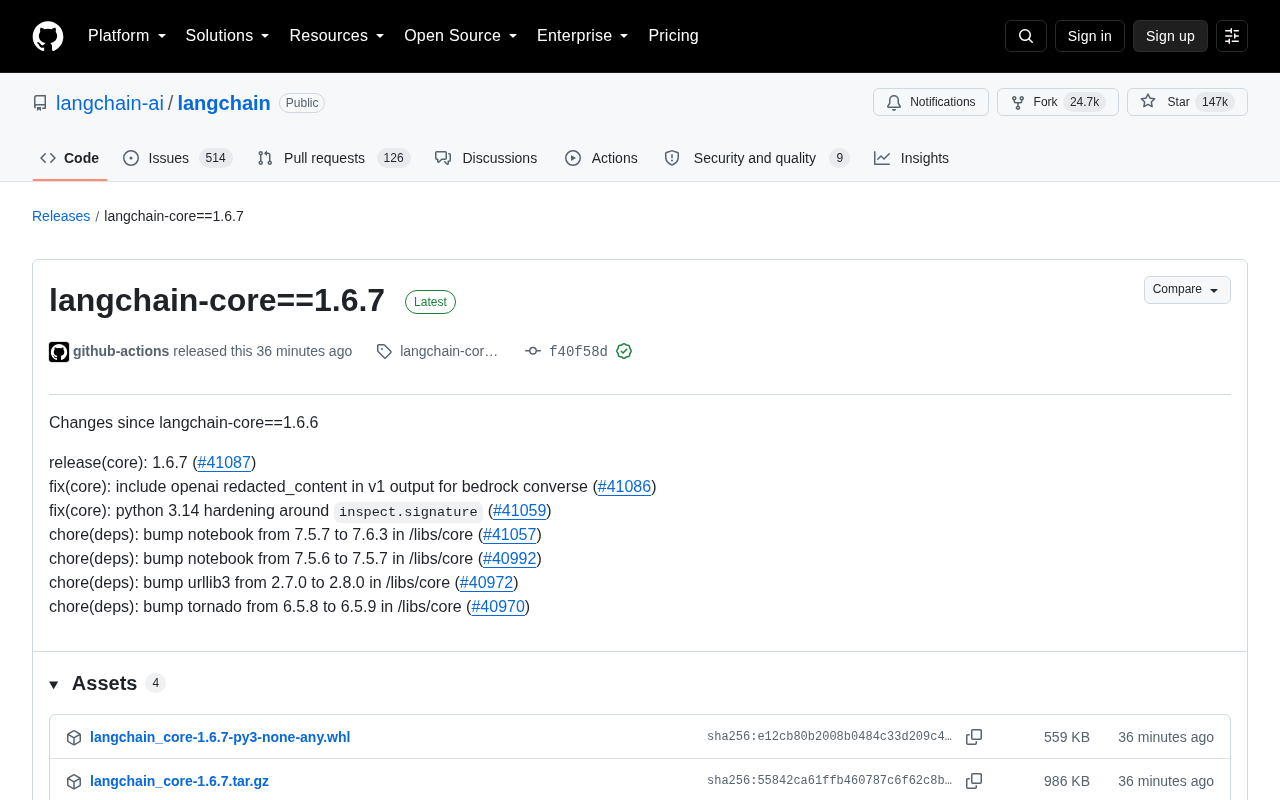
What's in This Update
Compared to 1.6.6, the changes in 1.6.7 are limited in scope but each addresses a real-world stability or compatibility concern. For teams running LangChain in production, patch releases like this often deserve more attention than major feature releases — they directly affect whether existing code continues to run smoothly.
Python 3.14 Compatibility Hardening
The most forward-looking change in this release is a compatibility fix around inspect.signature for Python 3.14 (#41059). Python 3.14 introduces adjustments to the introspection mechanisms in the standard library, and LangChain Core relies heavily on the inspect module to parse function signatures and construct tool-calling parameters. Getting ahead of this now means developers can upgrade their runtime environment with fewer surprises.
This change reflects the LangChain maintenance team's commitment to tracking upstream language versions. Since ecosystem libraries often lag behind new Python releases, having the core framework proactively harden against these changes benefits the stability of the entire toolchain.
inspect.signature is the core API in Python's standard inspect module for retrieving the parameter signatures of callable objects — functions, methods, and classes. LangChain Core uses it at runtime to automatically parse parameter names, type annotations, and default values from developer-defined functions, then converts them into JSON Schema format to pass to large language models as tool-calling arguments. Python 3.14 adjusts the introspection behavior of the inspect module, and in certain edge cases involving deferred annotation evaluation (along the PEP 563/649 evolution path), the existing signature-parsing logic could throw exceptions or return incomplete information. This hardening adds defensive handling for those edge cases, ensuring the framework can reliably map function signatures to tool-calling parameters under Python 3.14.
Bedrock Converse Content Fix
The other functional fix adds support for OpenAI redacted_content in v1 output, specifically for the Bedrock Converse scenario (#41086). Amazon Bedrock is a critical gateway for enterprise users accessing multiple foundation models, and previously there was a gap in handling redacted content fields.
With this fix, developers using the Bedrock Converse API can now correctly retrieve the redacted_content field in the v1 output format. This is a practical improvement for applications that require complete auditing of model outputs or handle scenarios involving sensitive content filtering.
Amazon Bedrock Converse API is a unified conversational interface launched by AWS in 2024. Developers can call foundation models from multiple vendors — including Anthropic Claude, Meta Llama, and Mistral — through a single API without needing to adapt to each model's individual request format. The redacted_content field is the mechanism by which the API marks message segments that have been redacted or intercepted by AWS content filtering policies in its responses. When model output triggers a safety Guardrail, the original content is replaced with this field, carrying a redaction identifier and reason code. For enterprise applications that need to maintain complete logs of model interactions or track content filtering decisions for compliance audits, if the application-layer framework cannot correctly pass through this field, it can create blind spots in the audit trail or even cause parsing errors due to missing fields.
Dependency Security and Maintenance Upgrades
Beyond functional fixes, this release includes several dependency upgrades focused on security and maintenance:
urllib3bumped from 2.7.0 to 2.8.0tornadobumped from 6.5.8 to 6.5.9notebookupgraded through to 7.6.3 (via 7.5.6 → 7.5.7 → 7.6.3)
These Dependabot-submitted dependency updates may seem minor, but in an era where supply chain security is increasingly critical, staying current with upstream patch releases is a fundamental practice for reducing potential vulnerability exposure. As commonly used components in the networking layer, urllib3 and tornado updates typically include security fixes — something production users should take note of.
What This Means for Developers
LangChain currently has over 147,000 stars and 24,700 forks on GitHub, making it one of the most widely used open-source frameworks in the AI application development space. Because of its massive ecosystem, every update to the core library ripples across a large number of downstream projects.
The value of a patch release like 1.6.7 lies in:
- Forward compatibility assurance: Early adaptation for Python 3.14 gives teams planning a runtime upgrade some breathing room.
- Edge case fixes: The Bedrock Converse content field fix resolves a data integrity issue in a specific integration path.
- Maintaining the security baseline: Dependency upgrades ensure the framework doesn't become a weak link due to known vulnerabilities in underlying components.
For developers currently using LangChain, it's worth checking whether your project involves Bedrock integration or plans to migrate to Python 3.14 before upgrading. If neither applies, this is a low-risk routine update you can adopt on your normal schedule.
Summary
LangChain Core 1.6.7 is not a feature-packed major release — it's a textbook engineering maintenance update. It reflects that mature open-source frameworks, beyond rapid feature iteration, place equal importance on compatibility tracking and security upkeep. For teams that rely on this framework for long-term production systems, keeping up with patch releases like this is an important part of maintaining system robustness.
Related articles

JobRunner MCP Server: AI Agents Can Now Fix Failed Java Jobs
JobRunner launches an open-source MCP server enabling AI agents to view cluster status, diagnose failures, and recover Java jobs—incident response from any cloud coding environment or existing agent.

MLAI Digital Launches 9 Security Agents: MCP Server Safeguards the Full Lifecycle of Agentic AI
MLAI Digital launches Security MCP Server with nine built-in specialized security agents covering vulnerability discovery, attack simulation, prompt injection detection, API and infrastructure assessment, and accelerated remediation—embedding security validation across the full Agentic AI lifecycle from development to production.

Running Isaac Lab on H100 GPUs: Exploring Better Approaches
Exploring optimization methods for running Isaac Lab on NVIDIA H100 GPUs, including MIG configuration, mixed precision, TensorRT acceleration, and community experience to improve robotics simulation and reinforcement learning efficiency.