LangChain Deep Agents in Practice: Ten Agent Development Pain Points and Their Solutions

LangChain launches Deep Agents framework to solve enterprise Agent development challenges from Demo to production
LangChain introduces the Deep Agents system, providing framework-level standardized solutions for ten major pain points in enterprise Agent development, including tool sprawl, context pollution, cost blowout, and security risks. Using Deep Research as a representative application, it demonstrates AI Agents' ability to simulate human researchers through autonomous planning, multi-source information integration, and structured report generation, while offering enterprises customizable infrastructure to bridge the gap between generic AI products and enterprise-level applications.
Introduction: Why Is Agent Development So Hard
As large model applications move into deeper waters, more and more enterprises are building intelligent applications based on Agents. But anyone who has actually done this knows there's a massive chasm between a Demo and a production environment. The LangChain team clearly recognized this — starting from V1, they repositioned their core focus toward Agents, introducing the Deep Agents paradigm, aimed squarely at those persistent challenges in enterprise-level Agent development.
This article breaks down the core design philosophy of Deep Agents, using Deep Research as an entry point to discuss how it lands in real business scenarios.
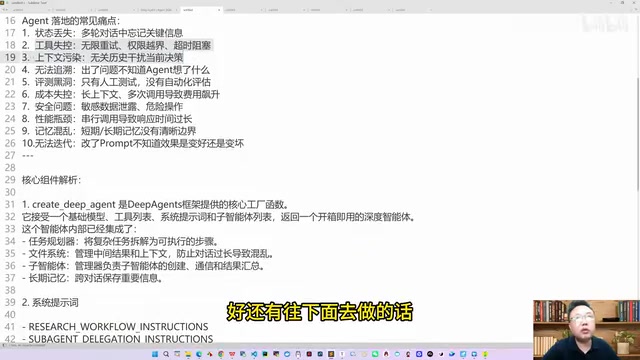
The Ten Most Common Pitfalls in Agent Development
Developers who've worked on Agent projects can usually rattle off a long list of problems. Boiled down, there are roughly ten high-frequency pain points. The two most devastating are tool sprawl and context pollution.
Tool Sprawl: Things Fall Apart When Tools Multiply
In the lab, giving an Agent three to five tools seems to work fine. But in real business environments, where an Agent needs to interface with dozens or even hundreds of APIs and tools, problems explode:
- Incorrect tool selection: The Agent can't determine which tool to call, and Tool Calls frequently go off-track
- Parameter extraction failures: Key parameters can't be accurately extracted from user input and conversation context, leading to call errors or garbage data
- Chaotic call chains: In multi-step tasks, the calling order and combination logic of tools deviates, rendering final results unusable
The root cause of tool sprawl lies in the Function Calling mechanism of large language models. When a model faces a large number of available tools, it needs to select the correct tool combination from an enormous decision space. This is similar to the "combinatorial explosion" problem in software engineering — permutations and combinations of 20 tools grow far beyond linear. Current mainstream solutions include tool hierarchical routing (classify first, then select), tool description optimization (making it easier for the model to understand each tool's applicable boundaries), and introducing intermediate reasoning steps for tool selection (similar to Chain-of-Thought but specifically for tool decisions).
This problem becomes particularly pronounced when the number of tools exceeds 20, making it the number one roadblock in enterprise Agent development.
Context Pollution: More History Means More Chaos
In multi-turn conversation scenarios, historical information continuously accumulates in the context window. The problem is that content from earlier turns can interfere with role judgment and task execution in the current turn, causing the Agent's behavior to gradually drift. How to isolate semantic information across different turns and manage the context window well is an engineering problem that requires careful design — prompt tuning alone is far from sufficient.
Context pollution is essentially a side effect of the attention mechanism in Transformer architecture. In multi-turn conversations, the model's attention disperses across all historical tokens, and instructions, role settings, or erroneous information from early conversations may create semantic interference with the current task. Common industry strategies include: sliding window truncation, conversation summary compression, relevance-based context filtering, and more granular separation management of System Prompts and User Messages. LangChain has introduced a Memory management module in this area, supporting combined use of multiple memory strategies.
Other Pain Points That Can't Be Ignored
Beyond the two core challenges above, developers are frequently troubled by the following:
- Cost blowout: When autonomous planning Agents handle long-chain tasks, token consumption is enormous — a single complex query can burn several dollars, with costs hard to predict. Taking GPT-4o as an example, input token pricing is approximately $2.5 per million tokens, and output is approximately $10 per million tokens. A single Deep Research task may involve dozens of LLM calls, each with a context window potentially containing tens of thousands of tokens of search results and intermediate reasoning. By conservative estimates, a complete deep research task may consume 500,000 to 2,000,000 tokens, corresponding to costs of $1-$5. For high-frequency use cases, monthly costs could reach thousands of dollars.
- Security risks: Sensitive data leakage, accidental execution of dangerous operations — these issues are not to be underestimated. Especially with next-generation Agents like Manus that can execute system commands through code, incidents like accidental file deletion or configuration changes are no exaggeration
- Insufficient observability: The Agent's decision path is like a black box, making it very difficult to pinpoint which step went wrong when issues arise
- Hallucinations and factual errors: Agents easily generate incorrect information during multi-step reasoning and propagate it layer by layer
- Multi-Agent collaboration difficulties: When systems involve multiple Agents working together, communication and state management complexity skyrockets. The complexity of Multi-Agent Systems (MAS) stems from classic distributed systems challenges: state consistency, communication protocol design, and failure recovery. When multiple Agents need to collaboratively complete a task, they need to share intermediate states, coordinate execution order, and handle conflicts and deadlocks. LangChain's LangGraph component is designed specifically to solve this problem — it models inter-Agent collaboration relationships as a directed graph, where each node is an Agent or processing step, and edges define state passing and conditional branching logic, thereby transforming complex multi-Agent orchestration problems into a visualizable, debuggable graph structure.
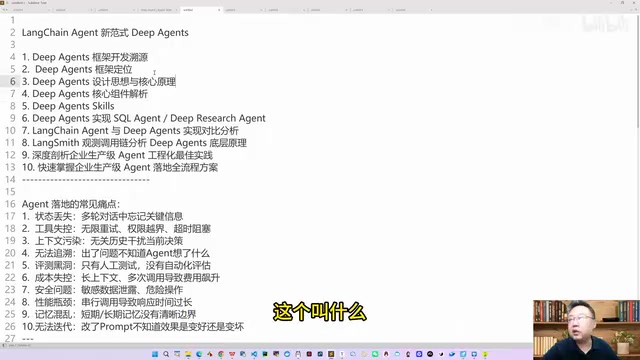
What Does LangChain Deep Agents Actually Solve
If developers had to tackle all these pain points individually, not only would the workload be massive, but solution consistency and maintainability would be hard to guarantee. LangChain's approach is: on top of the existing development framework, introduce the Deep Agents system, abstracting the common problems in enterprise Agent development into framework-level capabilities.
The core design philosophy of Deep Agents can be summarized in three points:
- Autonomous decision-making: Agents can independently complete complex task decomposition and planning
- Deep integration: Multi-source information fusion through internet search, document parsing, and other means
- Structured output: LLMs generate final results with standardized formats and clear logic
The goal of this system isn't to replace developers, but to standardize the repetitive, error-prone foundational work, letting teams focus their energy on business logic.
Deep Research: The Best Example for Understanding Deep Agents
What Is Deep Research
Deep Research is the most representative application scenario in the Deep Agents system. Simply put, it's an intelligent search and research technology driven by large language models, built on top of AI Agents' autonomous search capabilities.
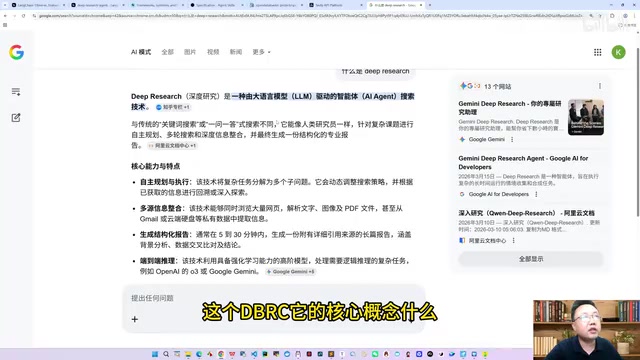
Compared to traditional keyword search or RAG (Retrieval-Augmented Generation), the fundamental difference with Deep Research is: it's not a single-turn "you ask, I answer" interaction, but rather simulates how a human researcher works — after receiving a complex topic, it independently formulates a research plan, searches step by step, cross-validates, and ultimately synthesizes a complete report.
It's worth explaining the technical differences between RAG and Deep Research here. RAG (Retrieval-Augmented Generation) has been the most mainstream knowledge augmentation approach since 2023. Its core process is: converting user queries into vectors, retrieving relevant document fragments from a pre-built vector database, then feeding the retrieved results as context to the large model for answer generation. RAG's limitation is that it's essentially single-round retrieval — one query corresponds to one retrieval, unable to handle complex research tasks requiring multi-step reasoning and cross-validation. Deep Research adds a planning layer and iteration layer on top of RAG, dynamically adjusting subsequent retrieval strategies based on intermediate results, forming a "search-read-think-search again" loop similar to a human researcher's workflow.
Its applicable scenarios are very broad:
- Market research: Industry analysis, competitor comparison, market trend forecasting
- Academic research: Paper topic exploration, literature review, research framework construction
- Financial analysis: Investment target research, industry financial report interpretation
- Government and consulting: Policy research, industry white paper authoring
Deep Research's Three-Step Workflow
Broken down, Deep Research's operational logic consists of three key stages:
Step 1: Autonomous Planning and Task Decomposition
When a user poses a complex topic (e.g., "Write a market research report on new energy vehicle overseas expansion"), the system doesn't directly search this big question. Instead, it first breaks it into multiple executable sub-questions — target market policy environment, main competitors, supply chain layout, consumer preferences, etc. — then dynamically adjusts the search strategy. This autonomous planning capability is what fundamentally distinguishes Deep Research from ordinary search.
Step 2: Multi-Source Information Integration
The system retrieves data from multiple heterogeneous information sources including web pages, PDF documents, databases, and charts, integrating them into a unified knowledge framework. This step solves the real-world problem of "information scattered everywhere in various formats."
Step 3: Structured Report Generation
The final output isn't a pile of links or scattered text fragments, but a professional research report with clear logic, sufficient data, and definitive conclusions.

Are Generic Products Enough? Why Do Enterprises Still Need Customization
There are already quite a few Deep Research products on the market — OpenAI's Deep Research, Google Gemini's Deep Research, and domestic platforms like Alibaba's Qwen have also launched similar features.
But there's a key issue: these products all target general-purpose scenarios. For enterprises, generic Deep Research can provide some help, but in vertical industry analysis, internal data integration, and specific business process interfacing, the results often fall short of business requirements.
For example: a pharmaceutical company needs to conduct comparative analysis of clinical data for competing drugs. Generic Deep Research can neither access the company's internal databases nor possesses the pharmaceutical industry's professional knowledge system — the generated report is likely to remain superficial.
This is precisely the core value of the LangChain Deep Agents framework — it provides an extensible infrastructure on which enterprises can connect their own data sources, inject industry knowledge, customize output formats, and build Deep Research systems that are truly production-ready.
Four Practical Recommendations for Enterprise Deep Agents Implementation
For technical teams considering adopting Deep Agents, the following experience points are worth referencing:
1. Start with Specific Scenarios — Don't Jump Straight to Building a Universal Agent
Choose a proven, mature scenario like Deep Research as your first implementation project, accumulate experience, then gradually expand. Attempting to build an "omnipotent Agent" in one shot is the most common path to failure.
2. Invest Heavily in Tool Orchestration
The number and complexity of tools in enterprise environments far exceeds experimental settings. You need to establish a comprehensive tool registry, intelligent routing mechanisms, and call monitoring systems — rather than dumping all tools onto the Agent at once.
3. Security Mechanisms Must Come First
For scenarios involving code execution and system operations, strict permission controls, sandbox isolation, and approval workflows must be established at the design phase. Security issues cannot wait until after an incident to be addressed.
A Sandbox is a security technology that restricts program execution to a controlled environment, preventing code execution from causing damage to the host system. In Agent scenarios, sandbox isolation is particularly critical when AI needs to execute code (such as data analysis, file operations). Common implementations include: Docker container isolation (each code execution runs in an independent container), lightweight sandboxes like gVisor, and WebAssembly-based browser-side sandboxes. Additionally, multiple layers of protection are needed, including file system whitelists, network access controls, and execution time limits, ensuring that even if an Agent generates dangerous instructions, no actual damage can occur.
4. Use Caching and Task Decomposition to Control Costs
Token consumption for long-chain Agents is a very real cost issue. Through proper intermediate result caching, task granularity control, and tiered model calling strategies (using lightweight models like GPT-4o-mini or Claude Haiku for simple subtasks, and strong models like GPT-4o or Claude Sonnet for critical decision steps), you can significantly reduce costs without sacrificing effectiveness. This is also why task decomposition isn't just a functional requirement — it's a core means of cost control.
Conclusion: From "It Runs" to "It's Usable" — Deep Agents Fills the Critical Gap
LangChain Deep Agents represents an important step in Agent development from "the Demo runs" to "production-ready." It doesn't just provide technical solutions for pain points like tool sprawl and context pollution — through representative applications like Deep Research, it demonstrates the real value of AI Agents in complex knowledge work.
For enterprises, the most important realization is: there will always be a gap between general AI products and enterprise-level applications, and the significance of frameworks like LangChain Deep Agents lies in helping you efficiently bridge that gap. Choose the right scenario, leverage the framework well, execute proper engineering — only then can Agents truly transform from a technical concept into business productivity.
Related articles
 Tutorials
ChatGPT Plus Subscription Guide: Are GPT-5.5, image-2, and Codex Worth the Upgrade?
A detailed look at ChatGPT Plus features — GPT-5.5, image-2, and Codex — with a Plus vs Pro comparison and a complete step-by-step subscription guide for users outside the US.
 Tutorials
Harness AI Engineering in Practice: Using Claude Code to Master Enterprise-Level E-Commerce Development
Deep dive into Harness AI Engineering: master enterprise e-commerce development with Claude Code using the Rules, Skills, Wiki, and Changes framework.
 Tutorials
Cursor + Codex Dual-IDE Collaboration: A Practical Methodology for Open-Source Project Customization
A complete methodology for open-source project customization based on real-world experience, detailing the Cursor+Codex dual-IDE workflow, seven-stage process, MVP validation, and AI source code reading techniques.