LangChain Enterprise Development in Practice: A Complete Path from Zero to Agent Deployment
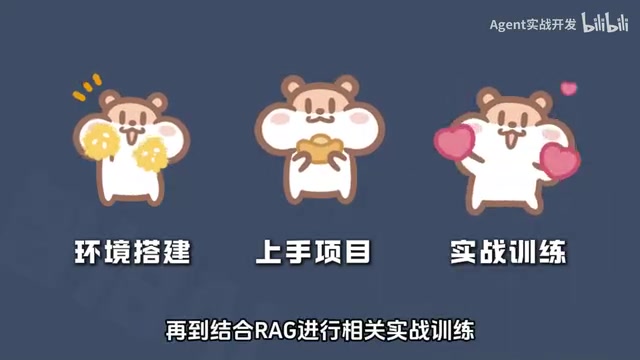
Outlines the Bilibili LangChain enterprise practice tutorial's structure, key knowledge points, and target audience.
Based on the public content of the Bilibili tutorial *LangChain Enterprise Development in Practice*, this article outlines the complete learning path from environment setup to enterprise-level Agent development. Core topics include model invocation, Chat Prompt Template, Messages object and System Prompt design, Output Parser, Chain and LCEL expressions, plus hands-on RAG training and Agent project deployment. The tutorial is positioned as a zero-foundation practical introduction, suitable for beginners who want to build knowledge bases and learn large model application development, but not for advanced learners already familiar with LangChain basics or seeking source-code-level principles. Follow-along suggestions emphasize coding while watching, with special attention to Prompt management, Output Parser, and RAG details such as data chunking and retrieval concatenation.
LangChain is a mainstream framework for large model application development. Its ecosystem is mature, but the learning curve is not low. This tutorial series on Bilibili, LangChain Enterprise Development in Practice, is positioned as "from zero to project deployment," attempting to take beginners from environment setup all the way to enterprise-grade Agent development through one complete path. Based on the publicly available content of this tutorial, this article outlines its course structure and core knowledge points to help you decide whether this path is worth following.
What This Tutorial Actually Covers
According to the tutorial's own description, the course starts with environment setup, first guides learners through running their first project, and then moves into hands-on RAG training. The overall design emphasizes gradual progression: each lesson delivers knowledge points densely, so learners do not have to piece together materials from scattered sources.
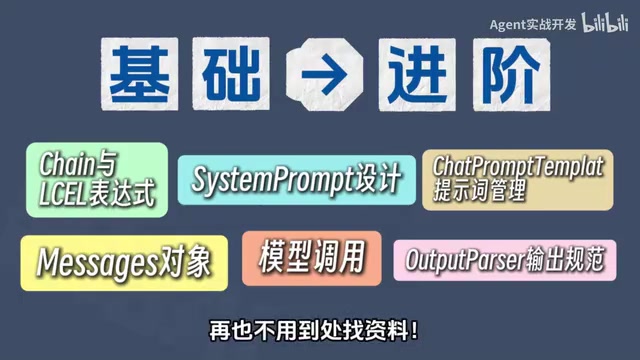
From the content arrangement, it breaks LangChain knowledge points down and explains them one by one, covering core modules such as model invocation, Prompt management, message objects, output parsing, chain invocation, and LCEL expressions, and extends to enterprise-level Agent project deployment. This linear structure from fundamentals to advanced topics is relatively friendly to beginners with no experience in large model applications.
Breaking Down the Core Knowledge Points
Model Invocation and Prompt Management
The course starts with the most basic model invocation, which is the starting point of every LangChain application. It then moves into Chat Prompt Template prompt management, which addresses how to templatize and parameterize prompts so that the same logic can adapt to different inputs.
The Messages object and System Prompt design are another focus. In enterprise applications, role setting and conversation context management directly determine output quality. This part explains the message structure clearly, which helps with building multi-turn conversations and multi-role Agents later.
LangChain is an open-source framework for building large language model (LLM) applications. Its core value lies in abstracting model invocation, prompt management, external data retrieval, tool invocation, and other steps into reusable components, and combining them through "chains." It was initially released as a Python library and later expanded to a JavaScript/TypeScript version, forming a multi-language ecosystem. LangChain's abstractions free developers from having to wrap API requests and context management from scratch, but they also introduce many conceptual layers, which is exactly why its learning curve is relatively steep. Understanding the framework's positioning—it is an "orchestration layer" rather than the model itself—helps determine which capabilities come from the model and which come from framework wrappers.
Output Parser and Chain Invocation
Output Parser is responsible for converting the raw text returned by the model into structured data, and it is a key link between model output and business logic. The tutorial treats output specifications as a separate section, indicating their importance to real projects—without reliable parsing, subsequent automation workflows cannot be built.
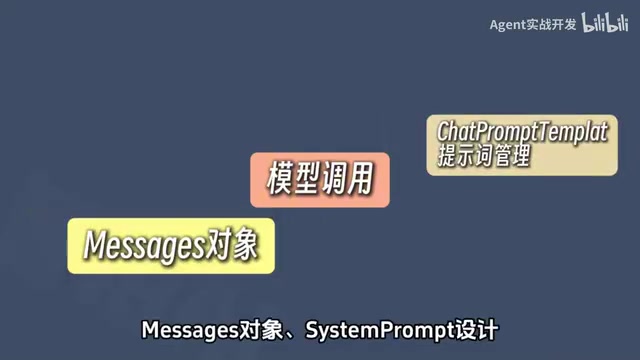
Chain and LCEL expressions are where LangChain's composition capabilities lie. LCEL uses declarative syntax to connect multiple components into a pipeline. The tutorial explains this part from basics to advanced topics, helping learners understand how to combine models, prompts, and parsers into reusable invocation chains.
LCEL (LangChain Expression Language) is a declarative composition syntax introduced by LangChain. It uses the pipe operator | to connect components such as prompt templates, models, and output parsers into an invocation chain, for example prompt | model | parser. Its design borrows from the idea of pipelines in functional programming. Each component implements a unified Runnable interface, so they can be freely combined, parallelized, or branched. The benefits of LCEL include native support for streaming output, asynchronous calls, batch processing, and retry mechanisms, as well as a clear chain structure at a glance. For beginners, the difficulty of LCEL is not the syntax itself, but understanding that the input and output types of each Runnable must match; otherwise, the chain will break at runtime.
RAG and Agent in Practice
The second half of the course moves into hands-on RAG training, one of the most common scenarios for enterprise deployment today: building a knowledge base and letting the model answer questions based on private data. The tutorial treats it as an independent practical segment, indicating that its purpose is not merely conceptual demonstration but a runnable project.
The ultimate goal is enterprise-level Agent development. Agents require the coordination of model invocation, tool use, context management, and output parsing, which correspond exactly to the knowledge points in the preceding modules. The course uses one main line to connect these contents, lowering the barrier for beginners to understand the overall Agent architecture.
RAG (Retrieval-Augmented Generation) is a technical paradigm that combines an external knowledge base with an LLM: first, documents are split into chunks and vectorized into a vector database; when a user asks a question, the most relevant chunks are retrieved, concatenated into the prompt, and then passed to the model to generate an answer. It addresses problems such as outdated model knowledge, inability to access private data, and the tendency to fabricate facts (hallucinations). The engineering difficulties of RAG are concentrated in three areas: document chunking strategy (chunk size and overlap), retrieval quality (choice of vector model and recall ranking), and context concatenation (how to organize retrieval results into the prompt without exceeding the context window). These details directly determine answer accuracy and are where enterprises invest the most effort during deployment.
Who It Is For and Who It Is Not For
The tutorial's positioning is clear: people with zero foundation who want to develop AI applications, build knowledge bases, and learn the core technologies of large model applications. If you are already familiar with LangChain's basic components or need in-depth source-code-level principles, this practice-oriented introductory course may not be enough.
The tutorial claims that learners can "avoid 99% of detours." This claim has a promotional flavor, and the actual effect depends on how much hands-on practice learners do. For beginners, setting up the environment, running the first project, and completing a RAG practice project can indeed build an overall understanding of large model application development.

Suggestions for Following Along
When following long video tutorials like this, it is advisable to type the code while watching and reproduce each module after finishing it. Prompt management and Output Parser may look simple, but they are the most error-prone parts in real projects and deserve extra time. In the RAG practice section, pay close attention to details of data chunking, retrieval, and context concatenation, as these steps directly determine final answer quality.
For the Agent section, do not stop at running a demo. Try combining the parsers and chain invocations learned earlier to understand how components collaborate; only then will you truly turn the course content into your own skills.
Background Supplement
Agent differs from ordinary chain invocation in "autonomous decision-making": the execution path of an ordinary chain is fixed when it is written, while an Agent dynamically decides, based on the current state, which tool to call next and whether to continue looping until the task is complete. An Agent in LangChain is usually composed of a model, a tool set (Tools), prompts, and an output parser. The model output is parsed into structured instructions such as "call a certain tool" or "give the final answer." This also explains why the article emphasizes the importance of Output Parser—every decision step of an Agent relies on reliable parsing. Common risks of Agents include non-converging loops, incorrect tool invocation parameters, and uncontrolled costs. In real projects, it is necessary to set a maximum number of iterations and human fallback mechanisms.
One-line Summary
Outlines the course structure, core knowledge points, and target audience of the Bilibili LangChain enterprise practice tutorial.
Paragraph Summary
Based on the public content of the Bilibili tutorial LangChain Enterprise Development in Practice, this article outlines its complete learning path from environment setup to enterprise-level Agent development. The course's core knowledge points include model invocation, Chat Prompt Template, Messages object and System Prompt design, Output Parser, Chain and LCEL expressions, and extend to hands-on RAG training and Agent project deployment. The article points out that the tutorial is positioned as a zero-foundation practical introduction. It is suitable for beginners who want to build knowledge bases and learn large model application development, but not for advanced learners who are already familiar with LangChain's basic components or need source-code-level principles. The follow-along suggestions emphasize typing code while watching and focusing on details that are prone to problems, such as Prompt management, Output Parser, and data chunking and retrieval concatenation in RAG.
Related articles

Anthropic Files S-1: $16.3B Revenue, $80.7B Net Loss in Half a Year — Who Controls the Company?
Anthropic files S-1 for a Nasdaq IPO: H1 2026 revenue of $16.3B, an $80.7B net loss from valuation remeasurement rather than cash burn, founders' Class F shares holding 50.1% voting power, and no price or date yet.

Anthropic Files S-1: The Truth Behind $16.3B Revenue and $80.7B Loss
Anthropic's S-1 reveals $16.3B revenue and $80.7B net loss in H1 2026, with $72.4B from accounting effects. The filing also discloses $265.6B compute commitments, cloud deal details, and a 50.1% founder voting control structure, while IPO pricing remains blank.

Anthropic Financials Leaked: Revenue Far Exceeds Compute Costs, Claude Inference Gross Margin Hits 68%
Leaked Anthropic financials show revenue roughly twice total compute costs, Claude inference gross margin at 68%, while frontier training burns $2.8B per quarter. This article breaks down the two accounts and analyzes shifts in AI company valuation logic.