LangChain-Fireworks 1.6.3 Released: Tool Calling and PDF Support Updates Explained

LangChain-Fireworks 1.6.3 fixes tool call diagnostics, marks PDF input unsupported, and refreshes model profiles.
LangChain-Fireworks 1.6.3 is a focused maintenance release with three fixes and a data refresh. Key changes include: explicitly marking native PDF input as unsupported so the framework fails fast and clearly; preserving malformed tool call arguments as diagnostic JSON to improve observability in Agent scenarios; and refreshing Fireworks model profile metadata to keep context window sizes and tool support declarations up to date. Thanks to LangChain's independent packaging strategy, these fixes reach users quickly. Teams relying on tool calling or Agent functionality are encouraged to upgrade.
The Fireworks integration package for the LangChain ecosystem has received a 1.6.3 update. As the bridge between the LangChain framework and the Fireworks AI inference platform, this release is a minor version bump — but it delivers several practical fixes around tool calling robustness and input type declarations. For developers building production-grade LLM applications on top of this integration, these changes are worth paying attention to.
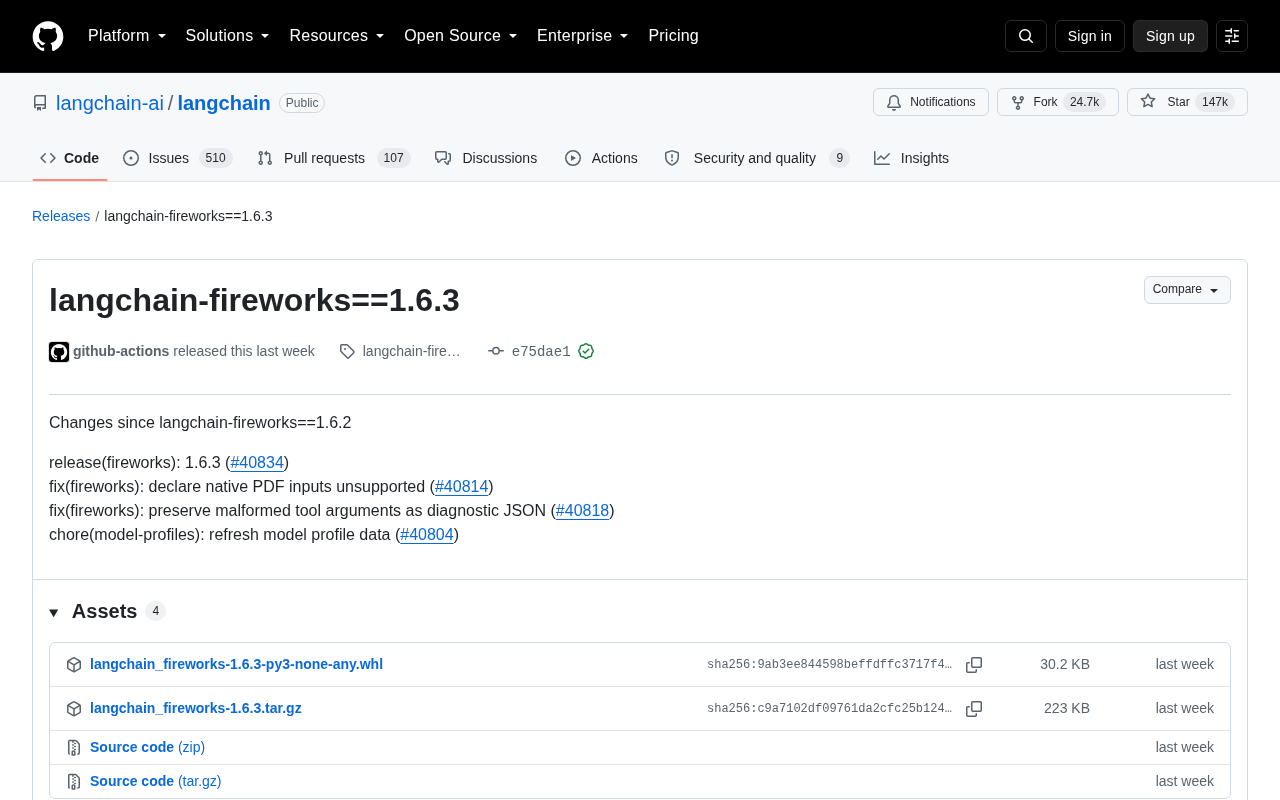
What's Changed in This Release
langchain-fireworks==1.6.3 includes three targeted fixes and one data refresh compared to the previous version, 1.6.2. The release was built automatically via GitHub Actions and published with a verified GitHub signature, ensuring the integrity of the distribution chain.
Based on the commit history, this isn't a feature-heavy update — it's a classic "patch the gaps" release. Each change addresses a boundary-case issue surfaced in real-world usage, reflecting the LangChain team's ongoing focus on polishing stability at the model integration layer.
Native PDF Input Officially Marked as Unsupported
One fix (#40814) marks native PDF input for Fireworks as "not supported." This might look like a step backward, but it's actually good news for developers. Previously, if a developer mistakenly assumed they could pass PDF files directly to a Fireworks model, they might have run into hard-to-diagnose silent failures.
By explicitly declaring the lack of support, the framework can now surface clear feedback earlier in the process, rather than letting errors surface at runtime in opaque ways. This kind of "be explicit about capability boundaries" approach is especially important as multimodal inputs grow increasingly complex. Developers who need to process PDFs should handle text extraction or page conversion at the application layer before passing content to the model.
Malformed Tool Arguments Preserved as Diagnostic JSON
Another fix (#40818) addresses a subtle but important behavior in tool calling: when a model returns malformed tool arguments, the new version now retains those invalid arguments as diagnostic JSON instead of silently discarding them or throwing an unreadable error.
This is highly valuable for debugging Agent and function-calling scenarios. Tool calling is one of the core capabilities of modern LLM applications, but models don't always generate fully compliant parameter structures. Preserving the raw error data lets developers see exactly what the model produced, making it easier to identify whether the issue lies in the prompt, the model's capability, or the parsing logic. This reflects a clear commitment to observability.
Background: Why Malformed Tool Arguments Are a Real Problem
Tool Calling (also called Function Calling) is a mechanism where an LLM, instead of giving a natural language answer, outputs a structured instruction telling the host application to invoke a predefined function with specific parameters. This mechanism underpins Agents, automated workflows, and retrieval-augmented applications. However, since LLMs are fundamentally probabilistic models, even after instruction fine-tuning they can produce parameters that don't fully conform to a JSON Schema in high-complexity scenarios — for example, missing fields, wrong types, or incorrect nesting. If the framework silently drops or throws an untraceable exception in such cases, developers have no way to identify the root cause. Serializing the malformed arguments as raw JSON and preserving them essentially introduces a "snapshot" mechanism into the call chain, giving developers a concrete record for post-hoc analysis and prompt iteration.
Routine Refresh of Model Profile Data
This release also includes a chore(model-profiles) change (#40804) that refreshes model profile data. Model profiles typically record metadata for each model — supported context window size, whether tool calling is supported, whether vision input is accepted, and so on.
As the Fireworks platform continuously onboards new models and adjusts capability parameters for existing ones, this kind of metadata needs to be periodically synchronized. While this type of change doesn't directly affect how API calls are made, it determines how LangChain judges at runtime what a given model can and cannot do — and is foundational to ensuring that higher-level abstractions work correctly.
Background: What Are Model Profiles and Why Do They Matter?
A Model Profile is a metadata manifest maintained by the LangChain integration layer, typically stored as structured configuration files. It records the capability boundaries for each model ID: maximum context window size, whether tool use is supported, whether image or audio input is accepted, output token rate limits, and more. The framework consults this metadata when routing requests, validating input formats, or automatically selecting fallback strategies. If profile data goes stale — for example, if a model has been expanded to a 128K context window but the profile still says 32K — upstream code might make incorrect chunking or truncation decisions. So even though a profile refresh doesn't change any API interface, its impact on application behavior is still substantial and represents non-trivial infrastructure maintenance.
What This Means for Developers
LangChain currently has over 147,000 stars and 24,700 forks on GitHub, making it one of the most influential frameworks in the LLM application development space. Its modular integration strategy — splitting each model provider's adapter into an independent package (such as langchain-fireworks) — allows each integration to iterate and release independently, without waiting on the main framework's major version cadence.
Minor releases like 1.6.3 are exactly where this strategy pays off: a bug fix in tool argument parsing can ship to users within days, rather than being bundled into a massive release cycle. For teams using Fireworks as their inference backend, here are the key recommendations:
- Projects involving tool calling or Agents should prioritize upgrading to get better error diagnostics.
- If you've previously attempted native PDF input, you'll need to switch to an application-layer preprocessing approach.
- Keep an eye on the model-profiles update to confirm whether the capability declarations for your models have changed.
Overall, this is a low-risk, high-value maintenance update with minimal upgrade cost. Users on the affected stack are encouraged to include it in their routine dependency updates.
Related articles

Chain of Thought Isn't Just for AI: How Humans Can Use CoT to Improve Thinking Quality
Chain of Thought isn't just a prompt trick for large models. Starting from a Hacker News discussion, this article analyzes why CoT works for human thinking too, breaks down actionable ways to transfer it, and highlights the key differences between human CoT and machine CoT.
Cloudflare Teams Up with OpenAI: Closi…
Cloudflare Teams Up with OpenAI: Closing the Loop from Vulnerability Discovery to Defense with AI
Cloudflare uses OpenAI Daybreak to investigate security vulnerabilities and generate reviewable remediation plans, while developers use Codex to boost coding efficiency and quality.

Orca Multi-Agent Orchestration in Practice: A Guide to Parallel Collaboration with Claude and Codex
Orca is Stable AI's free open-source agent workbench supporting 34 agents like Claude Code and Codex in parallel. Learn its Git worktree isolation, multi-model orchestration, and mobile management.