Langchain.js Agent Development: A Guide to Deconstructing the OpenClaw Engine Architecture

Deconstructing Langchain.js agent development and the OpenClaw-like engine architecture for frontend developers.
This guide walks frontend developers through Langchain.js-based AI agent development—contrasting workflow agents with the Agent Loop, explaining structured output, RAG, and MCP, comparing LangGraph and DeepAgent for tech selection, and showing how to build an OpenClaw-like engine skeleton in TypeScript.
The New AI Transformation Challenge for Frontend Developers
With the rapid adoption of large language model technology, the boundaries of the frontend developer's role are being redefined. The topic of transformation centered on "Frontend + AI" continues to heat up—from engineering, frameworks, and bundling/build tooling to 3D visualization, more and more frontend capabilities are becoming deeply integrated with AI application development. Among these, one of the most core directions—and the one that best demonstrates a developer's competitiveness—is AI Agent development based on Langchain.js.
This article focuses on the architecture and development approach of Langchain.js, using an analogy to OpenClaw (a general-purpose agent engine) to deconstruct the design thinking behind a complete agent system layer by layer. The core goal is to help developers build two levels of understanding: first, a holistic understanding of Langchain.js Agent development; and second, the engineering implementation path underlying a general-purpose agent engine.
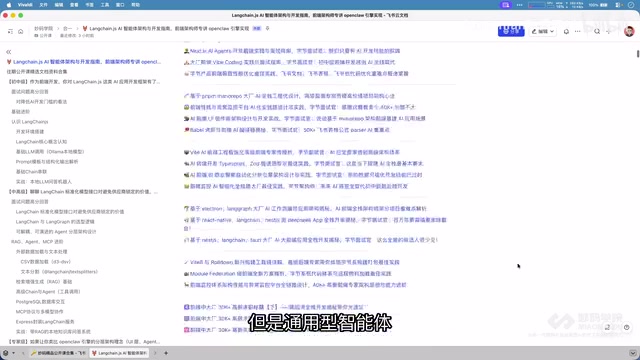
Workflow Agents vs. General-Purpose Agents
To understand agent development, you first need to clarify two distinctly different forms.
Workflow Agents
The core value of a Workflow Agent lies in helping enterprises complete the AI transformation of standardized business processes. Its decision-making path is relatively fixed—developers design the nodes, branches, and flow logic in advance, and the AI executes specific tasks within the established framework. This type of agent is suitable for scenarios with clear processes and well-defined rules; it offers strong controllability and predictable results.
General-Purpose Agents and the Agent Loop
In contrast is the general-purpose agent, whose typical form is the Agent Loop. Its design philosophy is to hand the decision-making and planning layers over to the AI to manage autonomously—the model continuously orchestrates and repeatedly invokes relevant tools to accomplish complex goals and produce the final result.
The underlying operating logic of the Agent Loop is an iterative cycle of "perceive-plan-act-observe." In each round of the loop, the model receives the current state and historical context, then autonomously decides whether a tool needs to be called, which tool to call, and how to interpret the results returned by the tool—until the termination condition is met and the final answer is produced. This mechanism was first systematized in the ReAct (Reasoning + Acting) paper—ReAct combines Chain-of-Thought reasoning with tool actions, allowing the model to interleave real-world information retrieval into the reasoning process, greatly improving the quality of complex task completion. This idea has been widely adopted by frameworks such as LangChain and has become the core execution paradigm of today's mainstream Agent frameworks.
The key difference is: the execution path of a workflow agent is designed by humans, whereas the Agent Loop lets the model autonomously plan "what to do next." The two are not replacements for each other, but rather two solutions addressing scenarios of different complexity—it's recommended to understand them comparatively.
The Core Capability System of Langchain.js
To pursue agent development with Langchain.js, you need to master a complete chain of capabilities:
- Models: The reasoning brain of the agent, responsible for planning and generation.
- Messages & Multimodal: Support for processing various input forms such as text and images.
- Tools and the Agent Loop: The core mechanism that gives the model the ability to invoke external capabilities and make decisions in a loop.
- Structured Output: The key dividing line between "beginner usage" and "engineering implementation."
Many developers currently still use models at the "question-and-answer" chat level, which is a very rudimentary usage. To truly unleash the value of a model, you must master structured output—getting the model to reliably return the required JSON data or a specific format so that it can be further consumed and invoked by programs. This is the fundamental prerequisite for agent engineering.
Mainstream approaches to implementing structured output include OpenAI's Function Calling / JSON Mode, as well as LangChain's withStructuredOutput() method combined with a Zod Schema for runtime type validation. By predefining data structure constraints, what the model returns is no longer free-form text requiring manual parsing, but rather a type-safe object that can be directly consumed by TypeScript programs. This mechanism upgrades the LLM from a "conversational tool" to a "programmable component" and is the engineering foundation that enables the Agent's tool-calling pipeline to run reliably.
Beyond this, you also need to support advanced capabilities such as Streaming, multi-agent collaboration, RAG (Retrieval-Augmented Generation), and MCP (Model Context Protocol). Together, these constitute the core technology stack of modern AI Agent applications.
RAG (Retrieval-Augmented Generation) is the mainstream engineering solution for addressing the "knowledge cutoff" and "hallucination" problems of large models. Its core idea is: before the model generates an answer, it first retrieves document fragments relevant to the question from an external knowledge base and injects them into the prompt as context, thereby enabling the model to generate based on real, up-to-date information. A typical implementation involves a vector database (such as Pinecone, Chroma, or Weaviate) to store the semantic embedding vectors of documents, along with algorithms such as cosine similarity for semantic retrieval matching, ultimately feeding the retrieval results together with the user's question into the model to complete generation.
MCP (Model Context Protocol) is an open standard proposed by Anthropic in late 2024, aiming to unify the interaction interface between AI models and external data sources and tools. You can think of it as the "USB port" of the AI world—any service developed following the MCP specification (such as database queries, file system access, or third-party APIs) can be directly discovered and invoked by models that support the protocol, without needing to develop separate adaptation logic for each tool. This greatly reduces the engineering cost of integrating external capabilities into agents and is rapidly becoming the foundational protocol of the Agent ecosystem.
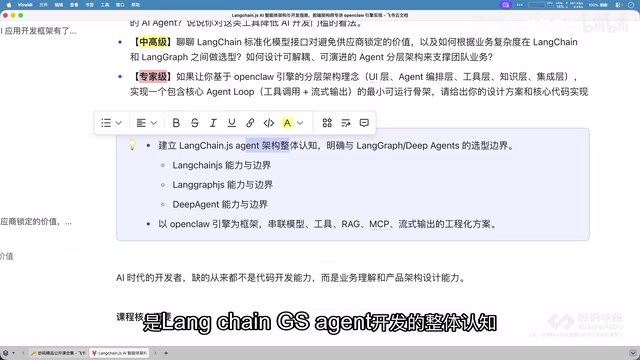
Technology Selection: Langchain.js, LangGraph, and DeepAgent
In actual development, the ability to make technology choices is often more important than the ability to write code. Around agent development, there are three tiers of technical solutions worth paying attention to:
Understanding the Three Capability Tiers
- Langchain.js: Provides standardized model integration, tool invocation, and Agent abstractions—it's the framework of choice for getting started and rapid prototyping.
- LangGraph.js: When agent logic becomes complex and requires fine-grained control over state transitions and multi-node collaboration, LangGraph provides stronger orchestration capabilities, making it suitable for building complex Agents with clear state machines.
- DeepAgent: Aimed at deeper autonomous agent forms, exploring further automation of decision-making and planning.
LangGraph models an agent's execution logic as a Directed Graph, where each node represents a processing step (such as calling a model, executing a tool, or human review), and edges represent state transition conditions. Unlike LangChain's linear chained invocation, LangGraph natively supports loops, conditional branching, and parallel node execution, and it provides state persistence and checkpoint mechanisms that allow execution flow to be paused, resumed, or rolled back at any node. This makes it particularly well-suited for enterprise-grade scenarios requiring Human-in-the-Loop review—inserting a manual confirmation step before high-risk operation nodes while keeping the overall process automated.
Understanding the capability boundaries and applicable scenarios of all three is key to good architecture design. The choice between Langchain.js and LangGraph essentially comes down to whether the business is a "linear task chain" or a "complex state graph."
Capability Grading from an Interview Perspective
From the perspective of the job market, AI-related capabilities can roughly be divided into three tiers:
- Junior/Intermediate: Familiar with and has used AI application development frameworks such as Langchain, with hands-on Agent development experience.
- Intermediate/Senior: Able to clearly explain the standardized model capabilities of Langchain.js, as well as the selection design considerations between it and LangGraph.
- Senior/Architect Level: Understands the underlying implementations of general-purpose agent engines such as OpenClaw, Codex, Claude Code, and Manus, and is able to design tool-calling and streaming-output solutions and build a minimal runnable engine skeleton.

An Analogy to OpenClaw: Implementing an Agent Engine with TypeScript
A common question is: if you only know TypeScript and aren't familiar with Python, can you implement an agent engine similar to OpenClaw? The answer is yes.
Based on the complete ecosystem of Langchain.js, developers can fully use TypeScript to complete the entire process from model chaining to engineering implementation. The core engineering solutions include:
- Model Chaining: Designing and integrating the corresponding large model as the reasoning engine.
- Tool Design: Defining the set of tools the agent can invoke to extend its action capabilities. Tools are essentially function wrappers around external capabilities (API calls, database queries, code execution, etc.), paired with JSON Schema descriptions that let the model understand the tool's functionality and parameter format, so it can autonomously decide when to call which tool within the Agent Loop.
- Knowledge Base and MCP: Providing the agent with context and external data access capabilities through a RAG knowledge base and the MCP protocol.
- Skills Mechanism: Encapsulating reusable skill modules to enhance task-handling capabilities.
- Streaming Output: Implementing real-time streaming return of results to optimize the interaction experience. Streaming pushes the model's token-by-token generated content to the frontend in real time via Server-Sent Events (SSE) or WebSocket, avoiding long waits on a blank page—it's a standard engineering solution for improving the interaction experience of AI applications.
By organically chaining these capabilities together, you can build a minimal runnable skeleton with tool invocation and streaming output—and this is precisely the best-practice path for understanding the implementation of OpenClaw-class engines.
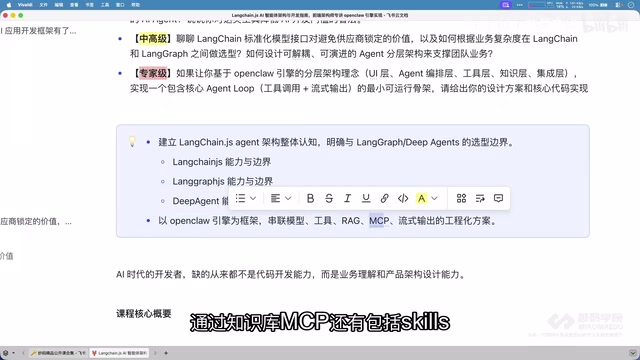
The Real Core Competitiveness of Developers in the AI Era
Finally, here's a judgment worth deep reflection by all developers: in the AI era, what developers lack is not code-writing ability.
Whether it's Codex, Claude Code, or various AI programming tools, they can already rapidly complete code generation and project implementation. Pure coding ability is rapidly depreciating. So, when leveraging AI to empower enterprises with AI, what core competitiveness do developers really need to possess?
The answer points to two things:
- Business understanding—Can you deeply understand business scenarios, pain points, and real needs?
- Product architecture design—Can you translate business requirements into reasonable technical architectures and product solutions?
These two capabilities happen to be precisely the parts that AI currently finds difficult to replace. For frontend developers, moving from "writing code" to "designing agent system architectures" is exactly the most worthwhile direction to invest in during this wave of AI transformation. Mastering Langchain.js agent development and understanding the underlying logic of general-purpose engines is, in essence, training this kind of architecture-level thinking.
Key Takeaways
Related articles

Session-Based Home Server: Running a Low-Power Homelab on an Old Laptop
A Reddit user runs Plex, qBittorrent, and Watcharr on a 10-year-old laptop for just 10–12 hrs/day, using only 305MB RAM idle. Exploring session-based vs. 24/7 Homelab trade-offs.

OpenAI Launches ChatGPT for Financial Services: Built-in Financial Data + GPT-6 Reasoning
OpenAI launches ChatGPT for Financial Services, combining built-in financial data with GPT-6 Astra reasoning to support research, financial modeling, and client materials for financial institutions.
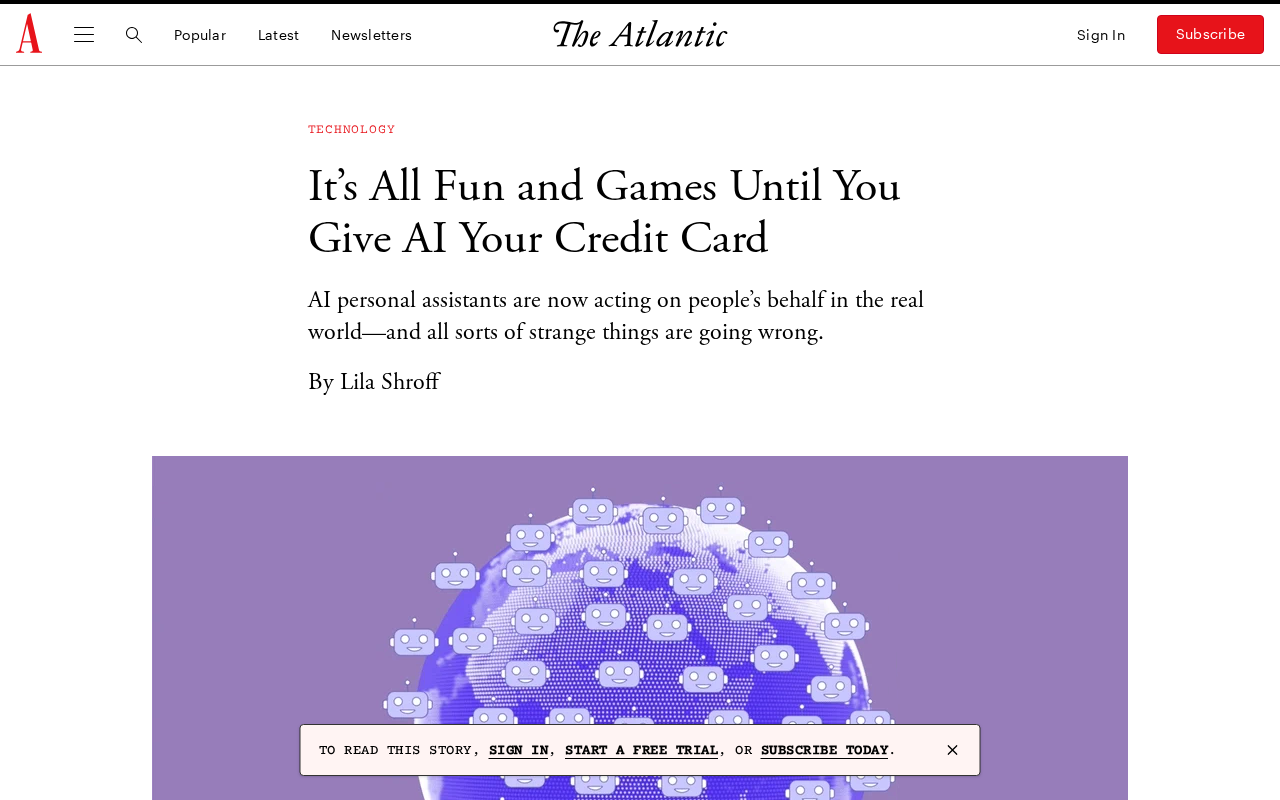
When AI Controls Your Credit Card: The Hidden Risks of Autonomous Payments
When AI agents gain credit card access, hidden dangers emerge: vague authorization, prompt injection attacks, and unclear liability. Learn the real risks and how to stay protected.