LangChain + MCP in Practice: A Complete Guide to Building Enterprise-Grade AI Agents

A practical guide to building enterprise AI agents using LangChain framework and MCP protocol.
This guide explains how LangChain and MCP (Model Context Protocol) work together to build enterprise-grade AI agents. It covers why frameworks are essential for LLM application development, how Agent abstraction handles conversation history and tool execution through ReAct reasoning loops, and how MCP standardizes the connection between LLMs and external tools for reusable, production-ready AI systems.
Why We Need Frameworks Like LangChain
The core strength of large language models lies in their powerful reasoning capabilities. We can have natural conversations with them—they understand our intent, provide responses, and can even organize messy, unstructured files into logically clear content. But there's a fundamental limitation: the content a large model returns is essentially based on data from its training cutoff point.
Large language models (such as GPT-4, Claude, etc.) are trained on massive amounts of internet text data, but this data has a clear knowledge cutoff date. For example, GPT-4's training data cuts off at April 2023, meaning it has no knowledge of events or updates that occurred afterward. More importantly, enterprise-internal data—CRM records, order systems, knowledge base documents, and other private data—never appeared in the training set. The model is completely "blind" to this information. This is why pure LLM conversations cannot directly serve enterprise business scenarios.
This leads to two practical questions:
- How can we enable LLMs to converse using enterprise-internal business data?
- How can we build more advanced intelligent agent applications on top of that?
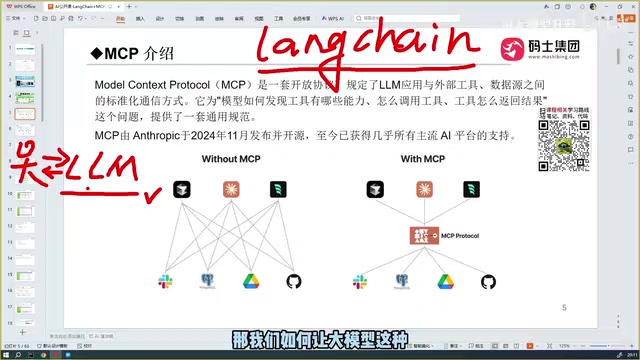
For the first question, the solution is to bind tools to the LLM. Once tools are bound, the model can not only understand your questions but also invoke tools to retrieve internal business data or text content, then leverage its own reasoning ability to organize and answer. This is the key step in making AI truly empower business operations.
The core mechanism behind tool binding is Function Calling. Developers provide the model with tool names, descriptions, and parameter schemas in JSON Schema format. During inference, the model determines whether the user's intent requires calling a specific tool. If so, it outputs a structured function call request (containing the tool name and parameter values). This request is merely a JSON string—the model doesn't actually execute it. Actual execution requires an external program to receive this JSON and invoke the corresponding API or database query. This design enables the model to safely interact with external systems while maintaining controllability over the calls.
Building from Scratch vs. Using LangChain: How to Choose
Some might think: can't I just write my own LLM calling logic and manually invoke tools? Theoretically yes, but in practice there are many issues.
When you implement this entire workflow yourself, you'll find all your energy consumed by low-level concerns—how to call the model, how to manage tools, how to maintain conversation context—rather than focusing on the business logic that actually creates value.
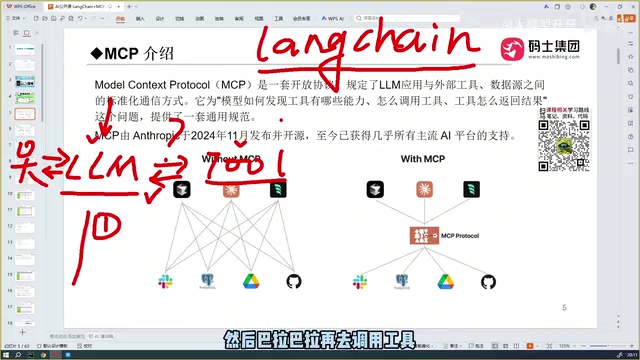
LangChain was built precisely to solve this pain point. It's a framework specifically designed for developing LLM applications (AI applications) that encapsulates the complex underlying calling and management logic, allowing developers to truly focus their energy on business concerns.
LangChain consists of several core modules: Models (a model abstraction layer that unifies calling interfaces across different providers like OpenAI, Anthropic, and local models), Prompts (prompt template management), Chains (chaining multiple operations into workflows), Memory (conversation history and context management), and Tools/Agents (tool definition and intelligent scheduling). LangChain's core value lies in providing a unified abstraction interface that allows developers to switch underlying models without modifying business code, while enabling declarative workflow orchestration through LCEL (LangChain Expression Language).
Of course, LangChain isn't the only framework for building AI applications. You may have also heard of Claude SDK, OpenAI SDK, and others—they can also be used to build AI applications.
Here's a piece of advice worth emphasizing: don't get caught up trying to write your own framework from scratch. Some developers insist on implementing their own version of LangChain or Claude SDK, but these frameworks already do the job well. You can stand on the shoulders of giants and apply them directly—there's no need to waste precious energy reinventing the wheel at the infrastructure level.
AI Agents: A Higher-Level Abstraction Beyond Conversation + Tool Calling
Beyond simple conversation + tool calling, a term we hear even more often is Agent (intelligent agent). An agent also contains an LLM internally, but it represents a higher-level abstraction on top of the model.
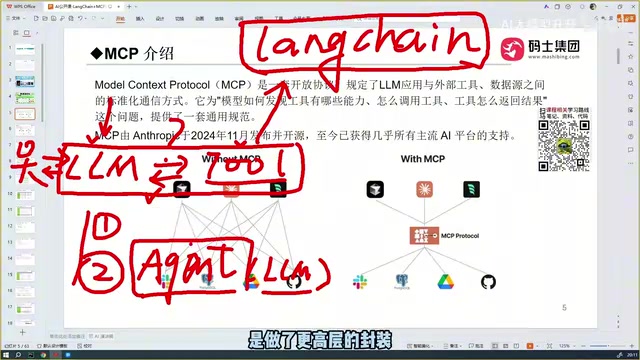
This "higher-level abstraction" is specifically reflected in the following aspects:
Automatic Conversation History Management
When you converse with an LLM, a large volume of chat history is generated. If you implement this yourself, you need to manually maintain the context. An Agent can automatically manage this history, relieving developers of that burden.
Actually Executing Tool Calls
When an LLM calls a tool on its own, it only knows "which tool should be called" but doesn't actually execute it. An Agent can truly complete this task for you—performing the actual operation, calling the tool, and returning the results.
Loop-Based Reasoning on Results
Furthermore, an Agent can evaluate whether it needs to call another tool based on the results returned. This "think—act—observe—think again" loop is the core characteristic that distinguishes intelligent agents from simple conversations.
AI Agents typically adopt the ReAct (Reasoning + Acting) paradigm, a method proposed by Google and Princeton University in 2022 that allows LLMs to alternate between reasoning and acting. The specific flow is: Thought (consider what to do next) → Action (decide which tool to call and with what parameters) → Observation (observe the tool's returned results) → Thought again (decide the next step based on results). This loop continues until the Agent determines it has gathered enough information to provide a final answer. Compared to single-shot calls, the ReAct pattern enables AI to handle complex tasks requiring multi-step reasoning and multiple information retrievals.
MCP Protocol: Standardizing the Connection Between LLMs and External Tools
On top of the LangChain ecosystem, the MCP (Model Context Protocol) further standardizes how LLMs connect with external tools and data sources.
MCP is a protocol standard open-sourced by Anthropic in late 2024. Its design was inspired by LSP (Language Server Protocol)—just as LSP unified communication between code editors and language servers, MCP aims to unify the interaction standard between LLMs and external tools/data sources. MCP adopts a client-server architecture: the MCP Server is responsible for exposing tool capabilities and resources (such as database queries, file read/write, API calls), while the MCP Client (typically embedded within AI applications) is responsible for discovering and invoking these capabilities. The protocol communicates via JSON-RPC 2.0 and supports two transport methods: stdio and HTTP SSE. MCP's greatest advantage is decoupling—tool providers only need to implement an MCP Server once, and any AI application that supports MCP can directly connect and use it.
If LangChain solves the problem of "how to orchestrate LLM applications," then MCP aims to solve "how to make tools and context accessible to LLMs in a standardized way." Combining both makes enterprise AI application development more standardized and reusable.
In actual development, the LangChain + MCP architecture typically involves several key components:
- Agent Tool Definition: Clearly specifying each tool's functionality, input/output formats
- Interceptor Implementation: Inserting custom logic before and after tool calls, such as permission verification, logging, and result processing
- Architecture Analysis: Understanding the overall data flow and state management
- End-to-End Case Implementation: Integrating all components into a runnable business system
Summary: Focus Your Energy on Business Value
Whether it's LangChain or MCP, their core value can be summarized in one sentence: free developers from low-level complexity so they can focus on real business value.
For developers with zero experience or some foundation in LLM development, understanding "why to use a framework" is more important than "how to write a framework." The reasoning capabilities of large models are already powerful enough. What we need to do is leverage existing tools—through tool binding, Agent abstraction, and the MCP standardized protocol—to connect this reasoning power to real enterprise business scenarios.
This is the right approach to building modern enterprise-grade AI applications.
Related articles

DIY Air Purifier: Building a Silent CR Box with PC Fans and an Aluminum Frame
Learn how to build a quiet Corsi-Rosenthal air purifier using PC case fans and an aluminum frame, covering fan selection, PWM speed control, and cost analysis.

Universality of Gradient Descent Training: Does Neural Network Architecture Choice Really Matter?
Exploring the universal approximation capability of gradient descent training, analyzing the relationship between neural network architecture choice and learnability, from UAT to NTK theory.

From AI to Large Models: Understanding the Conceptual Landscape and Technological Evolution of Artificial Intelligence
Understand how AI, machine learning, deep learning, large models, and generative AI relate to each other. From Deep Blue to ChatGPT, learn how Transformer architecture gave rise to LLMs.