LangChain-OpenAI 1.6.7 Released: Adds Azure Workload Identity Support

langchain-openai 1.6.7 adds Azure workload identity auto-discovery, refreshes model configs, and cleans up deprecated tests.
langchain-openai 1.6.7 is a maintenance-focused minor release. Its headline feature is automatic discovery of Azure Workload Identity, enabling applications deployed on AKS and similar cloud-native environments to authenticate without hardcoded secrets — significantly improving enterprise security and compliance. The update also includes two model profile refreshes to accurately reflect the latest models' context windows and function calling capabilities, and removes live tests for OpenAI's retired Completions endpoint to reduce CI overhead. For most users this is a low-risk routine upgrade, with Azure OpenAI users benefiting most directly.
LangChain is one of the most popular frameworks for building large language model applications, and its OpenAI integration package langchain-openai has just received a 1.6.7 update. While this is a minor release, it includes a notable new feature valuable for enterprise deployments, along with model configuration refreshes and test maintenance.
What's New in This Release
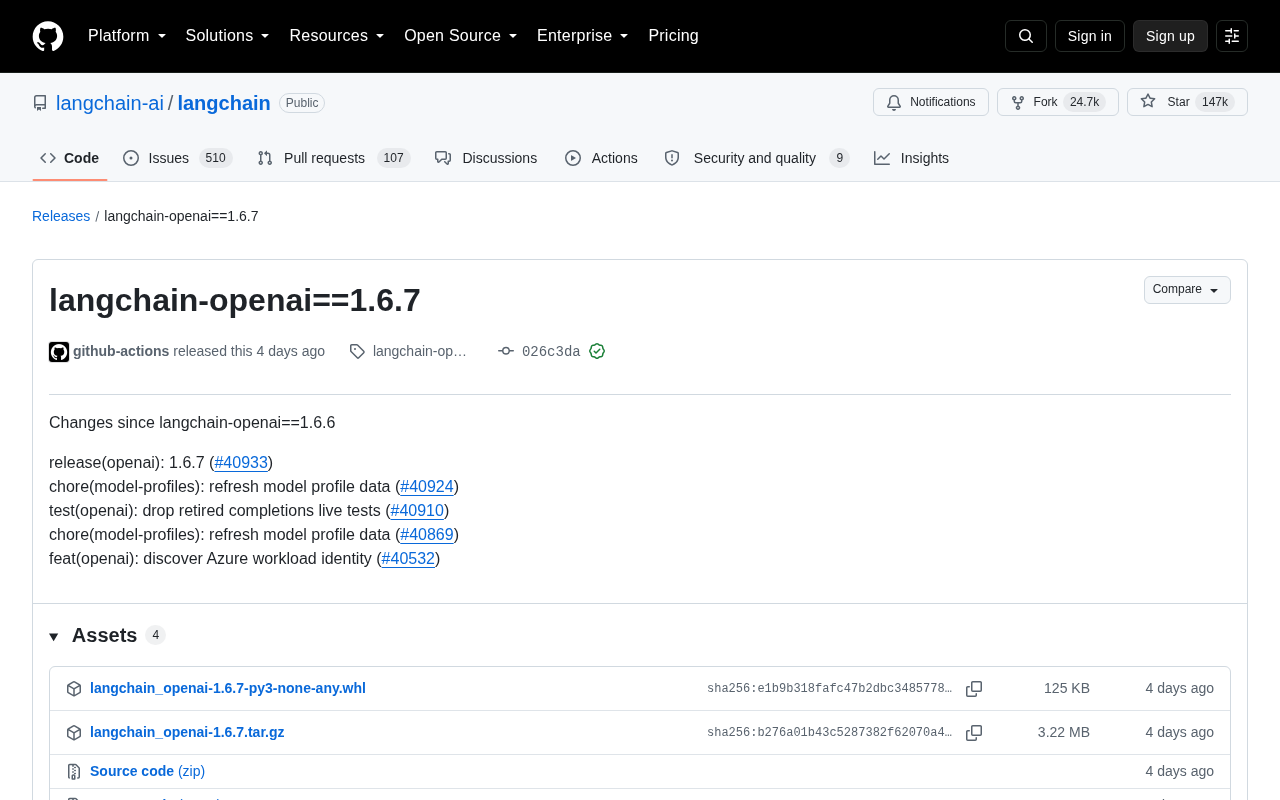
The changelog from 1.6.6 to 1.6.7 covers four areas: new features, model configuration updates, test cleanup, and the release itself. The most noteworthy addition is automatic discovery support for Azure workload identity.
Azure Workload Identity Auto-Discovery
This release adds discover Azure workload identity capability via PR #40532. This is a practical improvement for teams deploying LangChain applications in cloud-native environments like Azure Kubernetes Service (AKS).
Workload Identity is Azure's recommended authentication mechanism. It allows applications running in Kubernetes to access Azure resources using federated identity credentials — without hardcoding API keys or secrets in code or configuration files. Previously, developers using Azure OpenAI services often had to manually manage API keys or service principal credentials, which increased both the risk of credential leakage and operational complexity.
The new auto-discovery capability means langchain-openai can automatically detect and use workload identity for authentication in supported environments, making credential management more secure and aligned with cloud-native best practices. This is especially important for enterprise users with strict compliance and security requirements.
On the technical side, Azure workload identity relies on three core components working in concert: Azure Active Directory (AAD) federated identity credentials, Kubernetes Service Account token projection, and the OIDC Issuer endpoint on AKS. When a Pod starts, the Azure AD Workload Identity Webhook automatically injects the necessary environment variables — such as AZURE_CLIENT_ID, AZURE_TENANT_ID, and AZURE_FEDERATED_TOKEN_FILE — into the container. The application then authenticates without any secrets using either WorkloadIdentityCredential or DefaultAzureCredential from the Azure Identity SDK. DefaultAzureCredential tries multiple credential sources in priority order, and workload identity is one of the sources in that chain. The auto-discovery feature added in this release essentially brings this credential chain into the default detection scope when initializing the Azure OpenAI client, so developers can benefit from managed identity security without any extra configuration.
Model Configuration Refresh
This update includes two model-profiles refreshes (PR #40924 and #40869). Model profiles record the capability parameters of various models — such as context window size, function calling support, vision input support, and other metadata.
As OpenAI and related models continue to evolve, LangChain needs to periodically sync these configurations to ensure the framework accurately reflects each model's actual capabilities when routing requests and validating parameters. These maintenance updates typically don't introduce breaking changes, but they ensure developers get correct behavior expectations when working with newer models.
Test Maintenance: Removing Retired Completions Tests
PR #40910 removes live tests for the deprecated completions endpoint. OpenAI shifted its focus to Chat Completions and the newer Responses API long ago, and the legacy completions endpoint has been gradually phased out.
Cleaning up these tests reflects the evolution of the upstream API and reduces CI pipeline maintenance overhead — avoiding meaningless test failures caused by calling retired endpoints. This is a healthy engineering signal: the framework is trimming itself in sync with the lifecycle of its underlying APIs.
For context: OpenAI's Completions API (/v1/completions) was the original interface for base language models like text-davinci-003, using a simple single-turn text completion model with no conversation context management. The Chat Completions API (/v1/chat/completions) introduced message roles (system/user/assistant) and multi-turn conversation structure, becoming the primary interface for GPT-3.5/GPT-4 series models. In 2025, OpenAI further introduced the Responses API, which integrates tool calling, file retrieval, and other Assistants capabilities, representing the next generation of interface paradigms. As OpenAI officially stopped updating models that supported the legacy Completions endpoint, continuing to maintain integration tests for that interface wastes CI resources and leads to flaky tests as models are retired. Removing them is the right call.
What This Means for Developers
For developers building AI applications with LangChain, upgrade recommendations vary by use case:
- Teams using Azure OpenAI: If your application is deployed in a cloud-native Azure environment, upgrading and evaluating the workload identity approach is strongly recommended to simplify credential management and improve security.
- Teams using the standard OpenAI API: This update has minimal impact on you — primarily model configuration syncs. A routine upgrade is fine.
- Projects still relying on the legacy completions endpoint: Migrate to Chat Completions or the Responses API as soon as possible to avoid potential compatibility issues down the road.
LangChain currently has over 147,000 stars and 24,700 forks on GitHub, with a highly active community. As a core integration package, langchain-openai maintains a rapid iteration pace. This small-and-frequent release model is a classic approach for open-source infrastructure keeping pace with evolving model capabilities.
Summary
langchain-openai 1.6.7 is a typical maintenance release. The biggest highlight is Azure workload identity support, targeting enterprise security requirements. The model configuration refreshes and test cleanup reflect the framework's ongoing effort to stay in sync with upstream API evolution. For most users, this is a low-risk, routine upgrade worth following.
Related articles

MCP Protocol in 60 Seconds: A Real Session, Message by Message
Dissecting a real MCP session message by message: how an Agent dynamically discovers tools, forwards call requests, and has an MCP server execute them — all in just 9 JSON messages, with the model and reasoning loop untouched.

n8n 40-Minute Masterclass: Build Your First AI Automation Workflow from Scratch
Distilled from a 40-minute n8n masterclass: the core differences between automation, AI, and AI Agents, a comparison of n8n's four deployment methods, and a complete guide from dashboard to your first workflow.

Why Does a 35GB Quantized Model Blow Up an 80GB GPU? The Truth About KV Cache VRAM
Why does a 35GB 4-bit quantized LLM still blow up an 80GB GPU? This article breaks down the four components of inference VRAM, provides precise KV Cache formulas, compares GQA vs DeepSeek MLA memory, and offers production-grade OOM prevention like FP8 KV Cache.