LangChain-OpenAI 1.7.1 Released: Adds Mid-Conversation Interjection Support

langchain-openai 1.7.1 adds a mid-conversation support declaration to model profiles in a lightweight patch update.
langchain-openai has released version 1.7.1, with only two changes relative to 1.7.0: the routine release process and a new capability declaration, making it a lightweight patch update. The notable change is PR #41180, which jointly declares a "mid-conversation support" capability for model profiles across the core, anthropic, and openai packages—namely, the ability for a model to accept new input while generating a response. Model profiles abstract model capability differences from business code into queryable metadata, so upper layers do not need hard-coded judgment logic for each model. This change does not involve breaking changes, but if an upper-layer framework reads profiles to decide feature toggles, behavior may change after upgrading. Since the change spans multiple packages, projects using core, anthropic, and openai together should upgrade them in coordination and validate multi-turn conversation-related test cases in a staging environment.
The official package for integrating OpenAI models within the LangChain ecosystem, langchain-openai, has released version 1.7.1. This is a minor release focused primarily on fixes, while also introducing a noteworthy model capability declaration.
Version Overview
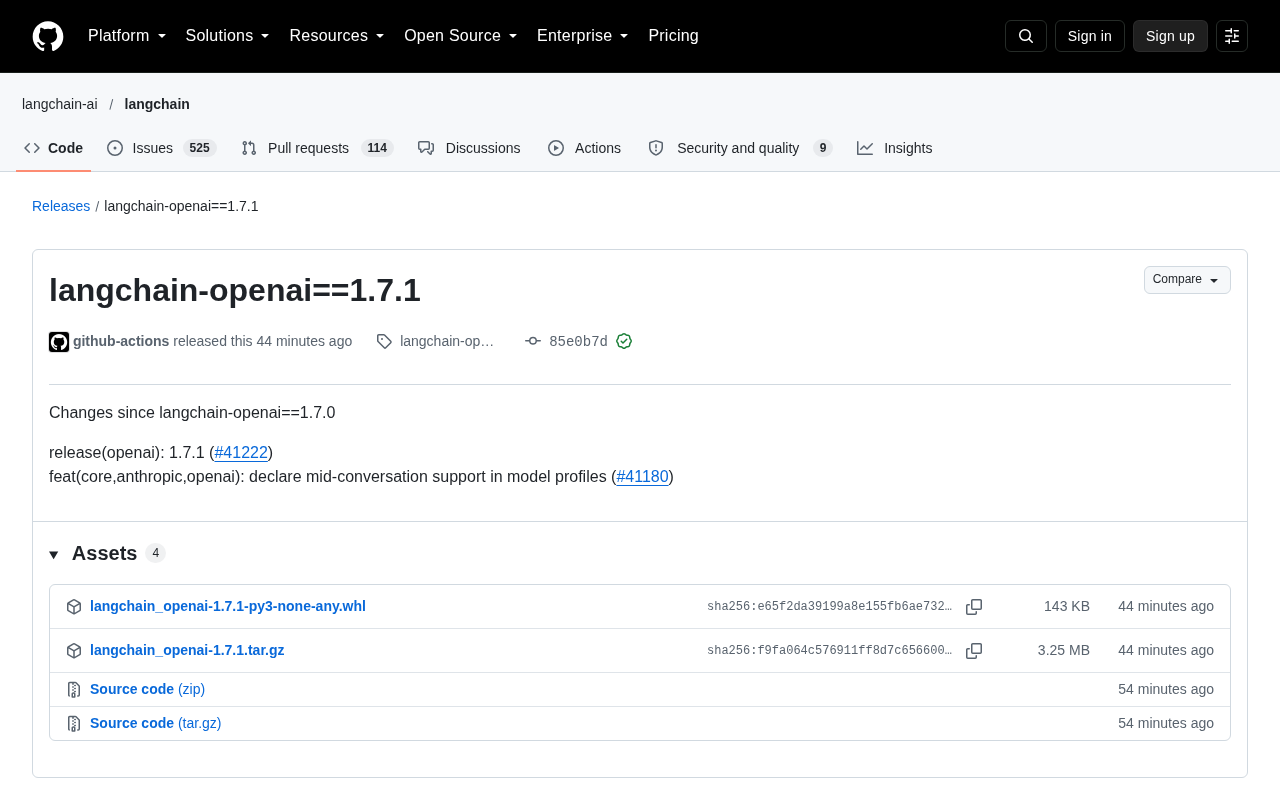
Based on the release notes on GitHub, the changes in 1.7.1 relative to 1.7.0 are concentrated in two areas: the routine version release process (PR #41222) and a cross-package feature declaration (PR #41180). Although the number of changes is small, the second one involves three packages—core, anthropic, and openai—indicating that it is a cross-module capability convention rather than a simple fix.
For developers building AI applications with LangChain, minor version updates like this typically require attention to two things: whether there are breaking API-level changes, and whether new behaviors have been introduced that require proactive adaptation. This update does not mention any breaking changes, but the newly added capability declaration may affect how you implement multi-turn conversation scenarios.
What Is "Mid-Conversation Support"?
The title of PR #41180 is "declare mid-conversation support in model profiles."
To understand the significance of this change, you first need to understand LangChain's model profiles mechanism. Model profiles are a capability inventory that LangChain maintains for different models, describing which features a model supports—such as whether it supports tool calling, whether it supports structured output, how large its context window is, and so on. Upper-layer code can use this to decide which features to enable for a given model, without having to hard-code judgment logic for each model.
The newly added declaration points to a model's ability to accept new input mid-conversation. In multi-turn conversations, users sometimes supplement information while the model is still generating a response, or want to insert new context into an existing conversation flow. Different models vary in how well they support this kind of interaction—some ignore mid-stream input, while others can incorporate it correctly. LangChain uses model profiles to explicitly record this difference, allowing the application layer to make choices accordingly.
How Model Profiles Are Stored and Read
In LangChain, model profiles are typically distributed as structured data with the package—for example, as JSON or Python dictionary constants attached to specific model classes or provider modules, with field names like supports_tool_calling, supports_structured_output, max_input_tokens, and so on. The application layer reads these fields through a unified interface (such as model.profile or a lookup function by model name), without needing to import vendor-specific judgment logic.
The key benefit of this design is decoupling: when a model's capabilities are upgraded or downgraded, only the profile data needs to be updated, rather than modifying if model_name == ... branches scattered throughout the code. At the same time, because profiles are released alongside package versions, declaring the same capability across packages becomes a way to coordinate release behavior—core defines the reading semantics, while anthropic and openai each fill in the values for their own models. This also explains why a seemingly small capability declaration touches three packages at once.
Why This Change Is Worth Noting
Mid-conversation interjection is a common requirement when building interactive AI applications. Typical scenarios include: a user changing their mind while waiting for a response, adding constraints, or another role inserting information in multi-agent collaboration.
In the past, such behavior often relied on developers determining on their own whether the target model supported it, and code easily ended up with hard-coded branches for specific models. The introduction of model profiles abstracts "whether a model can do this" out of code logic and turns it into queryable metadata. When core, anthropic, and openai all declare this capability simultaneously, it means LangChain is unifying cross-model capability descriptions into a single framework.
It is important to note that declaring support for a capability does not mean that capability is fully wired through all usage paths. This release note does not include detailed behavioral documentation, so before enabling it in a real project, it is advisable to validate against your target model.
Implementation Challenges of "Mid-Stream Input" in Multi-Turn Conversations
From the perspective of the underlying API, mid-conversation interjection involves coordinating streaming generation with a message queue. When a model is streaming tokens, newly arriving user input must either be buffered for the next request or injected into the current context through a specific interrupt/append mechanism. Different vendors' APIs support this differently: some interfaces only accept a complete message list at once, so mid-stream appends can only wait until the current response ends; others provide interruptible or appendable semantics.
As a middleware layer, LangChain needs to express this difference in the ChatModel abstraction. Declaring that a model supports mid-conversation means the framework can confidently hand mid-stream input to that model in multi-turn or agent scenarios, rather than degrading to waiting for the current response to finish before initiating a new request. For developers, this affects how the conversation loop is written and where state management lives, so it is worth confirming during upgrade whether your implementation path is covered.
Practical Impact on Developers
If you are using langchain-openai 1.7.0, upgrading to 1.7.1 is low-cost. The version number only changed in the patch position, and no interface signature adjustments appear in the change list.
What truly deserves attention is the behavioral change brought by model profiles. If your code or the upper-layer framework you depend on reads model profiles to decide feature toggles, then after upgrading, behavior for OpenAI models may differ from before. It is recommended to first run a round of multi-turn conversation-related test cases in a staging environment and confirm that mid-stream input handling meets expectations before going to production.
In addition, this change also involves the core and anthropic packages, indicating a version coordination relationship among them. If your project has these packages installed simultaneously, it is best to upgrade them together to mutually compatible versions to avoid inconsistency between capability declarations and actual implementations.
Considerations for Cross-Package Version Coordination
LangChain packages use independent semantic versioning: langchain-core provides interfaces and base classes, while langchain-openai, langchain-anthropic, and others provide concrete implementations. When a capability needs to be declared across multiple packages at once, the release timing of each package may vary slightly. If only langchain-openai is upgraded without synchronizing core, the upper-layer profile-reading logic may not recognize the new fields, or the declaration may be ignored without error—and vice versa.
A more prudent approach is to check the version constraints referenced by each package's release notes (such as peer dependency ranges), or confirm in the lock file that the core package and integration packages are in the same release cycle. For production environments, it is recommended to first upgrade several packages together to the latest patch of the minor version, then run regression test cases for multi-turn conversations and tool calling so that inconsistencies between declarations and behavior can be discovered early.
Summary
langchain-openai 1.7.1 is a lightweight patch release whose core value lies in formally incorporating "mid-conversation support" into the model profiles system. It reflects LangChain's continued investment in standardizing capabilities across models—moving model differences out of business code and into a unified metadata layer. For most projects, this is a low-risk update that can be adopted as needed.
One-line Summary
langchain-openai 1.7.1 adds a mid-conversation support declaration to model profiles in a lightweight patch update.
Paragraph Summary
langchain-openai has released version 1.7.1, with only two changes relative to 1.7.0: the routine release process and a new capability declaration, making it a lightweight patch update. The notable change is PR #41180, which jointly declares a "mid-conversation support" capability for model profiles across the core, anthropic, and openai packages—namely, the ability for a model to accept new input while generating a response. Model profiles abstract model capability differences from business code into queryable metadata, so upper layers do not need hard-coded judgment logic for each model. This change does not involve breaking changes, but if an upper-layer framework reads profiles to decide feature toggles, behavior may change after upgrading. Since the change spans multiple packages, projects using core, anthropic, and openai together should upgrade them in coordination and validate multi-turn conversation-related test cases in a staging environment.
Related articles

Chain of Thought Isn't Just for AI: How Humans Can Use CoT to Improve Thinking Quality
Chain of Thought isn't just a prompt trick for large models. Starting from a Hacker News discussion, this article analyzes why CoT works for human thinking too, breaks down actionable ways to transfer it, and highlights the key differences between human CoT and machine CoT.
Cloudflare Teams Up with OpenAI: Closi…
Cloudflare Teams Up with OpenAI: Closing the Loop from Vulnerability Discovery to Defense with AI
Cloudflare uses OpenAI Daybreak to investigate security vulnerabilities and generate reviewable remediation plans, while developers use Codex to boost coding efficiency and quality.

Orca Multi-Agent Orchestration in Practice: A Guide to Parallel Collaboration with Claude and Codex
Orca is Stable AI's free open-source agent workbench supporting 34 agents like Claude Code and Codex in parallel. Learn its Git worktree isolation, multi-model orchestration, and mobile management.