LangChain Releases langchain-openai 1.6.5: Enhanced Tool Calling Capabilities

langchain-openai 1.6.5 enables dynamic tool set changes mid-conversation and adds profile support for new models.
langchain-openai 1.6.5 ships three key changes: a standard version bump, new profile configurations for Anthropic and OpenAI models, and the most impactful feature — dynamic tool set modification mid-conversation via `SystemMessage`. This directly addresses the limitation of fixed tool sets within a session, enabling finer-grained tool permission control and context-driven orchestration for Agent workflows, reducing the need for workaround code. The update continues LangChain's long-term trends of cross-provider abstraction, Agent capability consolidation at the framework level, and proactive model profile adaptation.
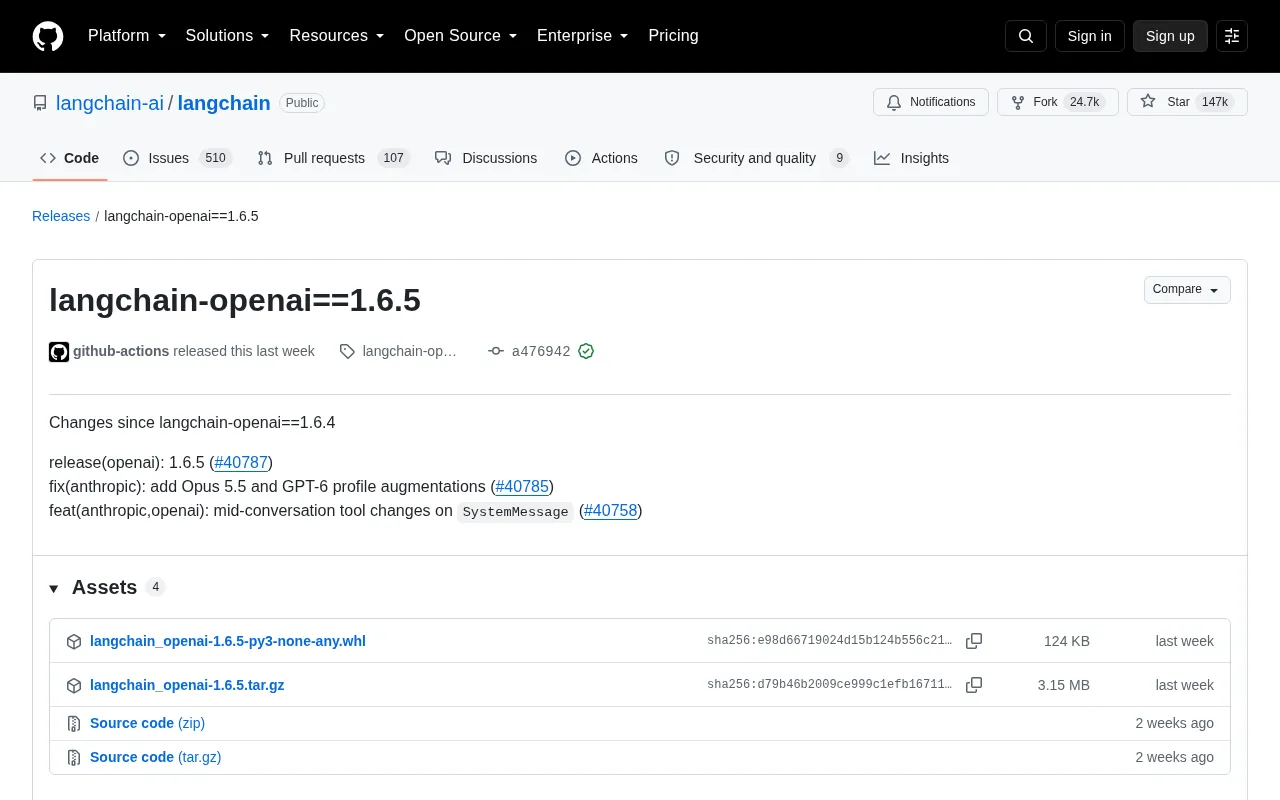
LangChain is one of the most widely adopted frameworks for building large language model applications, with over 147,000 GitHub Stars and 24,700 Forks. Every update to its ecosystem components draws significant attention from the developer community. Recently, the langchain-openai package released version 1.6.5, bringing several noteworthy improvements — particularly around the tool calling mechanism.
What's New in 1.6.5
Compared to the previous 1.6.4 release, version 1.6.5 includes three main changes:
- release(openai): 1.6.5 (#40787) — Standard version bump.
- fix(anthropic): add Opus 5.5 and GPT-6 profile augmentations (#40785) — Adds profile support for new models from Anthropic and OpenAI.
- feat(anthropic,openai): mid-conversation tool changes on
SystemMessage(#40758) — Enables dynamic modification of the tool set mid-conversation viaSystemMessage.
These three changes reflect the LangChain team's continued effort to provide unified capability abstractions across model providers (OpenAI and Anthropic), while further refining tool calling flexibility for Agent use cases.
Mid-Conversation Tool Changes: A Practical Boost for Agent Workflows
Among the three changes, the most practically valuable is #40758 — support for dynamically adjusting the tool set mid-conversation via SystemMessage.
In traditional tool calling workflows, developers typically bind a fixed set of tools at the start of a session, with no easy way to change them during the conversation. But in real-world Agent applications, the available tools often need to adapt based on conversational context. For example, when a user shifts from a query task to an action task, you might want to temporarily enable a set of tools with write permissions. Or at a certain stage of a multi-turn conversation, you might want to narrow down available tools to reduce the risk of incorrect invocations.
This update allows tool configurations to be changed mid-conversation via SystemMessage, providing foundational support for building more complex, context-aware Agents. Developers can now implement more granular tool permission controls and context-driven tool orchestration.
SystemMessage is a special message type in LangChain's message system, corresponding to the "system prompt" position in LLM APIs. Unlike HumanMessage (user input) and AIMessage (model output), SystemMessage is typically used to define the model's role, behavioral constraints, and contextual background — serving as a globally scoped directive throughout a multi-turn conversation.
In the tool calling system, some models (such as the Anthropic Claude series) support passing tool definitions or tool usage policies via the system prompt side. This update leverages that capability, allowing developers to insert or modify a SystemMessage mid-conversation to dynamically change the tool set visible to the model — without needing to reinitialize the entire conversation pipeline. This has significant engineering value for multi-phase, multi-permission Agent workflows (e.g., plan first then execute, read-only before write).
Continued Evolution of Cross-Model Profile Configuration
Change #40785 adds new profile augmentations for models. LangChain's profile mechanism is essentially an abstraction layer that describes the capability characteristics of different models — such as whether they support tool calling, context window size, and multimodal capabilities — enabling upper-layer applications to adapt their behavior based on model capabilities without hardcoding model-specific details.
It's worth noting that the model names mentioned in the changelog represent internal configuration placeholders or forward-looking adaptations within LangChain. Developers should refer to official announcements from the respective model providers for actual availability. This type of proactive adaptation reflects LangChain's design philosophy of staying "model-agnostic" in an environment where models iterate at a rapid pace.
LangChain's profile mechanism (also referred to as model profile or model augmentation) is a metadata layer introduced by the framework to achieve model-agnostic design. Each profile describes a set of capability characteristics for a specific model, such as: whether parallel tool calls are supported, the schema format requirements for function calling, maximum token context window size, and whether vision input is supported. At runtime, Chains or Agents query these profiles to automatically select the appropriate invocation method, avoiding runtime errors caused by model-specific differences.
The practical significance of this mechanism is that when developers switch the underlying model (e.g., from gpt-4o to claude-3-5-sonnet), business logic code doesn't need to change — the framework automatically adapts the call details based on each model's profile. Adding proactive profile support for new models means developers can integrate them seamlessly as soon as they're officially released, without waiting for a subsequent framework update.
How to Think About This Update
For developers who regularly use LangChain, minor version updates to official packages like langchain-openai are typically focused on bug fixes and incremental capability additions — making them relatively low-risk to upgrade. If your application relies heavily on Agent tool calling, the mid-conversation tool change feature introduced in 1.6.5 may well simplify workaround code you've previously written to implement dynamic tool sets.
From a broader perspective, this update reinforces several long-term trends in the LangChain ecosystem:
- Unified cross-provider abstraction: The same feature covers both Anthropic and OpenAI simultaneously, reducing the switching cost for developers working across different models.
- Agent capabilities moving into the framework core: More and more Agent orchestration logic that developers previously had to implement themselves is being absorbed into the framework's lower layers.
- Rapid follow-through on model iteration: The profile mechanism allows new models to be proactively adapted ahead of their release, keeping the framework current.
Upgrade Recommendation
Upgrading langchain-openai to 1.6.5 is straightforward:
pip install -U langchain-openai==1.6.5
It's recommended to review the full release notes before upgrading and validate your existing Agent tool calling logic in a test environment. For production environments, the safest approach is to pin the version number and then do a gradual rollout.
Overall, this is a pragmatic update aimed at Agent developers. While it's not a sweeping major version change, the continued refinement of tool calling — a core use case — is precisely what keeps LangChain competitive within its ecosystem.
Related articles

Chain of Thought Isn't Just for AI: How Humans Can Use CoT to Improve Thinking Quality
Chain of Thought isn't just a prompt trick for large models. Starting from a Hacker News discussion, this article analyzes why CoT works for human thinking too, breaks down actionable ways to transfer it, and highlights the key differences between human CoT and machine CoT.
Cloudflare Teams Up with OpenAI: Closi…
Cloudflare Teams Up with OpenAI: Closing the Loop from Vulnerability Discovery to Defense with AI
Cloudflare uses OpenAI Daybreak to investigate security vulnerabilities and generate reviewable remediation plans, while developers use Codex to boost coding efficiency and quality.

Orca Multi-Agent Orchestration in Practice: A Guide to Parallel Collaboration with Claude and Codex
Orca is Stable AI's free open-source agent workbench supporting 34 agents like Claude Code and Codex in parallel. Learn its Git worktree isolation, multi-model orchestration, and mobile management.