LangChain September Update: Delegated Access and Agent Observability Upgrades

LangChain's September release improves agent observability, sandbox security, and ecosystem package support for production workflows.
LangChain's September release spans Python and JavaScript, focusing on developer control, observability, and security. Key features include delegated LangSmith access for sandboxes via service URL, Claude stop_reason capture in SDK run tracing for clearer debugging, and a fix for the soupsieve ReDoS vulnerability. LangChain OpenAI and Anthropic now support mid-conversation tool changes, while LangGraph CLI strengthens self-hosted deployment. No single headline feature, but a clear trajectory: evolving LangChain into a production-grade agent orchestration platform.
LangChain's September release spans both Python and JavaScript ecosystems, delivering systematic improvements across developer control, observability, and security. The headline features include delegated LangSmith access for sandbox environments, SDK run tracing with stop_reason capture, and a set of security patches. For teams orchestrating complex agentic workflows in production, these changes mark another meaningful step forward in LangChain's reliability.
Delegated LangSmith Access for Sandbox Environments
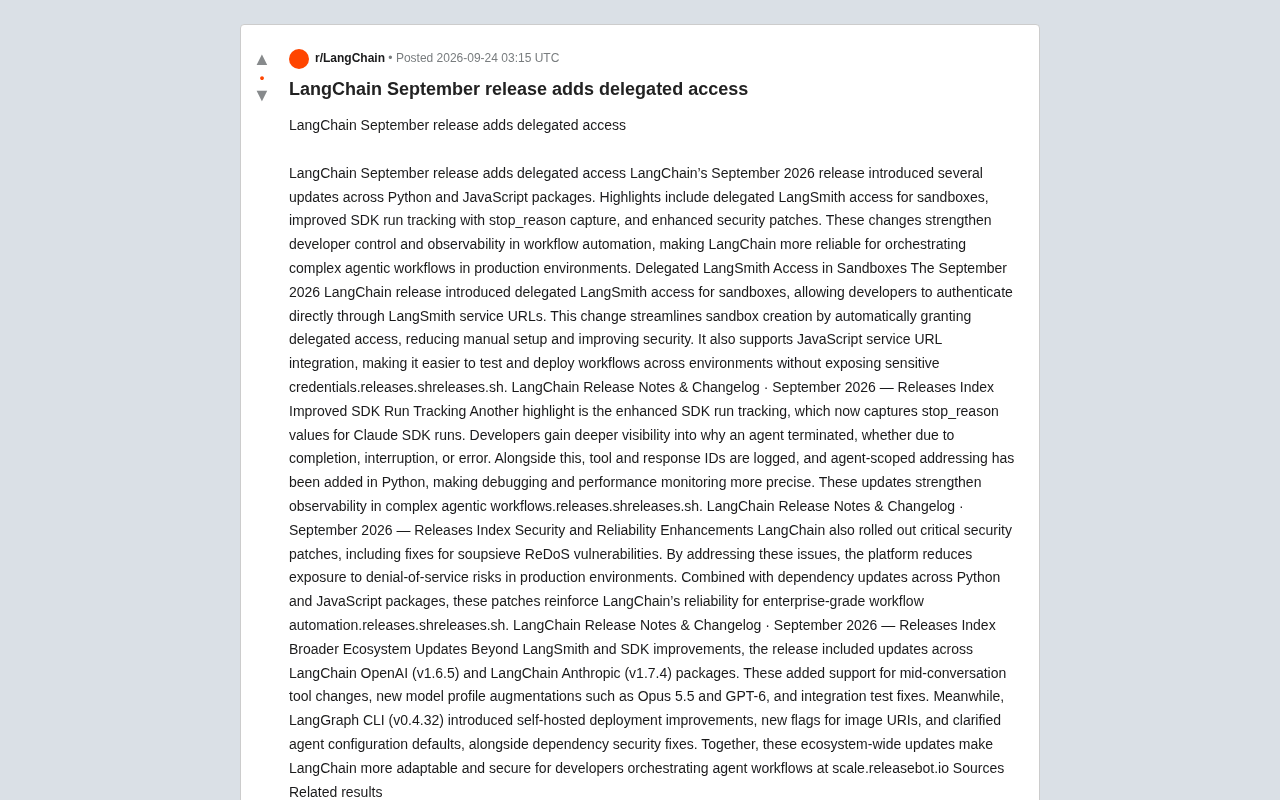
The most-discussed feature in this release is delegated LangSmith access for sandboxes. Developers can now authenticate directly via the LangSmith service URL, and sandboxes automatically receive delegated access upon creation.
The practical value here is twofold: streamlined workflows and improved security. Previously, setting up a sandbox required manual credential configuration — a tedious process that often exposed sensitive information across multi-environment testing setups. The new mechanism handles authorization automatically through the service URL, reducing manual intervention and eliminating direct credential exposure. The feature also supports JavaScript service URL integration, meaning teams working in either Python or JS can more smoothly test and deploy workflows across different environments.
For teams that frequently switch between development, staging, and production environments, infrastructure-level improvements like this may not be flashy, but they have a direct impact on day-to-day development velocity.
More Granular SDK Run Tracing
The second major update is an enhancement to SDK run tracing capabilities — most notably, the capture of stop_reason values for Claude SDK runs. Developers can now clearly see why an agent terminated: whether it completed normally, was interrupted, or encountered an error.
In agentic workflows, silent or abnormal agent termination has always been a debugging pain point. Without termination reason logging, developers were left guessing when troubleshooting issues. The introduction of stop_reason cracks open that black box. Combined with logging of tool call IDs and response IDs, as well as newly added agent-scoped addressing in Python, the entire debugging and performance monitoring pipeline becomes significantly more precise.
Observability is a hard requirement for production-grade agent systems. When a workflow involves multiple agents collaborating across many rounds of tool calls, the ability to quickly pinpoint problems often determines whether a system can truly be deployed to production. This batch of updates is squarely aimed at that goal.
Security and Reliability Hardening
LangChain also shipped critical security patches in this release, including a fix for the soupsieve ReDoS (Regular Expression Denial of Service) vulnerability. ReDoS vulnerabilities can be exploited in production to launch denial-of-service attacks, and patching them directly reduces the system's attack surface.
Beyond that, dependencies across both the Python and JavaScript ecosystems have been comprehensively updated. For a framework targeting enterprise-grade workflow automation, dependency security and supply chain risk are unavoidable concerns. These seemingly mundane maintenance updates are, in fact, an important signal when assessing whether an open-source project is suitable for long-term production use.
What is ReDoS? ReDoS (Regular Expression Denial of Service) is a class of denial-of-service attack rooted in the fact that certain regular expressions, when processing specially crafted input strings, can trigger exponential or polynomial backtracking complexity — causing CPU resources to be consumed for an extended period or exhausted entirely.
soupsieveis a widely used CSS selector library in the Python ecosystem, commonly introduced as a dependency of BeautifulSoup. If any part of LangChain's processing pipeline passes user-controlled input into this library's matching logic, an attacker could trigger the vulnerability with a carefully crafted string, causing service response times to spike dramatically or the service to become completely unavailable. For agent services hosted on the public internet, patching this type of vulnerability is high priority — the cost to trigger is extremely low while the impact is significant.
Broader Ecosystem Updates
Beyond LangSmith and SDK-level improvements, this release also includes iterations across several peripheral packages:
- LangChain OpenAI (v1.6.5) and LangChain Anthropic (v1.7.4): Added support for mid-conversation tool changes, new model configuration profiles covering models such as Opus 5.5 and GPT-6, and fixes for integration test issues.
- LangGraph CLI (v0.4.32): Brings improvements to self-hosted deployments, a new flag for image URIs, clarifications on agent configuration defaults, and dependency security fixes.
Mid-conversation tool changes deserve particular attention — this capability allows agents to dynamically adjust their available toolset based on context during a run, laying the groundwork for more flexible agent behavior. LangGraph CLI's strengthened self-hosted deployment support, meanwhile, directly addresses enterprise demands around data sovereignty and private deployments.
What are mid-conversation tool changes? This feature addresses a common architectural limitation in agentic workflows: the traditional approach declares all available tools at session initialization, with the toolset remaining fixed for the entire conversation. When the number of tools is large, this floods the context window with tool descriptions and prevents dynamic narrowing or expansion of the toolset based on conversation stage. The new capability allows different tool lists to be passed in at different turns within the same session, enabling agents to load "specialized toolkits" on demand — for example, exposing only search tools during the information-gathering phase, and only introducing write or external API-calling tools during the execution phase. This reduces token consumption while improving the precision and safety of tool calls.
Overall Assessment
This September update has no single "blockbuster" feature, but it presents a clear product direction: moving LangChain from a rapid prototyping tool toward an agent orchestration platform capable of supporting large-scale production environments. Delegated access resolves the tension between deployment convenience and security; stop_reason and run tracing fill the observability gap; and security patches hold the reliability baseline.
For teams evaluating the LangChain stack, these iterations send a clear signal — this framework is taking production-grade requirements seriously. Worth noting: the information in this article is primarily sourced from a single release notes index. For specific feature details, refer to the official Release Notes and Changelog as the authoritative source.
Related articles

Felix Rieseberg Personal Homepage
Felix Rieseberg's personal homepage sparks attention on Hacker News. This article covers the Slack engineer's technical background, the rise and fall of nativefier, and the value of a developer homepage as a tech calling card.

@ai-sdk/vue 3.0.306 Patch Release Syncs with [email protected] Update
@ai-sdk/vue 3.0.306 released, synced with [email protected]. A routine patch release for the Vercel AI SDK ecosystem with no public API changes; the Vue adapter layer stays version-aligned with the core package.

Gemini 4 Argon API Launches: The Era of Million-Token Output Begins
Google launches Gemini 4 Argon with sparse MoE architecture, up to 1M output tokens, and a 68.90% Vals Index score, available across API, AI Studio, and the Gemini app.